Like Jason's Facebook Page

Monday, August 25, 2014

Life's Television War of September, 1957


Life Magazine, September 30, 1957

The Golden Age of Television was in full bloom.  Already, viewers across the United States had been tuning in for several years to watch a bevy of what we now know as classic television shows: Captain Kangaroo, The Mickey Mouse Club, The Lawrence Welk Show, and everybody's favorite western, Gunsmoke.  All of these premiered in 1955.  Just a year later, such shows as As the World Turns, The Edge of Night, and The Price is Right joined in on the fun.

By the beginning of the 1957 season, viewers had every reason to pull up a TV tray laden with goodies every night of the week.  ABC premiered a promising new western on Sunday nights at 7:30 called Maverick.  Monday nights were a chance to catch the mix of dry and zany humor offered up by The George Burns and Gracie Allen Show on CBS.  CBS was also the channel to tune in on Tuesday night if you were a fan of The Red Skelton Show.  The whole family could spend an entire Wednesday night catching the new Leave it to Beaver (CBS at 8:00), Father Knows Best (switch over to NBC at 8:30) and finish up the night with The Ozzie and Harriet Show (switching yet again to ABC at 9:30).  Thursdays and Fridays offered up Dragnet and Dick Powell's Zane Grey Theater.  Saturday was the night you just couldn't miss.  CBS dominated that evening with its brand new courtroom drama Perry Mason, followed by Have Gun-Will Travel (the number four show that year) and Gunsmoke (the number one show.)

The Number One Show of 1957

When Life magazine hit the shelves on September 30th of that year, a little war was waged inside its pages; a war for television viewers and their money.  While television had been around since about 1939, sales of television sets had jumped remarkably in the Fifties.  The total number of sets sold before the Fifties was just over 3.6 million.  Beginning in 1950 the yearly number of sets sold in the decade averaged 6.3 million.  That number had peaked at 7.4 million in 1955 and the manufacturers saw a decline in '56 and '57.

At this time it was estimated that 41 million homes had televisions.  Sales were bound to slow down.  Just getting a television--any television--was no longer the goal for most consumers.  Shrewd buyers wanted value and options.  This led to fierce competition among TV manufacturers.  And this was easy to recognize while browsing the pages of Life in September of 1957.

We start with Admiral:


Though some shows were already broadcasting in color (The Red Skelton Show at that time was sporadically filmed in color) the market wasn't geared toward such a radical upgrade.  Of the six plus million sets sold in 1957, RCA, the leader in sales, only sold 85,000 color sets.  The real upgrades, meant to grab the attention of those homes looking to buy a second set, were geared towards convenience.  Admiral proudly showed off their Son-r dual remote control, which controlled both the television and their high-fidelity phonograph.  The higher end model also allowed you to control an AM/FM radio.  According to this ad, the remote allowed the chair-bound viewer/listener to perform 11 services, which included powering the three devices on and off, volume adjustment, and channel adjustment.  I haven't done the math but there are eleven services in there somewhere.  Oh yes, don't forget, this remote also rejects phonograph records!  That sounds a bit rude, if you ask me.

I really want to know how Admiral came up with a remote that had no wires and no batteries.  Was it, perhaps, like those survivalist wind-up radios?  Did you turn the crank like Radar O'Reilly trying to energize the phone on M*A*S*H?


  General Electric took a shot at winning the readers with their boast of a slim silhouette and an electronic tuner.  Here you get some space-saving convenience coupled with a time-saver.  A nice combination.  Once you pre-tune each channel on the day you buy your set you'll never have to tune again.  (Hmmm, that seems a bit hard to swallow.)  Not only can you quickly change the channel from Leave it to Beaver to Father Knows Best, you'll also get these cool neon-like glowing coils of smoke pulsing out from the dial.  A great incentive in the rocket age!


Philco waded in to the battle with this mobile device.  No, not a mobile phone.  But in 1957, this was the equivalent of a mobile TV.  As their PR department says here: "Go ahead--put a Philco Slender Seventeener on your coffee table, room divider, anywhere in any room.  This new Philco is fashion-styled to look stunning from every angle.  It's the most compact, powerful, big screen table TV ever!  And so easy to carry, it's like having a TV in every room!"

Well, it's like having a TV you can carry around to every room, but I get what they mean.  And let's not forget it includes the exclusively developed Philco Germanitron, which is a long-life transformer.  I will turn on the applause sign for their new colors peacock blue and charcoal, which were in addition to the usual mahogany and blond wood finishes.  The price is certainly right: $159.95.  A big RCA 21" color model was $495.  Considering that the average income in 1957 was $5,500 and the minimum wage was one dollar, this price might just be worth it.  And hey, even the back is beautiful!  Just what you'd expect from a slender seventeener.

(I'm proud of this one.  It took four scans and a lot of work to get this full spread so pristine.)
Motorola steps up the war with this volley of glamour and technology.  Forget about GE's auto-tuner.  You can tune this TV perfectly from your easy chair across the room.  And the remote has the added benefit of looking like a fine packet of cigarettes.  In addition, the Golden Satellite has an electronic discovery that ends "warm-up shock" (which costs TV owners $10 million yearly.)  This "Tube Sentry" eliminates 3 out of 4 service calles, brings on picture and sound simultaneously, and triples (!) the life expectancy of every tube and other parts of your set.  (They should have reworded that.  It sounds funny: every tube and other parts of your set.  What does that mean, exactly?)

In the fine print we are assured that not only will the remote control your TV, but you can control it at the set, too.  We should also note that the two hi-fi speakers are tilted up towards ear level, unless you're lying on the floor watching Captain Kangaroo with a bowl of Cheerios in front of you.  The tinted safety screen is tilted down to eliminate glare, which is also useless if you're on the floor.  And don't forget: the UHF is an optional extra, and specifications are subject to change without notice.  But that's just the small print.  And with that gorgeous blonde alongside the lean, lithe look of the television's rich-grained, satin-finished hardwoods, who will notice the small print?  The dame in the dress helps to distract as well.

I'm not sure what is with the cowboy marionettes shown in the inset with the remote control.  I do know that five of the top ten shows that year were westerns (also known as "oaters".)  So this was a way to incorporate westerns, televisions, dames, dogs, and satellites all in one advertisement.  A massive carpet-bombing aimed at wiping out the competition.  However, I've never heard of the Motorola Golden Satellite.  Perhaps, despite their winning the TV war in this issue of Life with this over-the-top, grandiose, superb advertisement, they lost the larger war for the hearts and wallets of the television-hungry buyers of 1957.

Which one would you have chosen?

Friday, August 22, 2014

A Richer Life: The Image of the American Dream in 1950

General Motors and the American Dream


At the center of a small town people pass each other on the street, stopping to chat, kids show off their new toys to their friends, packages tucked under their arms, boxes wrapped in brown paper.  At the supermarket the special is Rib Roast.  Across the intersection at the appliance shop you can see a great white Frigidaire refrigerator displayed in the window.  It is not a hot day; jackets are worn by all save a few ladies and children who grabbed a sweater that morning.  But the sun is shining on the green hills outside of town.

It is a perfect day.


I forgot to mention the traffic.  There are cars scattered around the intersection.  A big dark Buick Eight has the right of way as it passes the post office.  There are a few GMC pickups parked at the grocery store.  A Pontiac or two, a few Chevys and Oldsmobiles.  A Cadillac.  What you won't see is a Ford or a Mercury.  No Hudson, no Studebaker.  Not in this town.  Not a chance.

You see, this town was designed and created by General Motors.  The town isn't real.  It's just an image that is printed in brilliant color for magazine readers to enjoy.  To look over.  To imagine that their lives could be a little better, a little richer, a lot more like the American Dream.

Because when you buy a car from the General Motors family, you're getting a "key to a richer life".  After all, their motto is "More and Better Things for More People".  You can't argue with that.

Let's let the GM PR department give us their own take on the small town life.:

This is Main Street, U.S.A.  It is unlike any other Main Street anywhere else in the world.

It is rich in contentment and well-being.  It bustles with hearty and wholesome activity.  And as you see and know firsthand, it revolves very largely around the family car.

Along every Main Street in America, General Motors cars are a familiar and trusted part of the rich, full life Americans know.  And this is so, very largely, because General Motors men have never ceased trying to improve on their best, have never flagged in their zeal to build better cars each year than they built the year before.

Because of their practiced skill in Research, Engineering and Production, the key to a General Motors car is recognized today as the key to greater value.  It is perhaps not too much to say that it is likewise the key to a rich and satisfying life.

It is, perhaps, too much to say.  But they said it anyway.


I love these old illustrations.  I can't find the name of the artist who did this great scene.  If anyone out there knows it let me know.  I'm also intrigued by the very small print which says "Hear Henry J. Taylor on the air every Monday evening over the ABC Network, coast to coast."  I could Google his name, but I wanted to see if any of you readers know who he was.


So enjoy the rest of the day here in General Motors land.  As you can see, it's just the right sort of day to take your toy airplane along on a trip downtown.  After all, your dad bought a GM car, and that means your life will be better and even a little richer.

Well, at least that's what they said back in 1950.


Monday, August 18, 2014

Is Coffee Ruining Your Marriage? Vintage Wisdom From Sanka


Sanka knew 64 years ago that coffee was a major contributing factor to marriages that were bogged down with fighting and arguing.  And the experts at Sanka had a solution.

I first remember seeing Sanka on my grandparents' kitchen table, nestled on the wooden lazy Susan next to the pill dispenser and the butter plate.  What I didn't know was that it was that jar of Sanka that kept my grandfather from shouting at my grandmother and pointing a surprisingly long finger at her.  It also kept her from jamming her knuckles on her hips and yelling unexpectedly vile phrases in his general direction.  Such, we learn, is the healthy marital benefits of Sanka.

Let's just allow the Sanka experts a chance to prove their point.


And there you have it.  Proof positive!  Sanka will remove those caffeine irritations from your marriage, bringing a halt to fights, ending your need to make rude gestures as you reject your wife's coffee.  No more jumpy, jittery upsetting days for you!  And you won't have to cut back on coffee.  All the worry has been removed.  Even better: Sanka has a new, improved flavor and economy!  What more could you want?  So enjoy your cup of Sanka and the sweet disposition that comes with it.  Your spouse will be glad you did.

(The full Sanka ad ran in Life Magazine, the summer of 1950.  Room With No View does not endorse nor condone the drinking of de-caffeinated coffee.  We prefer to drink the hard stuff: caffeine-soaked coffee.  No matter what it does to our marriage.  We'll take our chances!)


Friday, August 15, 2014

Zippo Dating Tips: What a Woman Really Wants in Her Man

Zippo Dating Tips as seen in Life Magazine, August, 1950

From a 1965 Popular Mechanics, just one year
before the first label from the Surgeon General
warned of the dangers of smoking.


I've always known that Hollywood glamorized the use of cigarettes in the years after World War Two.  And any man who wanted to be a real man puffed away on Camels, Lucky Strikes, Chesterfields, Viceroys, Winstons, and a host of other brands in the feeding frenzy that was the golden age of smoking.  We've all since learned how dangerous and destructive cigarettes are.  But did you realize that one of the real dangers of smoking had nothing to do with the cigarettes but had everything to do with malfunctioning lighters?  No, people weren't getting burned from these malfunctioning butane-fueled gadgets.  They were losing their chances to date bikini-clad young ladies.

Really.  Seriously.  This was a problem.  But there was a remedy for this terrible tragedy.  And Zippo had the answer:

Okay, first they had the question, which is more like a question and statement mixed up in a single sentence:


That's right.  Women wouldn't give you the time of day if your lighter wouldn't light up on that first zip.  As you can see, this bathing beauty in the polka dots is far more attracted to the man with the zippo, despite his lack of hair, his lack of shape (I'm not kidding, take another look, the guy has no shape at all under that prison sackcloth) and despite the fact that he looks like C.S. Lewis.  I mean, really, who smokes a pipe on the beach?  The man's spindly legs are more narrow than his Zippo.  And he's so white the white stripes on his shirt are darker than his skin.  But who cares, right ladies?  As long as his lighter strikes up on that first zip, he's a dream come true.

But if you don't see what the big deal is, then you just need to let Zippo explain it for you, which they are more than willing to do.  And as you'll see, you can get a Genuine Calfskin or English Morocco leather crafted case.  You have the choice of chrome or sterling silver, too.  Even better, you'll never spend a penny for repairs.  And it almost goes without saying that you can find Zippo lighters at better stores everywhere.  But they went ahead and said it anyway.


Lest you think I'm making this up, here's the full ad below, all together.  And please remember that smoking is just about the best way to give yourself cancer and/or emphysema, which is a really awful way to die.


Don't forget:

Monday, August 11, 2014

Robin Williams: My View of a Man We Never Saw


Robin Williams.  As of this writing, just hours after the world learned of the death of Robin Williams, we have been told that the man who entertained millions has apparently died from suicide.  Shock is hardly a worthy term.  We are tempted to giggle; it must be a joke.  Some hoax thrown at us from the zany man who gave us Mork from Ork and Mrs. Euphegenia Doubtfire.  This is just the sort of gag he'd love to pull.  And when we'd learn of the hoax, when we'd discover how we'd been hoodwinked, we'd laugh, just as hard as we ever laughed at the man's improvised iambic pentameter.

We are also tempted to get angry.  How in the world could a man this successful, this accomplished, succumb to depression?  Who is he to be depressed?  How dare he?  Did he not learn anything from his own movies?  Wasn't he paying attention to what he'd been telling us all those years?  Didn't we see how tragic it was when Peter forgot how to enjoy life once he'd become an adult?  That we must seize the day and suck the marrow from its bones?  That in a world at war we could still look around and find those who need to be shown a little love and respect?  That we must never, ever, give in to despair lest we be damned in our own dismal hell for all eternity?

But we know that it matters little how successful the man was.  It matters little what inspirational moments he gave us on the big screen or our little screens at home.  We'll never know what was inside the man.  We may have caught glimpses of him.  We may have been witness to a few of the deeper recesses of his being.  But for those of us who never knew him--his fans, his critics, his voyeurs--we'll never know who he really was.


We'll read plenty about him in the next few days, weeks, and even years from now.  Exclusive interviews will tell us who he really was under all his Popeye muscles and Jumanji jungle clothes.  We'll learn the real Robin Williams shined through in his performance as a frustrated professor of English in a mid-century boys school, or that he was revealing the true Robin Williams when he slipped into his child-like wonder-filled beloved alien role of Mork.

That will all come later.  The sage co-workers and friends and estranged family members will nod wisely, speak softly, allude to inner demons, and finish with a profound anecdote that won't have a chance in Dante's hell of matching Williams' powerful delivery of such lines as "that the powerful play goes on...and you may contribute a verse."


I never knew this darker side of Robin Williams.  But let me tell you what side of him I did know.  You see, I raised five children from the early nineties until today, and Robin Williams played a part in that.  His were the movies my children picked out time and again to watch, re-watch, then watch all over again.  Hook, Aladdin, Flubber, Jumanji.  That pixie smile that erupted on Peter's face at the end of Hook was the same smile that blossomed on everyone's faces watching his movies.  All of us, adults included, were easily reminded of what it was to enjoy childhood, to imagine ourselves flying through the air, to see and partake of the wonders that surround us every day.  To find a friend and hold on to him or her to the very end.

And yet, even as he laughed, he would occasionally frown and allow a tear to roll down that cheek where once a smile had flourished: What Dreams May Come, Dead Poets Society, Good Morning Vietnam.  These movies also came along for our kids, as they grew older, learning more about the world and all its complexities.  We didn't always agree with the world-views presented in them, but they were always invaluable for stirring debate and discussion with our teens.


And for this I would thank Robin Williams if I could.  And while it is too late for that now, I can still do it here, in this shocking moment just hours after his passing.  Only a few days ago I'd seen a movie listing with him in it and I said to my wife "you know, we haven't heard or seen anything about Robin Williams for a while." I don't know the whys and hows of what he went through these last few years.  There will be plenty of people who will want to tell us all about it.  And when that happens, and we think we've discovered the real Robin Williams, I suggest you take a little time to remember the man we did know.  The man on screen.  The man who entertained us.  The man he gave us on the world's stage.

He did, indeed, contribute a verse.

Saturday, August 2, 2014

The Myth of Stranger Danger


Don’t talk to strangers.  Every young child has been taught this.

Don’t take advice from strangers.  Pinocchio learned this lesson the hard way.

There is safety within your circle of friends.

These maxims are lies.

Despite our determination to teach children the perils of Stranger Danger, we adults throw caution to the wind along with the above guidelines.

The easiest way for an adult to share what is on his or her mind is with a stranger.  When something is really troubling us, we seek out someone who knows nothing about us.  We go to a therapist, a psychologist—some sort of professional counselor.  We do not go to a close friend.  Sharing your intimate secrets with a close friend only opens the possibility of losing that friend.  We have nothing to lose from an encounter with a stranger.  You can tell a therapist anything and walk away.  There is nothing invested there to lose.  It is what drives this multi-million dollar industry.  Talking with a stranger is simply easier.

Taking advice from them is easier as well.  Instead of listening to family members, who know us intimately, and have an intimate perspective on our lives, we would rather take the advice of strangers, who don’t really know us at all.  We can claim the expert knowledge of the professional as if it were some sort of prescription.  If it works, we’re happy.  If it proves to be useless, we can blame the professionals.  Yet again, there is safety in the advice of strangers.

We’ll even turn to the advice of non-professionals, such as celebrities, talk-show hosts, and bloggers for tips and tricks to get through this thing we call life.  This is even safer than using a professional.  We don’t have to share our personal details with these sources.  And since we don’t have to look any of them in the eye we don’t have to take their advice if we don’t like it.  We can freely graze from any and all sources out there and nibble at, ignore, and devour whatever we come across.

But we don’t just fear sharing our intimacies with our friends.  After all, this would suggest that our friends are shallow, disloyal, and completely lacking in empathy.  There may be some of us out there who believe this of our friends.  (Which would lead to the question: why would such people be considered friends?)  But there is something else at work here.  A truth that we don’t like to face.


The more we know a person, the more we know about that person.  And as much as we deny it, we are judgmental little nitwits, and the thought of going to our friends for help is sometimes just an impossible idea.  “Ask him?  The guy who can’t straighten out his own life?”  “Her?  She doesn’t know me!”  (This last one is especially hard for us to swallow.  We just don’t want to acknowledge that someone has our number.  That someone can see us for what we really are.  And if they can, they had better never say a word of it aloud!)

All of which leads us back to strangers.  We don’t see them as dangerous; friends are dangerous, strangers are the safe bet.  And despite the warnings, we are easily led astray by people we don’t know.  Even worse, we ignore the friends who could lead us back on the right path.

Of course, the real trick here is to trust your friends.  But that's often harder than trusting a stranger.

Monday, July 28, 2014

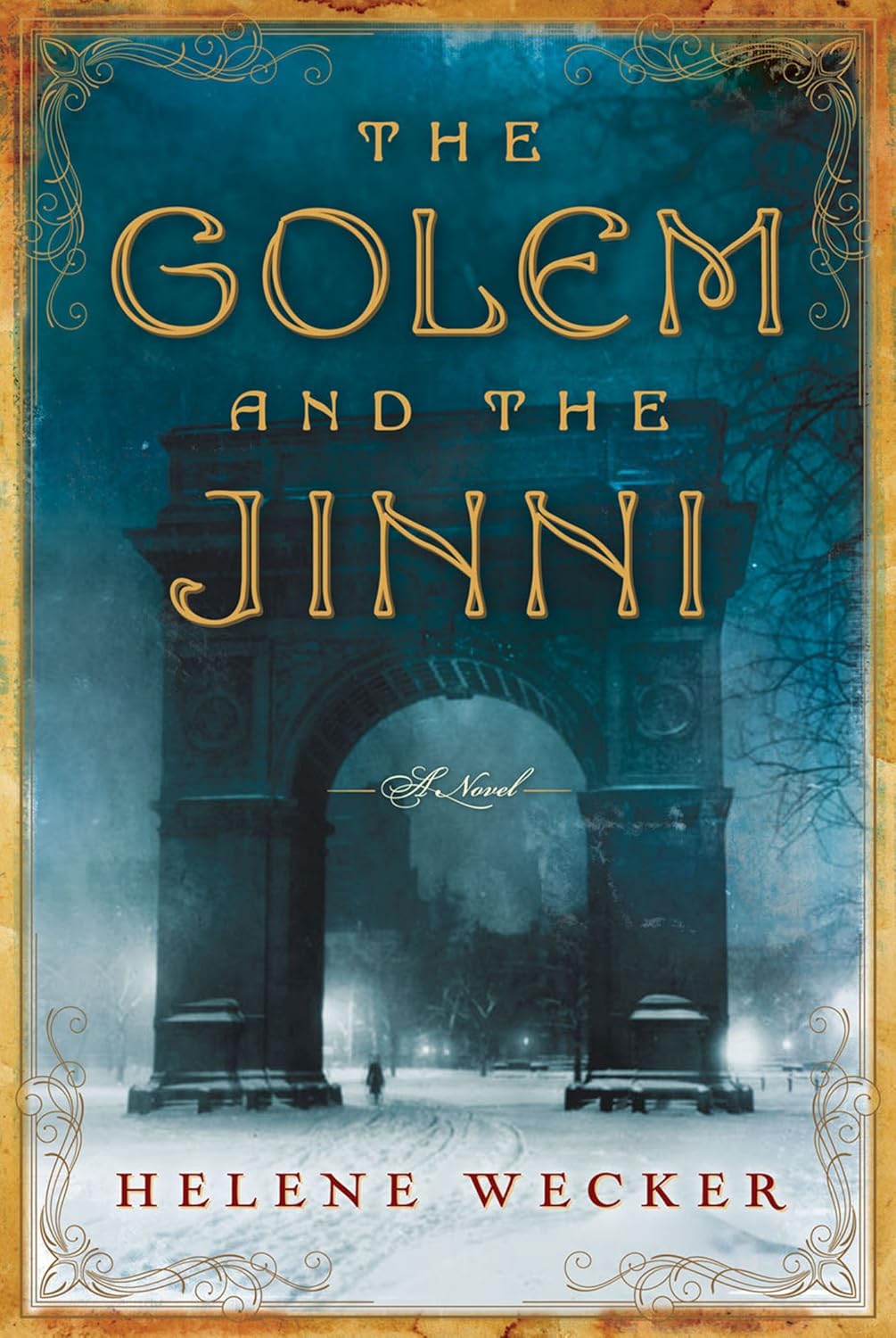
The Golem and the Jinni: A magical review of a book by Helene Wecker


The Golem and the Jinni: Helene Wecker

Can you remember reading books as a child?  Do you remember reading tales of magic and wonder that dazzled your mind with wild adventures set in faraway places?  I sure do.  And I think that as a reader, I'm always trying to retrieve that feeling I once had when reading Marguerite Henry's King of the Wind or Mark Twain's Huckleberry Finn.  Late;y, I've been having trouble recapturing this experience.  So many books are full of slick, quick-paced prose that leaves little chance a reader will become wrapped up in what he or she is reading.  I think editors believe we don't have the time to read such stories any more.  There seems to be this delusion that people won't read stories with detailed description and back stories.  But I was pleasantly surprised to find a novel with these very elements just a few weeks ago.

In Helene Wecker's debut novel, Chava, a magical clay being called a golem, comes to New York City in 1899.  Created to serve a master, she is adrift in this great city after her master dies before he can arrive on the shores of America.  Chava is taken in by a kindly Rabbi who lives in the Jewish quarter of the city.

At about the same time, Ahmad, a jinni  from the deserts of Syria (another magical being, though this one is made of fire), is released from his copper flask of a prison by a tinsmith in little Syria, an Arab section of New York City.  The tinsmith helps Ahmad adjust to life in the city, for the jinni is not yet free.  He is still bound by his jailer, though he has no memory of who that might be.  He only knows he has been trapped for thousands of years.

And then, one night, these two creatures meet.  Though people cannot recognize that they are not human, the golem can see that the jinni is made of fire, and the jinni can see that she is made of clay.  But this does not mean they will immediately become the best of friends.  Ahmad is lonely, and a bit reckless.  Chava is timid, afraid of discovery.  She is not willing to immediately befriend the man of fire.  She is not sure if she can trust him.

And that is all I will tell you.  From this point on the story goes its own way, full of enticing descriptions of Jewish baked goods and Syrian treats.  We are allowed a glimpse of two exotic, pulsating ethnic neighborhoods at the turn of the twentieth century, all through the eyes of these magical beings who are as new to the city of that era as we would be.  

The author, Helene Wecker.  (image source: helenewecker.com)
Wecker is masterful at combining the fairy tale elements of these two mythologies with a turn-of-the-century period novel.  As the story is a marriage of two cultures and mythologies, so too is the writing a marriage of simplicity and complexity.  There were times I thought I was reading text from an old Child-Craft volume followed by times when I thought I was reading the poetic prose of Mark Helprin's A Winter's Tale.  However, at no time does this sink into a childish Disney-like story, nor does it bog down with the weight of a period piece that is filled with too much detail.  Wecker knows adult readers have a desire for mature prose and child-like wonder and magically keeps this balance throughout the whole of the novel.

There are many secondary characters in this book that complimented this balance; a wonderfully villainous Rabbi who practices dark, Kabbalistic arts; Saleh, a mad ice-ream vendor; Fadwa, a young Syrian girl; and many others.  The ice-cream vendor really stood out in this mix.  His story was fascinating.  I can imagine that if this were ever made into a movie (a full mini-series would certainly be worth it here) the character of Saleh would be a juicy part for any veteran actor looking to pick up a top award.

I did feel that the end of the novel lost a bit of its originality at the end.  I had the feeling an editor demanded that the end include a bit of a stereotypical Hollywood-climax.  However, this did not have a negative effect on the book.  It merely was not something I had hoped to find at the end.  It would, however, make adapting this to a mini-series quite simple, and the screenplay could remain extremely true to the novel.

The Golem and the Jinni was nominated for a 2014 Nebula Award for Best Novel.  There have been complaints about its length and pace but if you've ever read any of my reviews you know that I only consider these a plus for any book.

This is the sort of book in which you can really lose yourself, perhaps best read on a cold winter's night.  If you love to read magical stories filled with exotic settings and empathetic characters, be sure not to miss this first novel from a very talented writer.

Check out Helene Wecker at her website: HeleneWecker.com

Click below for the eBook version:

Friday, July 18, 2014

5 Fully Fabricated Facts to Feed the Frenetic, Trivia-Famished Folks on the World Wide Web

Because all of us love lists that allow us to learn the latest ludicrous trivial bon-bons as we surf the truth-challenged waves of the global information sea, I thought it would be best if I offered up this list of fictional facts that in no way relate to the truth.  You'll be shocked at what you are about to read, and will wonder time and again: How is it I've never heard any of this before?  And I hope that once your incautious appetite for counterfeit trumpery has been satiated, you'll merrily and recklessly pass this along for consumption on the World Wide Web.

Hidden Messages lurking within...
5.  Hidden Messages in the Songs of The Beatles.  When you take the notes of any Beatles song and assign numerical values to them based on the Beaufort Scale then substitute letters from a backwards alphabet according to their numerical place value the resulting sentence reveals itself: The Beatles are better than the Rolling Stones.  The only exception to this is in the song I Am the Walrus.  The substitution cipher for Walrus reads quite differently, saying simply: Our fans scream like little girls.

The best tip for removing coffee stains.
4.  The Best Way to Remove Coffee Stains.  Coffee stains on table tops are most effectively removed by rolling the table with an ivory tusk.  Coffee is drawn to real ivory and will adhere to ivory indefinitely.  Since ivory tusks are no longer available you might be forced to use a synthetic tusk, which will work as long as the coffee stains are from a synthetic coffee.

Sleep?  Never!
3.  Children do not need sleep.  In a 2011 study conducted by Stanhope University's College of Psychology and Phrenology, children between the ages of six months and five years remained awake for seven straight months.  The only adverse side effects observed were mostly related to the amount of noise coming from each child.  Male children, while making far more noise than female children, showed less of an increase in noises made as their total number of sleepless days began to mount.  Female children, on the other hand, showed a marked increased in noise level as well as variety of noises created by the second and third month without sleep.  When asked how the researchers were able to keep the children awake, a spokesperson for the Department said they simply did not put the kids to bed.  The study was originally meant to last for twelve months but the researchers found the decibel levels of the sixty-five children intolerable and it was determined that the children should finally be put to bed.  No matter that the children had been awake for seven months, it still took the researchers three hours to settle the kids and get them to sleep.

Don Knotts: Too Violent for the The Godfather?
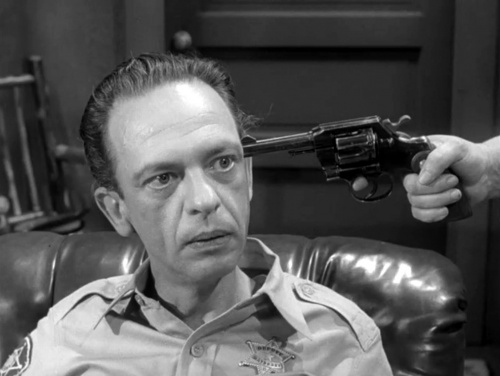
2.  The Godfather that Could Have Been.  We all know that Tom Selleck was originally offered the role of Indiana Jones in Raiders of the Lost Ark.  But did you know that Francis Ford Coppola first offered the role of Vito Corleone to Don Knotts?  According to sources inside the production of Coppola's 1972 The Godfather, Don Knotts screen tested for the title role and had actually signed a contract before Coppola decided Knotts was too dark and violent.  Mario Puzo supposedly fought against this change, as he felt the frighteningly psychotic Knotts was just the way he had imagined the head of the Corleone family.  Coppola, according to some, refused to change his mind, even when Knotts stormed into his office and threatened to tear out Coppola's liver with his bare hands.  An assistant to the director once admitted that four body guards were required to pull Knotts off the Academy Award-winning director, though he has since tried to say the incident never occurred.

1.  Reading a Book is the Number One Activity of All Age Groups.  A recent poll, conducted by the National Endowment for the Arts, in which every citizen of the United States was asked "what is your favorite way to spend time?", has shown that a stunning 89 per cent of the country's population prefers to read books over any other activity.  This included eating (a mere 7 per cent), playing Candy Crush (a paltry 1.2 per cent) and watching "Dancing With the Stars" (which came in as the second most popular on the list at 11 per cent.)  The dramatic increase in book readers is being attributed to the complete conversion of television programming to reality shows such as Top Gear and Myth Busters as well as Hollywood's refusal to produce any more movies unless they are connected to Marvel Comics in some way.  Cultural watchdogs are calling this the single most important step for our society, suggesting we are no longer destined to descend into hell in a hand basket but rather we are ready to climb up yet again to the pinnacle of our hopes and dreams.  One former Librarian of Congress has suggested that the increase in readers is directly attributable to the rise in sales of Kindle eReaders, saying "once the awful smell of books was removed from the reading process, and the thrill of playing with an electronic device was added to the thrill of reading, it was an unfair fight.  Nothing was ever going to be, and nothing will ever be, more fun than snapping open an eReader and reading a book from cover to cover.  There's no way to compete with that sort of experience."

And now you know.  Now get out there and pass this along so everyone else will know what you know.


Monday, June 30, 2014

Electronics and Rockets: February, 1961

Electronics Illustrated, February, 1961


I'm not a big electronics expert.  I can plug things in.  When they quit working, I can throw them away.  In between, I know how to turn most electronic things on and off.  I may even know how to set the digital clocks on them.  But that is about it.  So I was never one to read magazines like Electronics Illustrated.  But I did (and still do) like to look through them for the many cool pictures they had.  And here is a great example of why.  After all, if you didn't know, I'm the editor of Rocket Fire Books, and I love anything to do with rockets.

No, that's not George C. Scott dressed up like General Patton on the cover.  It's a real military officer pointing to America's Courier satellite.  And as it says, this satellite is "the communications brain that receives, remembers and rebroadcasts 75,000 words per minute!"

Sadly, you can see that the public in 1961 has missed the significance of this achievement as a new communications link.  After all, it is a telephonic-telegraphic-facsimile repeating station.  Considering it carries messages across the world through the sky at nearly 15,000 miles an hour, I can't see how all those people missed this achievement.  Perhaps instead of recognizing the impact of this telephonic-telegraphic-facsimile repeating station, they were spending too much time watching Gunsmoke and Wagon Train, the two top shows on TV at the time.  (What shocks me is discovering that Have Gun Will Travel, a show I've never enjoyed, eclipsed The Andy Griffith Show for third place.  I wish someone would explain that one to me.)  So at a time when we were launching this super-sophisticated telecommunications satellite into space, most of the people at home were watching western TV shows.  In fact, there wasn't one science fiction show in the top twenty-five shows that year.


Here we see the Pioneer VI sitting atop an Atlas-Able 3-stage rocket.  The plan here was to launch this one to the moon--well, at least into lunar orbit, where "it will stay there theoretically forever."  Or at least as long as Gunsmoke remained on the air, which it seemed to do metaphorically forever.  

Now here, you can see what the Pioneer VI will look like.  I notice that the author of this piece says the satellite will orbit the moon practically forever, which seems quite different from theoretically.  I wish they'd get their hyperbole straight.  Of a more interesting note, you can see where he takes a shot at the Russians, claiming that the only pictures we have of the dark side of the moon are just "a few blurry pictures of the far side of the Moon as Russia's Lunik I made its single pass."  We have here a double shot at the Russians.  Not only is this an attempt to point out the poor quality of the the Russians' photography skills, but it also points out how they only made one little trip around the moon.  And remember, the Pioneer VI will be orbiting the Grand Luna for all eternity (practically and theoretically speaking.)

In all fairness, Pioneer VI has been fairly successful.  Though NASA does not regularly check on the telemetry of this satellite, it did make contact with it on December 8, 2000, to celebrate 35 years of continual operation.  It is uncertain what Pioneer VI had to say on such an occasion or whether it felt proud of its achievements.  Oddly enough, according to Wikipedia, JPL says the Pioneer VI design life expectancy was only six months.  Which is no where near forever, whether you are speaking practically or theoretically, or even if you are talking impractically.  The only time six months is akin to forever is when you are a kid, and summer is still six months away.  Then yes, six months is practically forever.

Now, in case all of this electronics talk has left you with a desire to be a radio and TV repairman, here's a great little offer from Christy Trades School.  Get your free illustrated book that shows you how to learn every phase of electrical appliance repair.  It doesn't teach you electrical appliance repair, but it teaches you how to learn.  In no time you'll be fixing your own appliances, and your neighbor's appliances, all for the amazing figure of $5.00 to $6.00 an hour.  And, you'll learn so much, your head will be the shape of a beachball, you'll have no hair, and your eyes will give a clear indication that you've been sticking your finger into one too many light sockets.  Don't wait!  Write today!

Monday, May 12, 2014

David Morrell: An Interview with the Author of "Murder as a Fine Art" Part Two


International Best-Selling Author
David Morrell
(photo courtesy of David Morrell)


Last month I had the chance to talk with best-selling author David Morrell.  After discussing his latest book Murder as a Fine Art and its forthcoming sequel Inspector of the Dead, our conversation turned to his early influences.  (Be sure to read part one if you haven’t already.)

Television, Hollywood, and art of Turning Novels into Movies

Read any book of David Morrell’s and you’ll likely come across a foreword, afterword or author bibliography that begins with the story of Morrell’s early inspiration found in the television show Route 66 and one of its creators and head writer, Stirling Silliphant.  The series was about two young men in a Corvette convertible as they traveled across the country in search of America and themselves.

“I was 17 and aimless when Route 66 premiered,” he admitted.  “I had a troubled childhood. My widowed mother was forced to put me in an orphanage for a while because she couldn’t work in a factory and take care of me at the same time. When she remarried, my stepfather turned out not to like children. He and my mother argued a lot.  Afraid, I used to sleep under my bed. As I grew up, I spent most of my time watching television—sometimes 10 hours of it a day. My high-school principal told me that I’d never amount to anything. Then I happened to watch the first episode of Route 66, and it showed me what life could be like if you wanted to bust out (to use a favorite expression from the series) and make life your own instead of surrendering to it.”

Morrell was not just drawn in to watching a television show.  He was drawn to the writing, and the man who did the writing—Silliphant.

“It had an amazing mix of action and ideas. I sent a hand-written letter to him (thanks to a librarian who found the address for Screen Gems, the series’ distributor), telling him that I wanted to be him.  He sent me a two-page typed letter in return, encouraging me, and I was on my way.”

Out of that initial correspondence, they eventually became friends.

“We exchanged more letters over the years. I sent him congratulations when he received a 1968 Oscar for adapting John Ball’s novel, In the Heat of the Night. When my debut novel, First Blood, was published in 1972, he phoned me to tell me how thrilled he was. But we didn’t meet until 1985, during the height of the Rambo phenomenon. He was working on the miniseries for James Michener’s Space at the time. I happened to see a TV piece about the historical highway Route 66. It featured a clip from the series. On impulse, I phoned the Writers Guild and asked them to contact Silliphant and gave them my phone number. He called me a half hour later and suggested that I spend the Fourth of July weekend with him. So I flew to Los Angeles, and he introduced me to his family. He showed me the places where he used to live. At one point, we went to Malibu and had a photograph taken by his wife, Tiana.”

David Morrell with Stirling Silliphant in Malibu
(photo courtesy of David Morrell) 


This was only a few years before they would collaborate on the mini-series Brotherhood of the Rose.

“My espionage novel, The Brotherhood of the Rose, was published the year earlier.  It was the first novel to combine the British and American espionage-novel traditions. Stirling took the book to NBC, who bought it as a miniseries.  I did four drafts of the script. Stirling did one. Someone else finally got the credit. (That’s how television works.)  It was the only miniseries to be broadcast after a Super Bowl, and Stirling was the executive producer. Working with him was the highlight of my writing life.”

In his short story collection Nightscape, Morrell based a character in the short story “Front Man” on Silliphant.  Morrell explained:

“When Stirling was in his 60s, he didn’t get as much work as he once had, because TV networks thought he was out of touch with the culture because of his age. When he went to pitch an idea to a network executive, his agents warned him not to bring a list of his hundred credits, because no one would believe his amazing productivity.  Anyway, I used the anecdotes he told me about his meetings with executives. I combined them within my own weird meetings (a barefoot twenty-something executive swinging a golf club in a tiny putting green in his office), and “Front Man” was the result, about an aging screenwriter who hires a young writer to front for him, with disastrous consequences. It’s a primer about the negative aspects of the business.”

Weird meetings?

“I went to the office of a woman who was the head of production at a major studio. She was just under five feet tall.  She sat on the edge of her desk and indicated that I should sit on a nearby sofa.  As I sat, I realized that the sofa had no springs. I sank until my backside was literally on the floor. In that fashion, she was able to tower over me for the meeting.”

He continued to talk about the movie-making process, and I would have to say that while it was fascinating to me, it was both funny and discouraging.  A case in point was his sotry about the efforts to make a film version of his book The Fifth Profession.

“It’s funny in retrospect. I should add that more than half my novels have been optioned by studios or sold outright, but it takes a miracle to get a picture made.  Too many people need to share the same goal, but directors and actors come in and out of favor, and packages of talent keep falling apart. About The Fifth Profession, there were numerous screenplays, none of which I wrote. One of them depicted black-clad ninja warriors descending ropes into an extinct volcano that had been turned into a rocket-launching site.  This nonsense wasn’t in my novel.  I warned the producers that they risked a possible lawsuit from the producers of the James Bond film, You Only Live Twice, which used the same ending. The producers had no familiarity with that film. As they told me, ‘That’s a Sean Connery Bond movie. We’ve never seen the Connery films. We’ve only ever seen the Roger Moore ones.’ In the end, the picture was never made, but the screenwriter stole the central plot element and used it in another film. It wasn’t blatant enough for me to sue him, but he definitely stole.”

I was even more intrigued when he told me Pierce Brosnan was scheduled to be in the adaptation of his novel Burnt Sienna.

“When Pierce was James Bond (odd how the character shows up here), MGM optioned that novel for him, partly because the novel is a thriller about a painter and Pierce is a painter who wanted to feature some of his work in the film.  But then the screenwriter turned it into a horror movie about a painter whose work predicted the future (which isn’t in my novel). Then Pierce stopped being James Bond, and MGM lost interest in the project.”

“Does this drive you crazy?” I asked him.

“It’s show business. By its nature, it’s unpredictable. But I had a great relationship with Carolco, the company that made First Blood and the first two Rambo sequels.  And I had a great relationship with NBC’s miniseries department. Also I loved working with Laurel Entertainment when I did a script for their Monsters series.  One of the projects that I really regretted not reaching the screen was an adaptation I did of Michael Palmer’s The Sisterhood that Laurel Entertainment was going to produce.  When my schedule got weird, the producers actually flew to Iowa City where I then lived rather than asking me to come to a story conference in New York. Unfortunately the novel became lost in a rights issue, with another studio claiming involvement and the film never got made.  But the experience of working on it was wonderful.  Currently I have three books in development, Creepers, The Brotherhood of the Rose (for a feature), and Murder as a Fine Art (for a TV series). There are so many variables in getting a picture made that I’ve learned not to have expectations. And then, of course, there’s the risk that the finished films will be poorly made. In the end, I can control what goes into my novels, whereas the movies are in the hands of Fate.”

David Morrell and Sylvester Stallone
(photo courtesy of David Morrell)


Donald E. Westlake, Sinatra, and Irons in the Fire


I had once read that Morrell knew Donald E. Westlake.  I’m a big fan of Westlake’s work, which includes his hard-boiled detective novels as well as his hilarious crime-caper novels featuring John Dortmunder, the hapless New York thief.  I asked him how they’d met.

“In 1968, I was a graduate student at Penn State. My fiction-writing teacher was Phillip Klass (pen name—William Tenn), who had an agent named Henry Morrison.  Morrison also represented Westlake.  Klass had bought a house near Penn State, and Morrison and Westlake drove out from New York City for a house-warming party. At the party, Klass introduced me to them, told them that I was working on a novel (First Blood), and then suggested that they let me tell them about it. So in the middle of this housewarming, party, the first pitch I ever did, I had to sit down on the stairs with people going up and down to the only bathroom and I described First Blood. Morrison asked Westlake, ‘What do you think?’ Westlake answered, ‘I think it’s a helluva idea.’ Morrison said ‘I think it is too. David, you have an agent.’”

Westlake ended up reading the first draft of First Blood and passed along some advice.

“At that time, I was still learning about structure. I began the novel, wrongly, with a chase scene in the middle of the plot. I figured that I ought to start with action, but as Westlake pointed out, the reader didn’t know anything about the characters and hence couldn’t feel involved. I restructured the novel and began with the first time that Rambo and the police chief meet.”

Did they ever meet again?

“Every couple of years, most memorably at a Mohonk mystery weekend that he organized in upstate New York. He invited several of his author friends, including me, Brian Garfield, and Justin Scott to be guest speakers.  He was the funniest man I ever spoke to.  No one ever spoke more amusingly or more wisely about writing than he did. In October, the University of Chicago Press will release a collection of his non-fiction, The Getaway Car, in which he talks about his approach to writing.”
  
A real treasure supplied by David Morrell for this interview: The Mohonk Mystery Weekend organized by Donald E. Westlake.  From left to right: David Morrell, Donald E. Westlake, Justin Scott, Alice Turner, Christopher Newman, and Brian Garfield on the far right.  Newman is the author of the Joe Dante police thrillere.  Scott is a veteran writer who is now co-writing with Clive Cussler.  Garfield, who got his start cranking out westerns, is best known for his novel "Death Wish", the book that started the film franchise of the same name.  At the time this picture was taken, Turner was the fiction editor for Playboy magazine.

Just as I was surprised to learn that Morrell had written a Victorian murder mystery, I was also surprised to find that he had written an eBook about Frank Sinatra.  I asked him about Frank Sinatra; the Artist and His Music.

“Just before I discovered Route 66, I considered a career in music. At an early age (16-17), I took lessons in musical theory, harmony, counterpoint, and orchestration. I wanted to be a composer/arranger like Nelson Riddle, who wrote charts for Sinatra and, ironically, later wrote the music for Route 66.  By studying Riddle, I came to realize what a genius Sinatra was as a vocalist. I’ve been studying Sinatra for more than 50 years and finally wrote the e-book about him, just about his singing, about his breath control and phrasing and how he copied the lyrics of the songs he sang, writing them again and again on sheets of paper until he internalized them.  My hope was that anyone who reads my analysis of Sinatra’s technique will think of singing in a new way.  I wrote a companion e-book, Nelson Riddle: The Man behind the Music. I once wrote a similar piece (for Absolute Sound magazine) about Bobby Darin, another genius. I think that my interest in arranging music helps me understand structure in storytelling.”

“And you’ve written similar eBooks on John Wayne and Marilyn Monroe,” I added.

Morrell surprised me yet again.  “Those are more of the magazine pieces I wrote.  I have dozens of similar essays—about Steve McQueen, Rod Serling, and Richard Matheson, for example.  One day I’ll collect them in a book.”

I was amazed at how many irons Morrell had in the fire.  I brought up his involvement with Marvel Comics.  How did he manage to do it all?

“Well, I learned from Stirling Silliphant.  He wrote 5 pages every day. Sometimes he did TV scripts in a week.  In the 1960s, there was a joke, ‘How can Stirling Silliphant writes so fast?’  The answer was, ‘He has an electric typewriter.’  I have a lot of stories to tell, and whenever I feel lazy, I ask myself what Stirling would do. The answer is ‘Keep writing’.”

And he certainly does.  Murder as a Fine Art is a runaway hit (Publishers Weekly called it “One of the ten best summer detective/thrillers of 2013), his fans are eagerly awaiting the release of its sequel Inspector of the Dead next year, and he has a new Wolverine comic coming soon.  He’s been at it since the day he had an idea to write about a Vietnam veteran who goes to war with a local police chief.  Since then he’s never really taken a break.  But despite the odds in this shaky publishing business, he’s kept his writing career relevant and vibrant for over forty years.  And like both characters in his famous debut novel—John Rambo and Chief Wilfred Teasle—he obviously isn’t one to give up.  Even in the face of tragic events he’s found the inspiration to try new things and provide his readers with something fresh and exciting, infused with his never-dying passion for a great story.

Be sure to read Part One of this interview.

(David Morrell is a New York Times bestselling writer who holds a Ph.D. in literature. He has been nominated for numerous awards, including the Edgar, Macavity, and Anthony, and has received 3 Bram Stoker awards.  The International Thriller Writers organization honored him its prestigious career-achievement Thriller Master Award.  With eighteen million copies in print, his books have been translated into 26 languages.  I consider it an extraordinary honor to have been able to interview Mr. Morrell.)


For more information on David Morrell, visit his website at DavidMorrell.net 

I highly recommend the following:


At the end of this month, Marvel is releasing a collection of Spider-Man stories, which will include David Morrell's Spider-Man: Frost series as well as an essay on writing comic books written by Morrell.