Like Jason's Facebook Page

Friday, September 5, 2014

The Cars of Life--April 29, 1963

Life Magazine, April 29, 1963

Last week I highlighted the television war that raged in the pages of a 1957 edition of Life.  You can always be sure to find vibrant, full-page ads in that journal.  You can also get an idea of what the general public was buying at that time.  The more cynical observers out there might suggest that you can see what Madison Avenue wanted the public to buy.  In either case, flipping through an April '63 issue I could not help but notice its emphasis on cars.

In 1961, Ford and Chevrolet were neck in neck in the car production race.  Both of them produced 1.3 million vehicles, with Ford edging out its main rival by only a little more than 20,000 cars and trucks.  But in 1962 Chevrolet seemed ready to lap its rival Ford with a massive jump in sales.  That year saw Chevy streak ahead to 2 million vehicles produced, while Ford only reached 1.47 million.  The last time that had happened, in 1955 (Chevy increased from 1.1 to 1.7 and Ford from 1.1 to 1.4) production numbers fell off the next year.  This cycle is fairly steady in the history of car production.  However, in 1963, after the jump in production, the numbers increased yet again.

I suspect this is largely due to the fact that this was exactly 18 years after the end of World War II.  Baby Boomers were just turning eighteen, getting out of school, or at least getting jobs and beginning to buy cars.  The race had jumped into a different gear.  The car companies knew that even though it wasn't time yet to display next year's models, it was still worth it to push their present cars to the buying public.  And so the top car producers ordered up these full-page ads in the same issue of Life.


Oddly enough, the most luxurious car to enter the race in this issue was the only monochromatic car ad: Imperial's Lebaron four-door.  Since 1955 Chrysler had given its Imperial marque its own line, devoid of the Chrysler name.  And while designer Virgil Exner had made a name for himself with his "forward look", 1963 would be the last year he helmed Imperial's design.  It was the only year that the sloped trim actually wrapped all the way around the back of the body.  And although Imperial was known for its gunsight taillights you can see that the Lebaron did not use them.  It does, however, have the distinctive "Flitesweep Deck Lid", a fake tire bulge (imitating a Continental look) which had been an option from 1957 to 1961, and was brought back for 1963 by popular demand.

But the body styling was not the emphasis in this ad.  The ad-men, instead, pushed the comfort angle along with the "unaccustomed luxuries as standard equipment".  More legroom (due in part to the squared-off steering wheel), inside remote control of the side mirror, front door hidden storage compartments, automatic parking brake release, and a host of other power controls.  This one isn't being marketed for the young kids.  And Imperial only produced a little more than 14,000 cars that year.  This number would peak the very next year at 23,295.  Eventually, in 1976, Imperial was folded back into Chrysler.  Wunderkind Lee Iacocca revived the Imperial name for a short run in the 1980s, but it was never to have its own identity again.


Mercury was launched in 1938 by none other than Edsel Ford.  It was to be an entry-level line of luxury cars, a bridge between Ford and Lincoln.  But Mercury was in danger of being streamlined off the road in the 1960's due to the failure of--yeah, you might have guessed it--the Edsel.  Ford was in a little trouble, and Mercury faced some changes because of it.  Then billed as "Mercury, the man's car", the S-55 Monterey emphasized power.  This two-door sports a Marauder 390 V-8.  I'm not sure kids of today would see this car as a possible vehicle for mountaineering, but the boys at Ford declared that awesome "4-on-the-floor" stick-shift brought "oneness between you and your car...Effortless cornering, passing, and mountaineering."

Mercury was only rolling about 300,000 cars off the production line at this time.  It would peak in 1978 and 1979 above 600,000.  This is significant only to me, since my first car was a 1978 Mercury Monarch, a car I bought in 1988 for $1300.  I don't recall doing any mountaineering in it, but it was powerful and fun to drive.  Mercury's sales fizzled out after the new millennium and it finally died in 2011.

(Disclaimer: I drive a Pontiac, and my anger at GM for shuttering this brand is still at a high-level.)

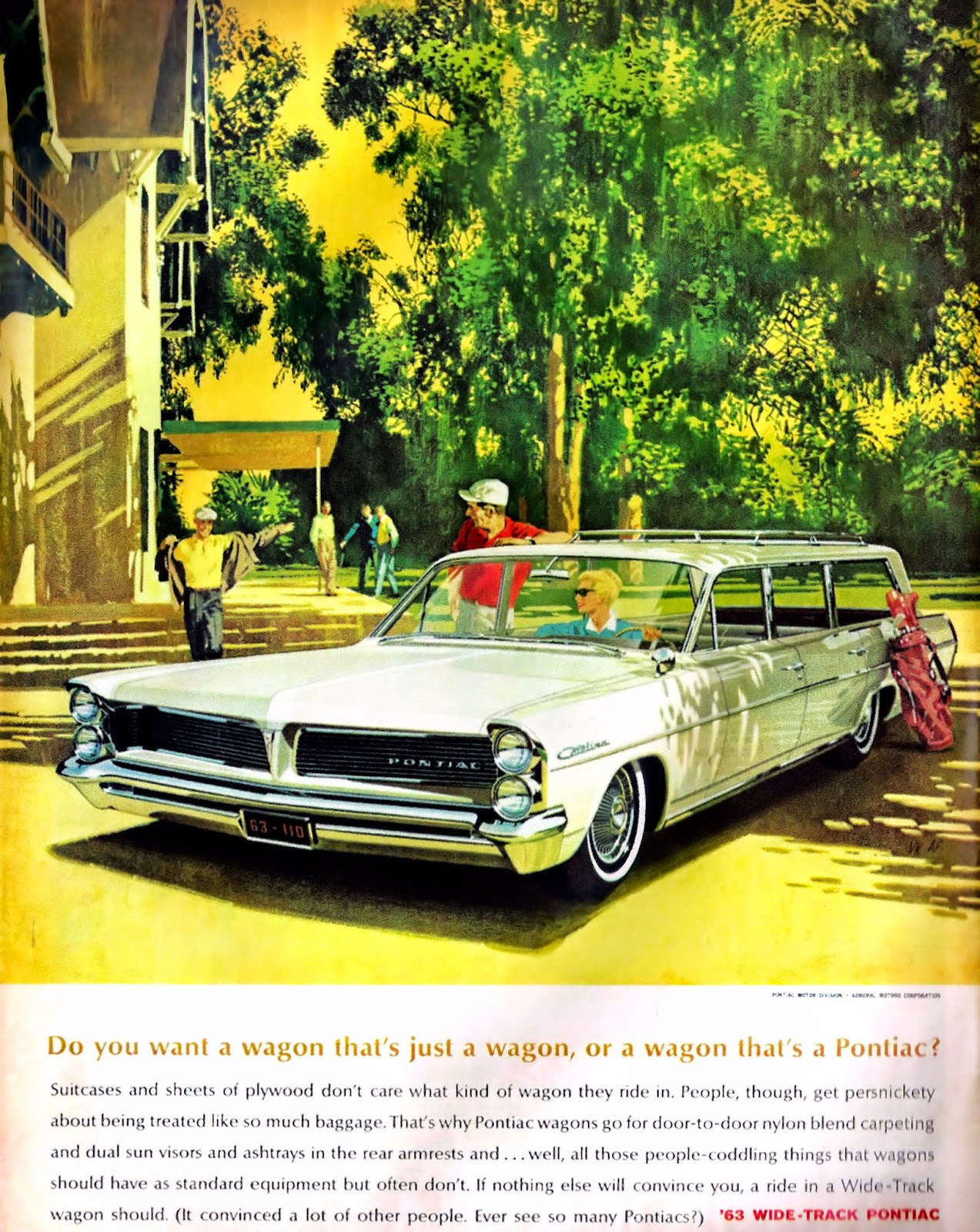
In 1962, Pontiac overtook its rivals, Plymouth and Rambler, for the number three spot in the race.  It held this spot, just behind the big boys, for the rest of the decade, finally losing out to Plymouth, where Pontiac settled into fourth place for the entirety of the 1970s.  But in 1963 it was feeling pretty good.  Not only were they approaching their fortieth anniversary (in 1966) but they had recently seen the entire line of Pontiac models named as Car of the Year by Motor Trend magazine (1959).  Despite this success, however, and the spectacularly ornate designs which included such dazzling features as the twin v-shaped tailfins of the late fifties models, the early sixties models lost some of that glamour.  With more squared roofing and body designs, Pontiac, nevertheless, moved firmly into third place.

This ad, proudly displaying the front-end of a 1963 Catalina "Wide-Track" Station Wagon gives us a view of the split grille, which was first introduced in 1959.  It was dropped for 1960, only to be brought right back the next year.  A variation of this has been on the majority of models for Pontiac, up to and including my own 2005 Grand Am.  It was also in 1959 that the arrowhead emblem with the star in its center became what was ultimately Pontiac's final symbol.  This station wagon is lauded for "all those people-coddling things that wagons should have as standard equipment but often don't."  Pure poetry.

By the 1980s, the Pontiac line was in decline, dropping to fifth and sixth place early in that decade.  However, in 1987 it surged back to third place and held that spot for more than ten years.  In what can only be described as yet another dirty, back-stabbing attack on the Indians, Pontiac's life was snuffed out by GM in an attempt to save their own hide due to terrible management of the entire GM family of cars at the start of the new millennium, finally ending production of this noble fleet of cars in 2009.


I find it interesting that Ford, fighting to get back to number one, ran a truck ad in Life instead of its Galaxie, the high-volume rival to Chevy's Impala and Pontiac's Catalina.  I would expect this truck ad to be in Progressive Farmer or maybe The Saturday Evening Post.  But here we see an F-100, one of Ford's models in their fourth generation of trucks.  This design, restyled in 1961 to be lower and longer than previous generations, only lasted for five years.  The emphasis here is on its durability, despite its smart looks and smooth ride.  Ford copy-writers did want readers to notice that this truck had a "Comfort-Conditioned Custom Cab" with a full five inches of cushion under the driver and 23 pounds of insulation around him.  That's right, I said him.  Don't try to tell me that there were many women driving pickups in 1963.  Maybe Ellie May Clampett did now and then, if Jethro didn't throw a fit.  But not many more than that.

I don't think Ford's decision to push the pickup truck in Life was the right way to chase down Chevy.  They wouldn't overtake Chevy for the lead in the race until 1966, and that was only because they produced a mere 5,776 more vehicles that year.  They wouldn't hold the top spot for two years in a row until 1970-71.


 In 1960, Chevy took a beating from Ford in the small car category.  Chevy was depending on its rear engine Chevrolet Corvair to wow young families, but it was the Ford Falcon that stole the show.  In an unprecedented hurry, Chevy designed and produced the Chevy II in eighteen months.  According to Chevy, it combined "maximum functionalism with thrift."  Sounds to me like wearing socks with sandals.  Maximum ventilation with warmth.  But in this ad, Chevy wants us to ponder another combination: thrift with sport.  Here they are taking this basic, stripped down compact and trying to get the attention of all those young baby-boomers just getting out of school, I suppose.  Let's give their copy-writers a chance to win us young (at-heart) people over to the Chevy II:

"Under the hood you've got a peppery 6-cylinder engine.  Smooth, dependable, eager to do about everything but run through a gallon of gas.  (From the way it nurses the stuff, in fact, you're likely to suspect that it goes around making its own.)...The package comes on either convertible or hardtop.  Either way gives you plenty of ginger--without a lot of needless gingerbread."

Wow.  This car nearly makes its own gasoline.  I'll fall for that.  And then there's all that ginger.  I haven't a clue what ginger is on a car, but I can see this one's got ginger in spades.  Fan-tastic!

The Chevy II, a Nova that eventually dropped the "Chevy II" in its name in 1969, came with a 4-cylinder engine, which could be upgraded to that peppery straight-6.  A third option made this a popular choice for drag-racers: a dealer-installed V-8.  It wasn't until the next year, 1964, in trying to fend off stiff competition from the brand-new Chevelle, that a factory V-8 became available.  That Super Sport option offered in the ad cost $161.40.  But don't forget all that ginger your $161.40 bought.  I don't know what that works out to per pound of ginger, but it can't be too bad.

Nova lived on until 1979 when it was replaced by the underwhelming Chevy Citation.  It could not sustain a short revival in the late eighties, and is now just a memory.

So these were your choices as you read your Life magazine in April of '63.  Which car would you have chosen as a winner?

And since every car needs oil, I'm tossing in the below oil advertisement that was also in this issue.  I'll let the ad speak for itself.


US Automobile Production Figures can be found here.

Tuesday, September 2, 2014

Ice Cream of Yesteryear: or, Life Scream for Ice Cream

The Ice Cream of Life Magazine

Summer is mostly over.  Hot days still linger in parts of the country but they won't for long.  And what better way to enjoy the last of these warm days than to dip into a tub of ice cream?  Of course, the trouble with eating ice cream is choosing one from all of the great flavors out there.  I used to believe that all these flavor choices were new, and that in the old days people just had vanilla, chocolate and strawberry ice cream.  Didn't you?

But as I look through old magazines I find that is not the case.  Below is a small selection of ads I found in Life magazine, ranging from 1953 to 1963.

Life, January 19, 1953 advertisement

As you can see, this first vintage ad gives a somewhat common flavor a fancy name: Lorraine Cherry.  Only Lady Borden Ice Cream had this elegant cherry.  Full of big, juicy black cherries, this sweet treat was one of the many products offered by Borden.  Begun in 1957, Borden primarily produced condensed milk, including a contract to supply canned milk to Union armies during the American Civil War.  By the 1950s, Bordon's food division had gobbled up a great many smaller food lines, including Cracker Jack, Wyler's, ReaLemon, Wise (potato chips) and Bama jams.  Despite their smorgasbord offerings to the public, and their boast in fine print at the bottom of this ad that "Borden foods must be good--folks buy more food packages carrying the Borden brand name than any other in the world..." Borden could not maintain their place in modern markets.  This 19th century company closed its food division in 2001.

Life, September 5, 1955 advertisement

Here's a great look at a favorite brand of mine.  My grandmother never seemed to buy any ice cream other than Meadow Gold.  But she always stuck with vanilla.  Here you can see that Butter Brickle was available in 1955.  According to the fine print, you'll taste a wonderful candy surprise when this ice cream melts in your mouth.  It seems that at this time, butter brickle was one of America's popular candy bars.  In addition, there is a recipe supplied here to make the mocha topping.  Even better!  You can buy a life-sized doll for nearly 25% of its value, all with the Meadow Gold shield from your ice cream.  I wonder if anyone out there still has one of these dolls?

Meadow Gold began producing dairy products in 1901 in Topeka, Kansas.  Originally named the Continental Creamery Company of Topeka, the new name was selected by company employees to describe the golden quality of their fresh creamery butter.  There is some confusion as to the origin of this company.  Dean Foods, who now owns the brand, supplied the information on the Topeka Kansas origin.  However, they provide a link to Meadow Gold of Hawaii as the brand's website, which says that it began in Hawaii in 1897.  If anyone knows the real story I'd love to hear it.

Life, September 30, 1957 adversitement

Rolling down the river of time, we come upon this fun little vintage ad from 1957 for Sealtest ice cream.  And what other flavor would we see down south on the Mississippi than South'n Pecan Crunch?  Oh yes, this scrumptious southern delight has just arrived!  It is, in fact, "a packet of pure eatin' pleasure--full of chewy, crunchy goodness."  Wonder if you could send off for the toy boat?

The Sealtest brand was originally a franchise name sold to local milk bottlers throughout the Midwest and as far east as Philadelphia and  New York City.  The Sealtest Dairy Company was founded by Vernon F. Hovey.  Eventually the brand was acquired by Kraft in 1993.

Life, Apil 29, 1963 advertisement

Moving on a few years we see that Sealtest is still pushing pecans to the readers of Life magazine.  At some point in those five years their ice cream became Prestige French.  And the Pecan Crunch became Butter Pecan, a flavor that is quite common today.  It appears that the change has made this ice cream "so tantalizing, so distinctively different!"  This stuff is so good it incorporates "all of the skill of the ice cream maker's art".  That's hard to top.  Note the clear bucket, which is heralded as "ice cream that shows its good taste--and yours."

This is the kind of luxury I can understand.


Thursday, August 28, 2014

Bayou Rum: A Little Taste of Local Flavor

Bayou Rum, Louisiana Spirits, Lacassine, Louisiana


Just a few miles east of Lake Charles, Louisiana, a new distillery is attracting attention.  Room With No View took advantage of a beautiful day to stop in and see what Louisiana Spirits is all about.  Impressed with what we saw on the outside, we stepped inside and were disappointed to discover that we'd missed the last tour of the day.  A very gracious and apologetic young lady invited us to watch a short film on the distillery and assured us that we could still enjoy a taste test afterwards.

The film highlighted the use of Louisiana products in this locally owned and operated company.  Once it was over we learned just how local the ownership really is.  To our surprise, one of the owners of Louisiana Spirits was on hand and offering to give us a personal tour.  We were more than happy to accept.

Our host was Skip Cortese, part owner and one of the creative forces behind Bayou Rum.  (His partners are Tim and Trey Litel.  Trey is a former Bacardi Rum marketing and sales representative.)  After introductions we were taken back to the distillery floor where we could see a hand-painted mural depicting a scene from a Louisiana bayou.  Painted by Skip's brother, Peter Cortese, the scene evokes the days of old when rum was distilled by rum-runners paddling the back waters of this state.  In the center is T-Boy, heading out on a rum run.  That's him in the bottom right corner as well, with his bag of crawfish and a bottle of Bayou Rum.  He's wearing a no smoking sign around his neck which is a precaution he may have learned the hard way while working around his still.  According to Skip, T-Boy is on each bottle of Bayou Rum five times.  He assured us it was five times, though I've only found him four times.


We visited the bottling room first.  It is there that the bottles are first labeled then washed.  The label design was an eighteen-month process and I think their time was well spent.  There are many Louisiana products that cater to the tourists and end up looking quite tacky in their zeal to highlight what outsiders imagine is the Louisiana/Cajun culture.  But the Bayou Rum label has a classic look that includes an alligator, a French motto (L'esprit de la Louisiane) and the Bayou Rum seal with T-Boy at its center.  The new bottles are washed to ensure there is no contamination of the product.  And what better cleaning agent can you think of than rum?  This helps keep the rum as pure as possible.


Back on the distillery floor Skip explained how they processed the sugar and molasses.  (All of the sugar, molasses, and other ingredients come from Louisiana.  Louisiana produces more sugar than any Caribbean island.)  The distillation unit is a very clean operation.  Stainless steel shines everywhere save for the 18 foot copper tower which is the heart of the still.  The rum is drawn off from the center of the column; the heart's cut.  The heads and tails (the products taken from the top of the column as well as the bottom of the column) are sold off for fuel.  It is important that the column is made from copper; the presence of the copper in the process destroys the sulfides that would otherwise naturally end up in the rum.


Once drawn off the copper column, the rum can be used in several different ways.  Presently there are three rums produced here; Bayou Silver Rum, Bayou Spiced Rum, and Bayou Satsuma Rum.  A batch of rum can be bottled or put into barrels for aging.  The barrels, made from American White Oak (the same material used in the Tabasco sauce process), are charred on the inside which caramelizes the rum.  You can see in the image below a top from one of the barrels that demonstrates this.


It was fascinating to hear Skip as he worked his way along the tour.  His passion for the business is quite evident and this made the tour that much more interesting.  He was eager to point out that Bayou Rum is now available in five states along the Gulf Coast.  In fact, demand for it has grown such that Louisiana Spirits has had to be careful not to expand too quickly.  It is their intention to continue to build a strong customer base along the coast, though don't be fooled.  They are well aware of the tourists who flock to New Orleans and the Gulf shores and are quite pleased to hear of so many of them returning up north to their homes with tales of an excellent new rum on the market.

In fact, Bayou Rum is getting some impressive attention.  Bayou Spiced Rum was just named Best in Class (Spiced Rum) at the 2014 Miami Rum Renaissance Festival.  In March of this year Bayou Rum was awarded Best in Class by American Craft Distillers.  And Caribbean Journal included Bayou Rum in their 2014 America's 10 Best Rums.  In addition to these accolades, Louisiana Spirits is now able to proudly say they are America's most decorated rum.


Once the tour was over, Skip put us in the hands of Megan at the tasting bar.  Laid out in a neat row were small cups with all three rums.  (Megan assured us that it was not enough to get us in trouble with the many State Troopers prowling the interstate.  In fact, they are not allowed to sell drinks at the bar.  It is for tasting purposes only.)  After listening to Skip brag about their rum it was time to find out for ourselves if all of these awards meant anything.  We were not disappointed.

The silver is the smoothest rum I've tasted.  I'm not much of a rum connoisseur but my impressions of rum have always included a fairly strong fuel-aftertaste.  There was none of that here.  And the spiced rum wasn't too strong.  It was perfectly flavored so that you noticed it, enjoyed it, and weren't overwhelmed by it.  But the real treat was the last of the three; the Satsuma Rum Liqueur.  The fruit flavor is sweet, but there's just the right tinge of bitterness to remind you that this wasn't a mixed drink.  

And speaking of mixed drinks, the last taste of the day was a small serving of a Bayou Blossom.  Made of two parts Simply Lemonade and one part Bayou Silver Rum, we poured into this mix what was left of our Satsuma Rum sample.  I have a strong feeling we will be hearing about some new awards being handed out when the Satsuma Rum is entered into next year's competitions.


Once in the gift shop you'll no doubt want to get a bottle (or three!) to take home.  But while you're there, be sure to look around at the shop and bar.  Everything around you is beautifully decorated with a variety of historic materials.  The pews in the film room were made in 1852 and purchased from a New Orleans church that was damaged in Hurricane Katrina.  The timbers were reclaimed from a century-old textile mill in North Carolina.  Old bricks and wrought-iron fences have been re-purposed throughout.  The design, by Architect Randy Goodloe of Lake Charles, is really top-notch.  I'm not sure I've ever seen a mere gift-shop look this magnificent.

Be sure to get at least two bottles of rum so you can get the Bayou Rum bag you see below, though honestly I'm not sure how you could decide which rum to leave behind.  


Bayou Rum is available in most stores in Louisiana now, and many restaurants.  We were told that the Ritz Carlton in New Orleans is offering a drink they call a "Blonde Hurricane" which features Bayou Rum.

Room With No View would like to thank Skip Cortese for his hospitality and we encourage our readers to read more about Bayou Rum at their home page.  You can also follow them on Facebook.  To take a tour of the distillery just exit I-10 at Lacassine (exit 48) and you'll see Louisiana Spirits on the frontage road to the west.  Unless it is gone on a promotion, you'll see the Bayou Rum truck parked out front.  They are open Tuesday through Saturday.


Monday, August 25, 2014

Life's Television War of September, 1957


Life Magazine, September 30, 1957

The Golden Age of Television was in full bloom.  Already, viewers across the United States had been tuning in for several years to watch a bevy of what we now know as classic television shows: Captain Kangaroo, The Mickey Mouse Club, The Lawrence Welk Show, and everybody's favorite western, Gunsmoke.  All of these premiered in 1955.  Just a year later, such shows as As the World Turns, The Edge of Night, and The Price is Right joined in on the fun.

By the beginning of the 1957 season, viewers had every reason to pull up a TV tray laden with goodies every night of the week.  ABC premiered a promising new western on Sunday nights at 7:30 called Maverick.  Monday nights were a chance to catch the mix of dry and zany humor offered up by The George Burns and Gracie Allen Show on CBS.  CBS was also the channel to tune in on Tuesday night if you were a fan of The Red Skelton Show.  The whole family could spend an entire Wednesday night catching the new Leave it to Beaver (CBS at 8:00), Father Knows Best (switch over to NBC at 8:30) and finish up the night with The Ozzie and Harriet Show (switching yet again to ABC at 9:30).  Thursdays and Fridays offered up Dragnet and Dick Powell's Zane Grey Theater.  Saturday was the night you just couldn't miss.  CBS dominated that evening with its brand new courtroom drama Perry Mason, followed by Have Gun-Will Travel (the number four show that year) and Gunsmoke (the number one show.)

The Number One Show of 1957

When Life magazine hit the shelves on September 30th of that year, a little war was waged inside its pages; a war for television viewers and their money.  While television had been around since about 1939, sales of television sets had jumped remarkably in the Fifties.  The total number of sets sold before the Fifties was just over 3.6 million.  Beginning in 1950 the yearly number of sets sold in the decade averaged 6.3 million.  That number had peaked at 7.4 million in 1955 and the manufacturers saw a decline in '56 and '57.

At this time it was estimated that 41 million homes had televisions.  Sales were bound to slow down.  Just getting a television--any television--was no longer the goal for most consumers.  Shrewd buyers wanted value and options.  This led to fierce competition among TV manufacturers.  And this was easy to recognize while browsing the pages of Life in September of 1957.

We start with Admiral:


Though some shows were already broadcasting in color (The Red Skelton Show at that time was sporadically filmed in color) the market wasn't geared toward such a radical upgrade.  Of the six plus million sets sold in 1957, RCA, the leader in sales, only sold 85,000 color sets.  The real upgrades, meant to grab the attention of those homes looking to buy a second set, were geared towards convenience.  Admiral proudly showed off their Son-r dual remote control, which controlled both the television and their high-fidelity phonograph.  The higher end model also allowed you to control an AM/FM radio.  According to this ad, the remote allowed the chair-bound viewer/listener to perform 11 services, which included powering the three devices on and off, volume adjustment, and channel adjustment.  I haven't done the math but there are eleven services in there somewhere.  Oh yes, don't forget, this remote also rejects phonograph records!  That sounds a bit rude, if you ask me.

I really want to know how Admiral came up with a remote that had no wires and no batteries.  Was it, perhaps, like those survivalist wind-up radios?  Did you turn the crank like Radar O'Reilly trying to energize the phone on M*A*S*H?


  General Electric took a shot at winning the readers with their boast of a slim silhouette and an electronic tuner.  Here you get some space-saving convenience coupled with a time-saver.  A nice combination.  Once you pre-tune each channel on the day you buy your set you'll never have to tune again.  (Hmmm, that seems a bit hard to swallow.)  Not only can you quickly change the channel from Leave it to Beaver to Father Knows Best, you'll also get these cool neon-like glowing coils of smoke pulsing out from the dial.  A great incentive in the rocket age!


Philco waded in to the battle with this mobile device.  No, not a mobile phone.  But in 1957, this was the equivalent of a mobile TV.  As their PR department says here: "Go ahead--put a Philco Slender Seventeener on your coffee table, room divider, anywhere in any room.  This new Philco is fashion-styled to look stunning from every angle.  It's the most compact, powerful, big screen table TV ever!  And so easy to carry, it's like having a TV in every room!"

Well, it's like having a TV you can carry around to every room, but I get what they mean.  And let's not forget it includes the exclusively developed Philco Germanitron, which is a long-life transformer.  I will turn on the applause sign for their new colors peacock blue and charcoal, which were in addition to the usual mahogany and blond wood finishes.  The price is certainly right: $159.95.  A big RCA 21" color model was $495.  Considering that the average income in 1957 was $5,500 and the minimum wage was one dollar, this price might just be worth it.  And hey, even the back is beautiful!  Just what you'd expect from a slender seventeener.

(I'm proud of this one.  It took four scans and a lot of work to get this full spread so pristine.)
Motorola steps up the war with this volley of glamour and technology.  Forget about GE's auto-tuner.  You can tune this TV perfectly from your easy chair across the room.  And the remote has the added benefit of looking like a fine packet of cigarettes.  In addition, the Golden Satellite has an electronic discovery that ends "warm-up shock" (which costs TV owners $10 million yearly.)  This "Tube Sentry" eliminates 3 out of 4 service calles, brings on picture and sound simultaneously, and triples (!) the life expectancy of every tube and other parts of your set.  (They should have reworded that.  It sounds funny: every tube and other parts of your set.  What does that mean, exactly?)

In the fine print we are assured that not only will the remote control your TV, but you can control it at the set, too.  We should also note that the two hi-fi speakers are tilted up towards ear level, unless you're lying on the floor watching Captain Kangaroo with a bowl of Cheerios in front of you.  The tinted safety screen is tilted down to eliminate glare, which is also useless if you're on the floor.  And don't forget: the UHF is an optional extra, and specifications are subject to change without notice.  But that's just the small print.  And with that gorgeous blonde alongside the lean, lithe look of the television's rich-grained, satin-finished hardwoods, who will notice the small print?  The dame in the dress helps to distract as well.

I'm not sure what is with the cowboy marionettes shown in the inset with the remote control.  I do know that five of the top ten shows that year were westerns (also known as "oaters".)  So this was a way to incorporate westerns, televisions, dames, dogs, and satellites all in one advertisement.  A massive carpet-bombing aimed at wiping out the competition.  However, I've never heard of the Motorola Golden Satellite.  Perhaps, despite their winning the TV war in this issue of Life with this over-the-top, grandiose, superb advertisement, they lost the larger war for the hearts and wallets of the television-hungry buyers of 1957.

Which one would you have chosen?

Friday, August 22, 2014

A Richer Life: The Image of the American Dream in 1950

General Motors and the American Dream


At the center of a small town people pass each other on the street, stopping to chat, kids show off their new toys to their friends, packages tucked under their arms, boxes wrapped in brown paper.  At the supermarket the special is Rib Roast.  Across the intersection at the appliance shop you can see a great white Frigidaire refrigerator displayed in the window.  It is not a hot day; jackets are worn by all save a few ladies and children who grabbed a sweater that morning.  But the sun is shining on the green hills outside of town.

It is a perfect day.


I forgot to mention the traffic.  There are cars scattered around the intersection.  A big dark Buick Eight has the right of way as it passes the post office.  There are a few GMC pickups parked at the grocery store.  A Pontiac or two, a few Chevys and Oldsmobiles.  A Cadillac.  What you won't see is a Ford or a Mercury.  No Hudson, no Studebaker.  Not in this town.  Not a chance.

You see, this town was designed and created by General Motors.  The town isn't real.  It's just an image that is printed in brilliant color for magazine readers to enjoy.  To look over.  To imagine that their lives could be a little better, a little richer, a lot more like the American Dream.

Because when you buy a car from the General Motors family, you're getting a "key to a richer life".  After all, their motto is "More and Better Things for More People".  You can't argue with that.

Let's let the GM PR department give us their own take on the small town life.:

This is Main Street, U.S.A.  It is unlike any other Main Street anywhere else in the world.

It is rich in contentment and well-being.  It bustles with hearty and wholesome activity.  And as you see and know firsthand, it revolves very largely around the family car.

Along every Main Street in America, General Motors cars are a familiar and trusted part of the rich, full life Americans know.  And this is so, very largely, because General Motors men have never ceased trying to improve on their best, have never flagged in their zeal to build better cars each year than they built the year before.

Because of their practiced skill in Research, Engineering and Production, the key to a General Motors car is recognized today as the key to greater value.  It is perhaps not too much to say that it is likewise the key to a rich and satisfying life.

It is, perhaps, too much to say.  But they said it anyway.


I love these old illustrations.  I can't find the name of the artist who did this great scene.  If anyone out there knows it let me know.  I'm also intrigued by the very small print which says "Hear Henry J. Taylor on the air every Monday evening over the ABC Network, coast to coast."  I could Google his name, but I wanted to see if any of you readers know who he was.


So enjoy the rest of the day here in General Motors land.  As you can see, it's just the right sort of day to take your toy airplane along on a trip downtown.  After all, your dad bought a GM car, and that means your life will be better and even a little richer.

Well, at least that's what they said back in 1950.


Monday, August 18, 2014

Is Coffee Ruining Your Marriage? Vintage Wisdom From Sanka


Sanka knew 64 years ago that coffee was a major contributing factor to marriages that were bogged down with fighting and arguing.  And the experts at Sanka had a solution.

I first remember seeing Sanka on my grandparents' kitchen table, nestled on the wooden lazy Susan next to the pill dispenser and the butter plate.  What I didn't know was that it was that jar of Sanka that kept my grandfather from shouting at my grandmother and pointing a surprisingly long finger at her.  It also kept her from jamming her knuckles on her hips and yelling unexpectedly vile phrases in his general direction.  Such, we learn, is the healthy marital benefits of Sanka.

Let's just allow the Sanka experts a chance to prove their point.


And there you have it.  Proof positive!  Sanka will remove those caffeine irritations from your marriage, bringing a halt to fights, ending your need to make rude gestures as you reject your wife's coffee.  No more jumpy, jittery upsetting days for you!  And you won't have to cut back on coffee.  All the worry has been removed.  Even better: Sanka has a new, improved flavor and economy!  What more could you want?  So enjoy your cup of Sanka and the sweet disposition that comes with it.  Your spouse will be glad you did.

(The full Sanka ad ran in Life Magazine, the summer of 1950.  Room With No View does not endorse nor condone the drinking of de-caffeinated coffee.  We prefer to drink the hard stuff: caffeine-soaked coffee.  No matter what it does to our marriage.  We'll take our chances!)


Friday, August 15, 2014

Zippo Dating Tips: What a Woman Really Wants in Her Man

Zippo Dating Tips as seen in Life Magazine, August, 1950

From a 1965 Popular Mechanics, just one year
before the first label from the Surgeon General
warned of the dangers of smoking.


I've always known that Hollywood glamorized the use of cigarettes in the years after World War Two.  And any man who wanted to be a real man puffed away on Camels, Lucky Strikes, Chesterfields, Viceroys, Winstons, and a host of other brands in the feeding frenzy that was the golden age of smoking.  We've all since learned how dangerous and destructive cigarettes are.  But did you realize that one of the real dangers of smoking had nothing to do with the cigarettes but had everything to do with malfunctioning lighters?  No, people weren't getting burned from these malfunctioning butane-fueled gadgets.  They were losing their chances to date bikini-clad young ladies.

Really.  Seriously.  This was a problem.  But there was a remedy for this terrible tragedy.  And Zippo had the answer:

Okay, first they had the question, which is more like a question and statement mixed up in a single sentence:


That's right.  Women wouldn't give you the time of day if your lighter wouldn't light up on that first zip.  As you can see, this bathing beauty in the polka dots is far more attracted to the man with the zippo, despite his lack of hair, his lack of shape (I'm not kidding, take another look, the guy has no shape at all under that prison sackcloth) and despite the fact that he looks like C.S. Lewis.  I mean, really, who smokes a pipe on the beach?  The man's spindly legs are more narrow than his Zippo.  And he's so white the white stripes on his shirt are darker than his skin.  But who cares, right ladies?  As long as his lighter strikes up on that first zip, he's a dream come true.

But if you don't see what the big deal is, then you just need to let Zippo explain it for you, which they are more than willing to do.  And as you'll see, you can get a Genuine Calfskin or English Morocco leather crafted case.  You have the choice of chrome or sterling silver, too.  Even better, you'll never spend a penny for repairs.  And it almost goes without saying that you can find Zippo lighters at better stores everywhere.  But they went ahead and said it anyway.


Lest you think I'm making this up, here's the full ad below, all together.  And please remember that smoking is just about the best way to give yourself cancer and/or emphysema, which is a really awful way to die.


Don't forget:

Monday, August 11, 2014

Robin Williams: My View of a Man We Never Saw


Robin Williams.  As of this writing, just hours after the world learned of the death of Robin Williams, we have been told that the man who entertained millions has apparently died from suicide.  Shock is hardly a worthy term.  We are tempted to giggle; it must be a joke.  Some hoax thrown at us from the zany man who gave us Mork from Ork and Mrs. Euphegenia Doubtfire.  This is just the sort of gag he'd love to pull.  And when we'd learn of the hoax, when we'd discover how we'd been hoodwinked, we'd laugh, just as hard as we ever laughed at the man's improvised iambic pentameter.

We are also tempted to get angry.  How in the world could a man this successful, this accomplished, succumb to depression?  Who is he to be depressed?  How dare he?  Did he not learn anything from his own movies?  Wasn't he paying attention to what he'd been telling us all those years?  Didn't we see how tragic it was when Peter forgot how to enjoy life once he'd become an adult?  That we must seize the day and suck the marrow from its bones?  That in a world at war we could still look around and find those who need to be shown a little love and respect?  That we must never, ever, give in to despair lest we be damned in our own dismal hell for all eternity?

But we know that it matters little how successful the man was.  It matters little what inspirational moments he gave us on the big screen or our little screens at home.  We'll never know what was inside the man.  We may have caught glimpses of him.  We may have been witness to a few of the deeper recesses of his being.  But for those of us who never knew him--his fans, his critics, his voyeurs--we'll never know who he really was.


We'll read plenty about him in the next few days, weeks, and even years from now.  Exclusive interviews will tell us who he really was under all his Popeye muscles and Jumanji jungle clothes.  We'll learn the real Robin Williams shined through in his performance as a frustrated professor of English in a mid-century boys school, or that he was revealing the true Robin Williams when he slipped into his child-like wonder-filled beloved alien role of Mork.

That will all come later.  The sage co-workers and friends and estranged family members will nod wisely, speak softly, allude to inner demons, and finish with a profound anecdote that won't have a chance in Dante's hell of matching Williams' powerful delivery of such lines as "that the powerful play goes on...and you may contribute a verse."


I never knew this darker side of Robin Williams.  But let me tell you what side of him I did know.  You see, I raised five children from the early nineties until today, and Robin Williams played a part in that.  His were the movies my children picked out time and again to watch, re-watch, then watch all over again.  Hook, Aladdin, Flubber, Jumanji.  That pixie smile that erupted on Peter's face at the end of Hook was the same smile that blossomed on everyone's faces watching his movies.  All of us, adults included, were easily reminded of what it was to enjoy childhood, to imagine ourselves flying through the air, to see and partake of the wonders that surround us every day.  To find a friend and hold on to him or her to the very end.

And yet, even as he laughed, he would occasionally frown and allow a tear to roll down that cheek where once a smile had flourished: What Dreams May Come, Dead Poets Society, Good Morning Vietnam.  These movies also came along for our kids, as they grew older, learning more about the world and all its complexities.  We didn't always agree with the world-views presented in them, but they were always invaluable for stirring debate and discussion with our teens.


And for this I would thank Robin Williams if I could.  And while it is too late for that now, I can still do it here, in this shocking moment just hours after his passing.  Only a few days ago I'd seen a movie listing with him in it and I said to my wife "you know, we haven't heard or seen anything about Robin Williams for a while." I don't know the whys and hows of what he went through these last few years.  There will be plenty of people who will want to tell us all about it.  And when that happens, and we think we've discovered the real Robin Williams, I suggest you take a little time to remember the man we did know.  The man on screen.  The man who entertained us.  The man he gave us on the world's stage.

He did, indeed, contribute a verse.

Saturday, August 2, 2014

The Myth of Stranger Danger


Don’t talk to strangers.  Every young child has been taught this.

Don’t take advice from strangers.  Pinocchio learned this lesson the hard way.

There is safety within your circle of friends.

These maxims are lies.

Despite our determination to teach children the perils of Stranger Danger, we adults throw caution to the wind along with the above guidelines.

The easiest way for an adult to share what is on his or her mind is with a stranger.  When something is really troubling us, we seek out someone who knows nothing about us.  We go to a therapist, a psychologist—some sort of professional counselor.  We do not go to a close friend.  Sharing your intimate secrets with a close friend only opens the possibility of losing that friend.  We have nothing to lose from an encounter with a stranger.  You can tell a therapist anything and walk away.  There is nothing invested there to lose.  It is what drives this multi-million dollar industry.  Talking with a stranger is simply easier.

Taking advice from them is easier as well.  Instead of listening to family members, who know us intimately, and have an intimate perspective on our lives, we would rather take the advice of strangers, who don’t really know us at all.  We can claim the expert knowledge of the professional as if it were some sort of prescription.  If it works, we’re happy.  If it proves to be useless, we can blame the professionals.  Yet again, there is safety in the advice of strangers.

We’ll even turn to the advice of non-professionals, such as celebrities, talk-show hosts, and bloggers for tips and tricks to get through this thing we call life.  This is even safer than using a professional.  We don’t have to share our personal details with these sources.  And since we don’t have to look any of them in the eye we don’t have to take their advice if we don’t like it.  We can freely graze from any and all sources out there and nibble at, ignore, and devour whatever we come across.

But we don’t just fear sharing our intimacies with our friends.  After all, this would suggest that our friends are shallow, disloyal, and completely lacking in empathy.  There may be some of us out there who believe this of our friends.  (Which would lead to the question: why would such people be considered friends?)  But there is something else at work here.  A truth that we don’t like to face.


The more we know a person, the more we know about that person.  And as much as we deny it, we are judgmental little nitwits, and the thought of going to our friends for help is sometimes just an impossible idea.  “Ask him?  The guy who can’t straighten out his own life?”  “Her?  She doesn’t know me!”  (This last one is especially hard for us to swallow.  We just don’t want to acknowledge that someone has our number.  That someone can see us for what we really are.  And if they can, they had better never say a word of it aloud!)

All of which leads us back to strangers.  We don’t see them as dangerous; friends are dangerous, strangers are the safe bet.  And despite the warnings, we are easily led astray by people we don’t know.  Even worse, we ignore the friends who could lead us back on the right path.

Of course, the real trick here is to trust your friends.  But that's often harder than trusting a stranger.

Monday, July 28, 2014

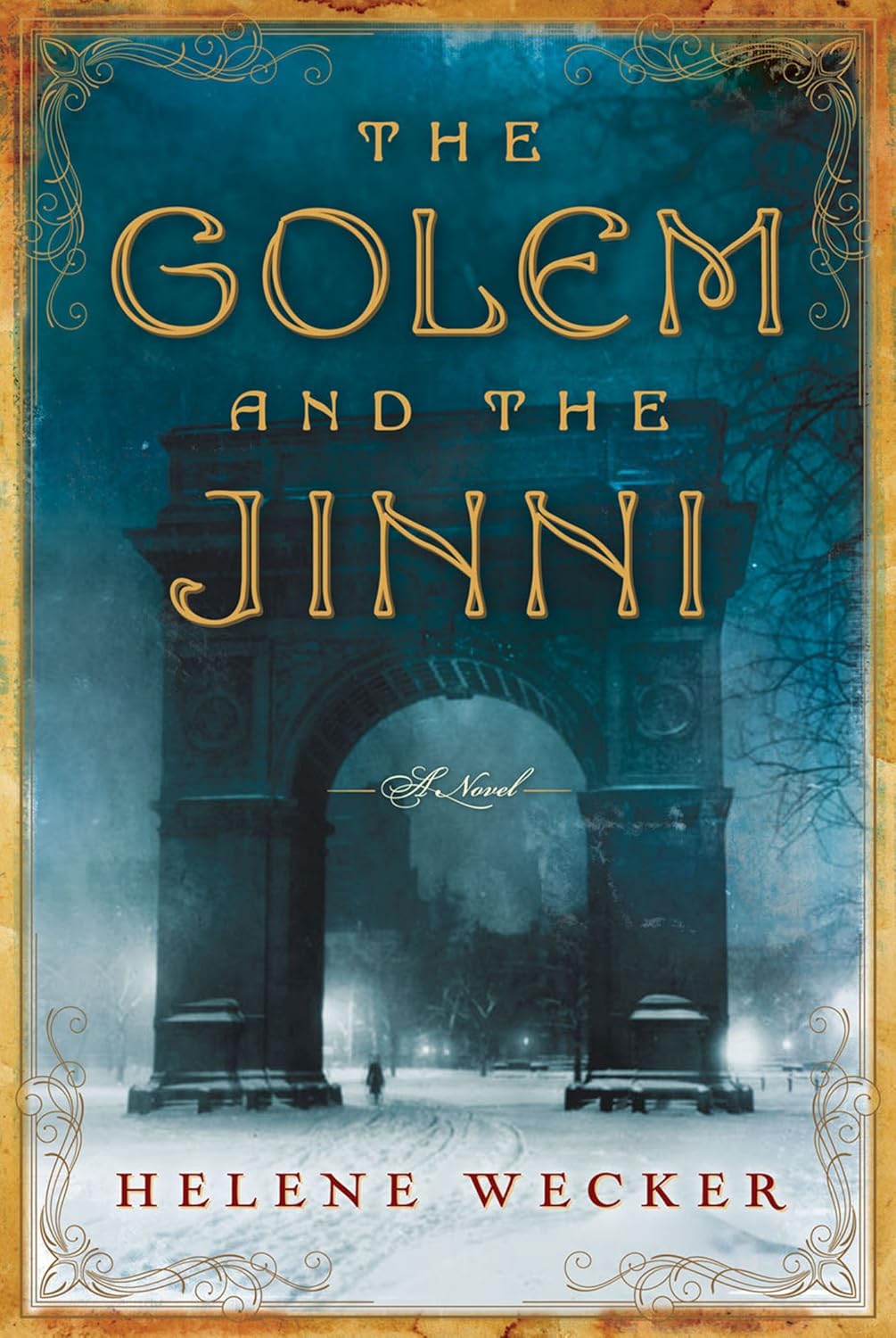
The Golem and the Jinni: A magical review of a book by Helene Wecker


The Golem and the Jinni: Helene Wecker

Can you remember reading books as a child?  Do you remember reading tales of magic and wonder that dazzled your mind with wild adventures set in faraway places?  I sure do.  And I think that as a reader, I'm always trying to retrieve that feeling I once had when reading Marguerite Henry's King of the Wind or Mark Twain's Huckleberry Finn.  Late;y, I've been having trouble recapturing this experience.  So many books are full of slick, quick-paced prose that leaves little chance a reader will become wrapped up in what he or she is reading.  I think editors believe we don't have the time to read such stories any more.  There seems to be this delusion that people won't read stories with detailed description and back stories.  But I was pleasantly surprised to find a novel with these very elements just a few weeks ago.

In Helene Wecker's debut novel, Chava, a magical clay being called a golem, comes to New York City in 1899.  Created to serve a master, she is adrift in this great city after her master dies before he can arrive on the shores of America.  Chava is taken in by a kindly Rabbi who lives in the Jewish quarter of the city.

At about the same time, Ahmad, a jinni  from the deserts of Syria (another magical being, though this one is made of fire), is released from his copper flask of a prison by a tinsmith in little Syria, an Arab section of New York City.  The tinsmith helps Ahmad adjust to life in the city, for the jinni is not yet free.  He is still bound by his jailer, though he has no memory of who that might be.  He only knows he has been trapped for thousands of years.

And then, one night, these two creatures meet.  Though people cannot recognize that they are not human, the golem can see that the jinni is made of fire, and the jinni can see that she is made of clay.  But this does not mean they will immediately become the best of friends.  Ahmad is lonely, and a bit reckless.  Chava is timid, afraid of discovery.  She is not willing to immediately befriend the man of fire.  She is not sure if she can trust him.

And that is all I will tell you.  From this point on the story goes its own way, full of enticing descriptions of Jewish baked goods and Syrian treats.  We are allowed a glimpse of two exotic, pulsating ethnic neighborhoods at the turn of the twentieth century, all through the eyes of these magical beings who are as new to the city of that era as we would be.  

The author, Helene Wecker.  (image source: helenewecker.com)
Wecker is masterful at combining the fairy tale elements of these two mythologies with a turn-of-the-century period novel.  As the story is a marriage of two cultures and mythologies, so too is the writing a marriage of simplicity and complexity.  There were times I thought I was reading text from an old Child-Craft volume followed by times when I thought I was reading the poetic prose of Mark Helprin's A Winter's Tale.  However, at no time does this sink into a childish Disney-like story, nor does it bog down with the weight of a period piece that is filled with too much detail.  Wecker knows adult readers have a desire for mature prose and child-like wonder and magically keeps this balance throughout the whole of the novel.

There are many secondary characters in this book that complimented this balance; a wonderfully villainous Rabbi who practices dark, Kabbalistic arts; Saleh, a mad ice-ream vendor; Fadwa, a young Syrian girl; and many others.  The ice-cream vendor really stood out in this mix.  His story was fascinating.  I can imagine that if this were ever made into a movie (a full mini-series would certainly be worth it here) the character of Saleh would be a juicy part for any veteran actor looking to pick up a top award.

I did feel that the end of the novel lost a bit of its originality at the end.  I had the feeling an editor demanded that the end include a bit of a stereotypical Hollywood-climax.  However, this did not have a negative effect on the book.  It merely was not something I had hoped to find at the end.  It would, however, make adapting this to a mini-series quite simple, and the screenplay could remain extremely true to the novel.

The Golem and the Jinni was nominated for a 2014 Nebula Award for Best Novel.  There have been complaints about its length and pace but if you've ever read any of my reviews you know that I only consider these a plus for any book.

This is the sort of book in which you can really lose yourself, perhaps best read on a cold winter's night.  If you love to read magical stories filled with exotic settings and empathetic characters, be sure not to miss this first novel from a very talented writer.

Check out Helene Wecker at her website: HeleneWecker.com

Click below for the eBook version: