Like Jason's Facebook Page

Showing posts with label book review. Show all posts

Monday, July 28, 2014

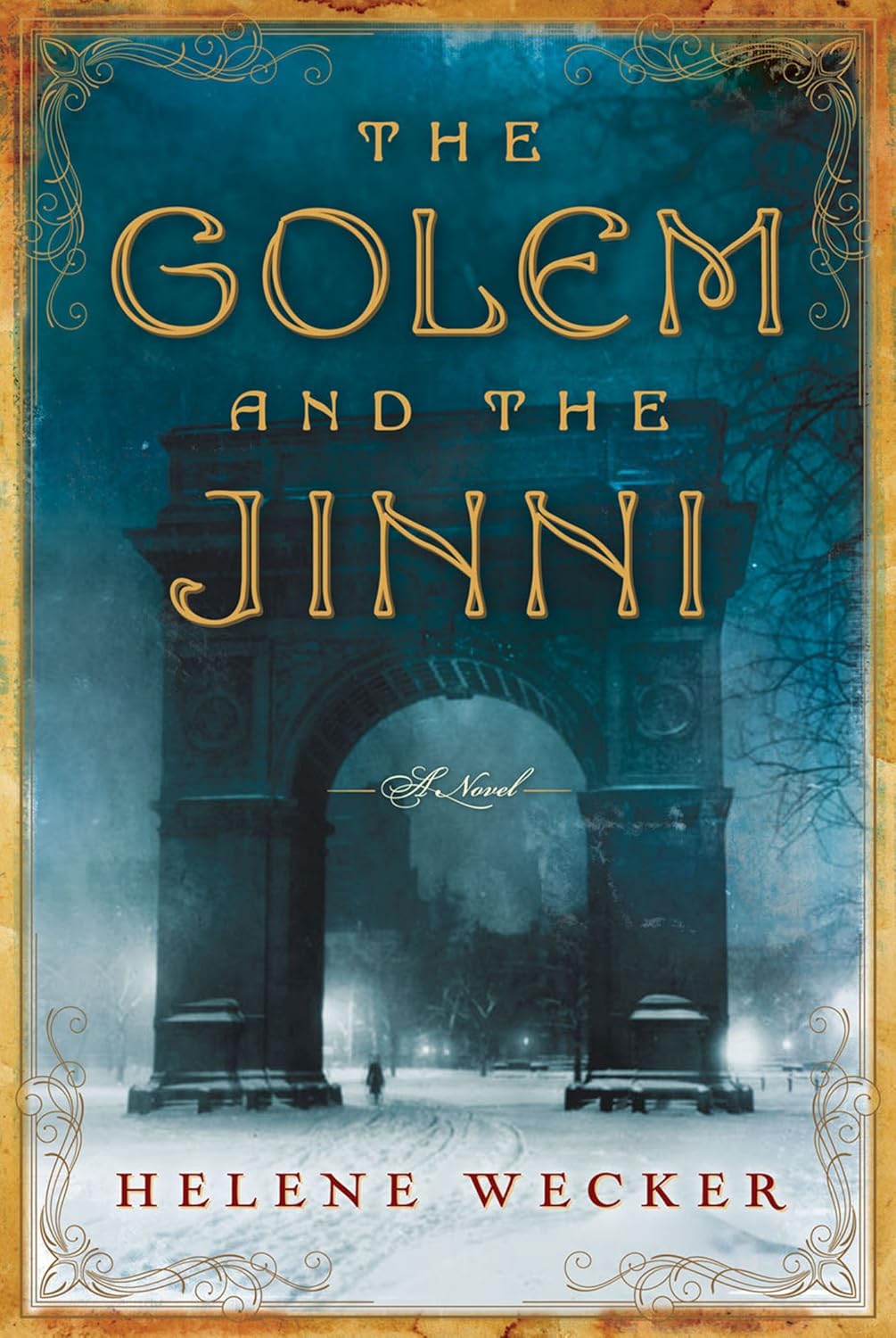
The Golem and the Jinni: A magical review of a book by Helene Wecker


The Golem and the Jinni: Helene Wecker

Can you remember reading books as a child?  Do you remember reading tales of magic and wonder that dazzled your mind with wild adventures set in faraway places?  I sure do.  And I think that as a reader, I'm always trying to retrieve that feeling I once had when reading Marguerite Henry's King of the Wind or Mark Twain's Huckleberry Finn.  Late;y, I've been having trouble recapturing this experience.  So many books are full of slick, quick-paced prose that leaves little chance a reader will become wrapped up in what he or she is reading.  I think editors believe we don't have the time to read such stories any more.  There seems to be this delusion that people won't read stories with detailed description and back stories.  But I was pleasantly surprised to find a novel with these very elements just a few weeks ago.

In Helene Wecker's debut novel, Chava, a magical clay being called a golem, comes to New York City in 1899.  Created to serve a master, she is adrift in this great city after her master dies before he can arrive on the shores of America.  Chava is taken in by a kindly Rabbi who lives in the Jewish quarter of the city.

At about the same time, Ahmad, a jinni  from the deserts of Syria (another magical being, though this one is made of fire), is released from his copper flask of a prison by a tinsmith in little Syria, an Arab section of New York City.  The tinsmith helps Ahmad adjust to life in the city, for the jinni is not yet free.  He is still bound by his jailer, though he has no memory of who that might be.  He only knows he has been trapped for thousands of years.

And then, one night, these two creatures meet.  Though people cannot recognize that they are not human, the golem can see that the jinni is made of fire, and the jinni can see that she is made of clay.  But this does not mean they will immediately become the best of friends.  Ahmad is lonely, and a bit reckless.  Chava is timid, afraid of discovery.  She is not willing to immediately befriend the man of fire.  She is not sure if she can trust him.

And that is all I will tell you.  From this point on the story goes its own way, full of enticing descriptions of Jewish baked goods and Syrian treats.  We are allowed a glimpse of two exotic, pulsating ethnic neighborhoods at the turn of the twentieth century, all through the eyes of these magical beings who are as new to the city of that era as we would be.  

The author, Helene Wecker.  (image source: helenewecker.com)
Wecker is masterful at combining the fairy tale elements of these two mythologies with a turn-of-the-century period novel.  As the story is a marriage of two cultures and mythologies, so too is the writing a marriage of simplicity and complexity.  There were times I thought I was reading text from an old Child-Craft volume followed by times when I thought I was reading the poetic prose of Mark Helprin's A Winter's Tale.  However, at no time does this sink into a childish Disney-like story, nor does it bog down with the weight of a period piece that is filled with too much detail.  Wecker knows adult readers have a desire for mature prose and child-like wonder and magically keeps this balance throughout the whole of the novel.

There are many secondary characters in this book that complimented this balance; a wonderfully villainous Rabbi who practices dark, Kabbalistic arts; Saleh, a mad ice-ream vendor; Fadwa, a young Syrian girl; and many others.  The ice-cream vendor really stood out in this mix.  His story was fascinating.  I can imagine that if this were ever made into a movie (a full mini-series would certainly be worth it here) the character of Saleh would be a juicy part for any veteran actor looking to pick up a top award.

I did feel that the end of the novel lost a bit of its originality at the end.  I had the feeling an editor demanded that the end include a bit of a stereotypical Hollywood-climax.  However, this did not have a negative effect on the book.  It merely was not something I had hoped to find at the end.  It would, however, make adapting this to a mini-series quite simple, and the screenplay could remain extremely true to the novel.

The Golem and the Jinni was nominated for a 2014 Nebula Award for Best Novel.  There have been complaints about its length and pace but if you've ever read any of my reviews you know that I only consider these a plus for any book.

This is the sort of book in which you can really lose yourself, perhaps best read on a cold winter's night.  If you love to read magical stories filled with exotic settings and empathetic characters, be sure not to miss this first novel from a very talented writer.

Check out Helene Wecker at her website: HeleneWecker.com

Click below for the eBook version:

Monday, May 5, 2014

David Morrell: An Interview with the Author of "Murder as a Fine Art" Part One

International Bestselling-Author
David Morrell
(photo courtesy of David Morrell)

When I first saw the book Murder as a Fine Art, I was intrigued by the author’s name: David Morrell.  Known the world over as the father of Rambo, Morrell had authored First Blood, a book that many people mistakenly call “Rambo” since its principle character became one of the most recognizable pop-culture icons in the world.  A Victorian murder mystery written by the father of Rambo?  Was this a bad mash-up of testosterone and fog-shrouded streets?  Murder as a Fine Art turned out to be a well-crafted, complex novel about the 1854 gruesome murder of a family that mirrors the unsolved Ratcliffe Highway murders of 1811.  Morrell’s foray into Victorian London was richly decorated with what was obviously a great deal of research.  The story and the characters were lots of fun.  Morrell had delivered a crackling-good Victorian thriller.

But I kept returning to my original question: A Victorian murder mystery written by the father of Rambo?

I was curious enough to request an interview.  At the time, in the fall of 2013, Morrell had to turn me down.  His schedule was full.  He was right in the middle of working on a sequel to Murder as a Fine Art.  We eventually agreed to reconnect in the spring of 2014.

During the interval I began to research Morrell’s diverse career.  Look him up online and you’ll find short stories, thrillers, comic books, and essays in addition to his twenty-five-plus novels.  Morrell has completely embraced the eBook revolution.  In fact, he holds the rights to most of his books in the eBook market, since so many of the original contracts he signed were written before the days of digital reading platforms.  One short story that caught my eye was They.   Available as a single, this thriller is something like Little House on the Prairie meets Wolfen.  (Morrell explains in the foreword how Laura Ingalls Wilder’s stories influenced this particular piece.)  Another single, My Name is Legion, is a World War II adventure involving the French Foreign Legion.  These are only a few of the titles available.  It is impossible to read everything out there; the man’s been writing for more than four decades.

I had never read any of Morrell’s books until I picked up Murder as a Fine Art.  One of the benefits of Morrell writing a Victorian murder mystery is that it is drawing in readers who are unfamiliar with his early books.  He had certainly drawn my attention.


Murder as a Fine Art and the Art of Time-Travel

We finally talked over the phone once Morrell had finished a major revision of the text to Inspector of the Dead, the sequel to Murder as a Fine Art.  Understandably, it was foremost on his mind.

Most of the time, editors of mainstream fiction are looking to cut down the word count of any and all manuscripts that come across their desks.  His Victorian novels, however, bucked this trend.  According to Morrell, every time he sent Inspector of the Dead to his Mulholland Books editors, Josh Kendall and Wes Miller, they would send it back, asking for more detail.  This was encouraging to hear.  The prevailing line among writers, editors, and anyone else associated with the publishing industry is that readers today just won’t read anything with detailed descriptions.  They don’t care about them, won’t spend the time it takes to read them, and they haven’t the intelligence to absorb them.  Did this mean there was a new wind blowing through the halls of publishing houses?  Well, there’s more to it than that.

We’ll start at the beginning; how a renowned writer of modern thrillers came to publish a Victorian novel, how the author who gave us John Rambo turned his attention to the London, England of the 1850s, and how this beginning, as with so many beginnings, started with the tragedy of death.

In 2009, Morrell explained, his fourteen-year-old granddaughter, Natalie, died from a rare form of bone cancer known as Ewing’s Sarcoma.  This in itself was a terrible blow.  It is often said no man should outlive his children.  To experience the death of a child’s child is to experience an exponential grief.  But there was a greater despair to be found here.  Morrell had already lost a son to this rare bone cancer in 1987.  The number of people who fall to this sickness in the United States is only a few hundred every year, yet the Morrell family had lost their second loved one to this disease.  Morrell’s response was to retreat.  “I wanted to get away from the modern world,” he admits.  “I wanted to disappear into another era.”

Morrell is known as a tenacious researcher, having been trained in hostage negotiation, assuming identities, defensive/offensive driving, and many other skills he incorporates into his novels.  At times it might even appear he goes a little overboard in this area.  He is a graduate of the G. Gordon Liddy Academy of Corporate Security and the National Outdoor Leadership School for Wilderness Survival.  Not only did he become a private pilot subsequent to his research for The Shimmer but he has also earned honorary lifetime memberships in the Special Operations Association and the Association of Intelligence Officers.

Retreating into the past, he brought this nearly manic obsession for research with him.

Still dealing with grief over his granddaughter’s death, he followed his daughter’s advice to watch a film about Charles Darwin.  The film, Creation, explores Darwin’s breakdown after his own daughter’s death, and includes a mention of Thomas De Quincey and his theories in the same vein as if he were a precursor to Freud.  Morrell was intrigued; soon enough, he was hooked.

Thomas De Quincey was a journalist and essayist best known for his Confessions of an English Opium-Eater, published in 1821.  It is an autobiographical account of De Quincey’s laudanum addiction and the effect it had on his life.  Not only did this work influence the literary efforts of such writers as Edgar Allan Poe, Charles Baudelaire, and Nikolai Gogol, but it also influenced the study of psychology and abnormal psychology.  And now we can add David Morrell to that list of influences, especially after he read De Quincey’s On Murder Considered as One of the Fine Arts.

Once the idea of a book began to take shape in his mind, Morrell admitted to his agents what he intended to do.  According to Morrell—“They said ‘Well, it’s a big risk’ and I said ‘I know, but you know what?  If I don’t write this I don’t think I’m ever gonna write anything.’”

Surprisingly, and to their credit, they agreed.

He was soon in the midst of writing an imitation Victorian novel.  Morrell felt early on that the style would have to match the story.  “I’m very big on form and content.  That what a book is about should match how it is written.”  He enjoyed the challenge of using techniques that no one uses anymore, including the Victorian habit of inserting journal entries into the story. 

As excited as he was about the book, there were those who questioned his judgment.

“When I told some fellow authors what I was doing they were horrified.”  They assured him he would lose his readers, and destroy his career.  Morrell simply didn’t care.  He was already known for not allowing himself to be pigeonholed as a one-trick genre writer.  He had dabbled in Westerns, Psychological Horror, and even Super Hero comics during his forty plus years as a writer.  And with his current issues of grief and a need to step back from the pain of this world it was easier to follow his heart in this endeavor.

Murder as a Fine Art artwork by
Tomislav Tikulin, courtesy
of David Morrell.

Once the book was completed, it caught the interest of then head-editor at Mulholland Books, Little, Brown by the name of John Shoenfelder.  In Morrell’s words, Shoenfelder “told me that he went in to his boss at Little, Brown and told him that this was an important book and it needed to be published, no matter that it seemed a departure for me.”  Shoenfelder was given the green light.

And that was it.  With the publishers on board, the book, or to be more precise, Morrell’s passion for the book became contagious, drawing in more supporters.  Morrell told me people said, “You know he’s done this weird thing but, my heavens, you know, it’s really interesting.”  Gaining more attention than many of his more recent books, Murder as a Fine Art was chosen by Publisher’s Weekly as one of the top ten Mystery/Thrillers of 2013.  Even better, it made the top five for Library Journal.

Morrell knew his gamble had paid off.  “God knows it could have gone the other way,” he gamely confessed.

Morrell says the email response to Murder as a Fine Art from readers was tremendous.  The good news was that his fan base had joined him as he led them down this new path.  But the better news was that he was hearing from readers who had never read his books before.  They were loving it and asking for more.

So were his publishers.

Morrell is not a series writer.  It is part of what has kept him from being stuck in a rut, like so many of his contemporaries.  (Realize that his contemporaries consist of writers from the 70s, 80s, 90s, 2000s, and the 2010s.  Many of them can no longer be listed as his contemporaries, since their time came and went long ago.)  That he has more often than not found a way to reinvent himself is a big factor in his longevity.  But his tendency to shy away from recurring characters did not prevent him from dipping his quill back into the inkwell for another adventure in Victorian London.  (Morrell was willing to acknowledge that a close friend read the first book and immediately told him he had a trilogy in the making.  Though he didn’t jump at the idea, he says her suggestion has always remained nestled in the back of his mind.  But he’s not making any promises.)

And that brings us back to Inspector of the Dead and his editors’ requests for more detail.  You see, in his modern thrillers, Morrell never felt the need to provide much detail to the world around us, since readers were already familiar with the day-to-day elements that make up our modern lives.  In his opinion, writers don’t need to add details that would be understood by a reader.  But since he had chosen the alien world of Victorian London, and he had learned so much about it, he just felt that readers needed a little help to get them to take the trip with him.

As he wrote that first book he had kept a note by his computer which read: Try to make readers believe they are truly in 1854 London.  Using shelves and shelves of research material on the time period, and at the same time befriending and relying on several historical experts in that era, Morrell began to fill his story with these rich details that would facilitate the reader’s ability to co-exist with him in that bygone London, something unnecessary for writer’s from that era.  Their readers were well acquainted with such things as the hygienic customs of the day and the cultural habits of all the classes.

It was this desire to recreate the past accurately that aided him in avoiding the recent steampunk fad.  I have teenagers who introduced me to steampunk around the time Morrell would have been writing Murder as a Fine Art.  It’s true I enjoyed that little sub-genre for a time, but its overuse in books and movies shortened its lifespan.  I told Morrell I was glad he had avoided giving Thomas De Quincey a steam-powered airplane in which to run around.  Morrell was amused at such an idea but said wasn’t the least bit tempted to go that route.  While he was aware of the steampunk revolution, as it has been called, he was determined to remain true to his goal and that note by his computer.

Morrell wasn’t ready to begin sharing too much of the story of Inspector of the Dead but he did make sure I understood that it wasn’t a simple matter to insert the details as requested by the editors.  Most importantly, it had to be done in such a way as to insure that the pace of the novel remained consistent.  In fact, this last round of edits brought more than a few new details to the book.  According to Morrell, he realized that he needed to change and expand a portion of the book, and it meant an increase of nearly 15,000 words.  While it meant a great deal of time had to be spent getting it right, he was able to complete it in time.  Deadlines, after all, and his ability to meet them, are a personal pride of his.  He emphasized this by repeating something he’d once told a fellow author.  “We all know authors who are more talented than we are, there’s always someone more talented, but can they meet the deadline?  Can they perform professionally and be part of the team in order to take this very complicated process and bring it to fruition?”  His experience has taught him that if you can’t do that, your career will never get off the ground.  “Deadlines are the absolute,” he said, adding off-hand, “I’ve never missed one.”

So we can be assured that if his editors ask him for yet another edit of the second book in his Thomas De Quincey series, Morrell will get the job done in time for his readers to catch that return trip to Victorian London.  I know I’m looking forward to tagging along.


Murder as a Fine Art artwork by
Tomislav Tikulin, courtesy
of David Morrell.


On June 14, Murder as a Fine Art will come out in trade paperback as a book-club edition.  Added material will include study questions, an interview between David Morrell and Thomas De Quincey biographer, Robert Morrison, and an essay by Morrell in which he discusses his approach to writing thrillers.

Inspector of the Dead is scheduled to be released on March 24, 2015.  

(Part Two of this interview, in which our discussion turns to Frank Sinatra, Stirling Silliphant, and Rambo, is available at this link.)

For more information on David Morrell, visit his website at DavidMorrell.net.

eBooks by David Morrell:  I highly recommend his short story They.  


Saturday, February 8, 2014

The Monuments Men: A Book Review

by Robert M. Edsel and Bret Witter

Don't give up on this blog because you've just now realized it is a review of a book instead of a movie.  The movie review can be found at the link at this end of this post.  But I wanted to start out with the book, to make sure the real story is given its rightful place.

Robert Edsel and Bret Witter have done a great job of bringing the story of the Monuments Men back from historical obscurity.  I can easily admit to the fact that even though I consider myself a major World War II history buff, and a lover of classical art, I was unaware of these men.  It is sad to think that Walker Hancock, James Rorimer, and George Stout have been largely forgotten.  Edsel and Witter are to be congratulated for unearthing their story and bringing it to light.

I first heard of the story through a movie trailer last summer.  I was excited at the prospect of such a film: WWII, precious art, and the men who risked their lives to save the bulk of Western culture.  That John Goodman and Bill Murray were in the cast was just an extra bowl of ice cream added to an already sumptuous feast.  A little research led me to the book and I felt I needed to read it first before the film arrived.  I'd read a few rumblings that the movie took far too many liberties with the source material and I did not want to get blindsided with the truth after watching the movie.  So I downloaded the book onto my Kindle and broke into the mysterious past of the Monuments Men.


George Stout (from
/www.monumentsmen.com)
One of the original members of the Monuments Men, the nickname derived from their MFAA designation (Monuments, Fine Arts, and Archives Section) was George Stout (pictured on the left).  Stout was the real drive behind this effort to get in with the Army as they liberated Europe and attempt to save whatever art and cultural artifacts they could.  It was an unheard of mission.  But early in the war, museum curators from Europe, as well as the United States, recognized not only that important architecture and art were at risk from battle damage but that the Nazis were quite purposefully plundering the continent.

Stout, like most of the men in the unit, worked mostly alone, moving with the allies as they pushed back the German line.  Given a list of monuments, art works, buildings, and historical places, Stout and his compatriots tried to find the items on the list as each area was liberated.  They weren't given much else.  No supplies, no transportation, and no authority to protect what they found.  But that did not stop Stout from accomplishing his mission.  Fortified with the zeal to protect the items listed, Stout and the others bullied, begged, and bluffed their way to protecting buildings and sites after, before, and even during battles.

In his mid-forties, Stout spent 13 months on the continent, in pursuit of the items on the list.  Many of them, valuable works of art, had been stolen by the Nazis, and Stout had to perform the work of a detective to track down the loot.  As the war drew to a messy end, the Monuments Men knew that their chances of finding so many missing works of art were growing slimmer by the day.  So desperate was their search for the pilfered paintings and statues, by the end of his tour, during those thirteen months, Stout only took one and a half days off for personal time.


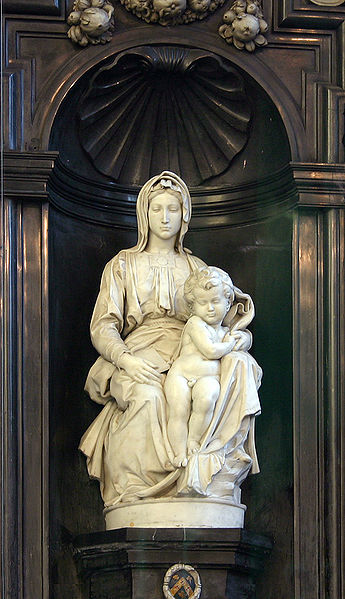
The Madonna of Bruges
The Madonna of Bruges was one of the most important pieces sought by the Allies.  Sculpted by Michelangelo in 1501-1504, it was a beloved piece that resided in the Cathedral of Notre Dame in Bruges, Belgium.  The only sculpture of Michelangelo's to leave Italy in his lifetime, it was first taken by the French during the Revolution (later returned by Napoleon) and then stolen by Germans during WWII.

This statue, one of over one hundred statues that were eventually recovered in the massive underground storage mine at Altaussee, had been meticulously hunted by Monuments Man Ronald Balfour for almost an entire year.  Along with Johannes Vermeer's famous painting The Astronomer,  it was one of the most sought after pieces during that last year.

One might wonder about more famous pieces, such as the Mona Lisa.  I knew it had been removed from the Louvre, as had all of the most important French pieces.  Oddly, the Nazis, under Hitler's direction, made an attempt to appear as if their looting had some basis of legality.  If works like the Mona Lisa were owned by a state such as France, they were left alone.  Most art stolen was taken from Jewish collectors, whom the Nazis declared to be non-citizens, which meant they could not own property.  As the war dragged on, this distinction became more hazy and the Nazi's lust for art led them to blur their own semi-legal standards.


from "Minutes of a Special Meeting of the Association of
Museum Directors on the Problems of Protection and
Defense held at the Metropolitan Museum of Art" Dec, 1941
The book is a fascinating look at the Monument men and their lonely attempts to complete such a noble exercise in the face of such a tragic, costly, and hellish war.  It follows not only the Monuments Men, but also the French heroes Rose Valland (custodian of the Jeu de Paume museum during the Nazi occupation, who spied on their looting operations) and Jacques Jaujard, director of French Museums, who asked her to do so.  

The amount of art stolen by the Nazis was astounding.  According to Edsel and Witter, "the Western Allies discovered more than one thousand depositories in southern Germany alone, containing millions of works of art and other cultural treasures, including church bells, stained glass, religious items, municipal records, manuscripts, books, libraries, wine, gold, diamonds, and even insect collections."  The totals are almost impossible to believe.

More impossible to believe is the dedication of the Monuments Men to save not just the culture of the Allies, but of the Germans as well.  British Monuments Man Walker Hancock, like the others, felt this was highly important.  According to Hancock, "to save the culture of your allies is a small thing.  To cherish the culture of your enemy, to risk your life and the life of other men to save it, to give it all back to them as soon as the battle was won..." was unheard of.  But it is unheard of no more, thanks to Edsel and Witter.

The review of the movie can be read here.

Saturday, October 12, 2013

Dracula, the Bram Stoker novel: A View from a First-Time Reader

Dracula, by Bram Stoker.

As much as I enjoy Bram Stoker's short stories, (The Squaw is one of my favorites) I was sort of dreading this book.  First of all, I've seen so many different adaptations of the book I felt sure that none of this would be fresh to me, and it might possibly bore me simply from my familiarity with the story.  Add to that my aversion to the epistolary form of writing: segments of journals, transcriptions of audible journals as recorded on wax cylinders, newspaper clippings, letters.  I can only imagine what Stoker's story would look like today--blog entry, e-mail, telephone answering machine message, text, faxes.  Yikes.  So basically, I embarked on a book I had little hope of enjoying.  Why?  

I was never a fan of Dracula.  But like all kids, I was intrigued by his mystique.  One day, as a young lad (and I have no idea how old I was when this happened), I came across a movie version of Dracula on a Saturday afternoon.  (More than likely it was Creature Feature.  Anyone remember that?)  So I caught one of those  versions wonderfully desaturated right about the time the Count was running from one side of his stone castle to another, cape swinging with him, as he advanced upon Van Helsing, until finally Van Helsing yanks down the curtains as daylight creeps in and using crossed candlesticks forces Dracula into the sunshine where it hits him like a death-ray and turns him to dust, leaving only a few hairballs that sort of float off in the morning breeze.  This, I discovered later in life, was the 1958 Dracula.  It seemed sort of cool, but I didn't become a fan.  He was, after all, evil, and that didn't appeal to me.

Christopher Lee, in Count Dracula, a film by Jesus Franco, in which
he attempted to portray the Count as he was described by Bram
Stoker.  Something that Hollywood never seemed to get right.
I tried to read the book about twenty years ago, and maybe I was distracted, who knows, but I couldn't get into it.  I put it aside and just forgot about it.  I eventually saw the 1979 Dracula with Laurence Olivier as Van Helsing and Frank Langella in the title role.  Though this was one of the more egregious uses of the "sexy" Dracula, the Van Helsing portrayal is one of the more faithful to the book.  And speaking of the book, let's get back to it.


I was pleasantly surprised to discover how much I enjoyed this novel.  I became accustomed to the epistolary style, though I did not grow fond of it.  I kept wondering how it would read if someone just took the darn thing and rewrote it in third person.  In fact, I would suspect that after all these years someone has.  I may look it up one day.  But the story itself really caught me by surprise.

Laurence Olivier (left) as Van Helsing in Dracula (1979).  This was
one of the most faithful portrayals of the character as Stoker wrote
him that I have seen.
There is so much to be admired in this book that it would take too long to list all of the elements that fall under this category.  Some of the highlights would be Renfield's story, Van Helsing's characterization as set forth by his accent and poor syntax, the fact that Dracula could be listed as a missing person for most of the book (which just made him that much more potent--something to be avoided at all costs), and even the exhaustive travel details of the 1890's.

Having seen the gory, modern Dracula movies, and the more discreet movies of the early days of cinema, I had this idea that the novel, written just before the turn of the 20th Century, would be so sanitized as to be dull.  However, I was surprised at how graphic a few of the scenes were.  It must have been quite a shocker for readers at that time.  But as one reviewer noted, it is not a story that glorifies evil, as most of the modern day vampire books do.  Instead, it truly vilifies the vampire, making him something to loathe, and hate, and something that must be destroyed as a sacred duty to God.  In no way did I ever pick up the completely audacious, Hollywood notion that Dracula has this inner, impossible-for-women-to-ignore, sexual attraction.  What a bunch of rubbish.

Need I say spoiler alert, when so many know the story?

The men are solid characters, all noble and willing to stand up to the horror that assails Lucy and Mina.  And these two women are strong characters in themselves.  Mina especially, despite the idea that Dracula has infected her against his will, is not just a doormat female cast member.  She even gets a Winchester rifle in her hand by the end of the book.

Leslie Nielsen in Mel Brooks' 1995 Dracula: Dead and Loving It, not a
faithful adaptation.
Speaking of spoilers, let me address the adaptations just a little.  Though no movie out there seems to have used all of the original story, I was surprised at how much of Stoker's novel has been used in the various films.  So much of it has been sprinkled over the various Dracula movies.  Yes, most of the movies never come close to filming the entire book, but many of them are quite accurate in what they depict from the novel and there was little in the book that I did not recognize from the many films.  I was quite impressed.  Still, Stoker's style kept it fresh and I never felt like I was going over stale material.

Though this is a long novel, clocking in over ten hours of reading for my reading-speed, I did not think it ever really dragged on slowly, and I found all of it interesting.  But if you decide not to read it, allow me one more spoiler:  never, at any point, will you read/hear Dracula say "I vant to suck yoor bloood."  Okay.  Now you know.  You won't be disappointed.

Tuesday, October 1, 2013

David Morrell's Unexpected View of Frank Sinatra: The Artist and His Music


I had set out to write a review of David Morrell's unique thriller Murder as a Fine Art (which I still intend to write) but as I was researching the author, I came across something unexpected: this thriller writer, the man who created John Rambo in his debut novel First Blood in 1972, which eventually greatly influenced the thriller genre of that era (and continues to do so today!), had stepped way out of his expected role and written a short biography that examined the music of Frank Sinatra.  I was intrigued.  I'm a huge Sinatra fan, and I did not hesitate to grab this eBook off the shelf.

For two hours, I did not put down my Kindle.  I read it straight through.  And why not?  Morrell essentially leads us through a written two-hour concert tribute to Frank Sinatra's career, while highlighting the songs and albums, and mixing in the singer's personal, tumultuous history as it affected his outlook, his voice, his success, and his failures. Sinatra had an unbelievably long and prolific career, yet Morrell manages to make sense of it all, weaving it into a narrative that left me with a mosaic image of Sinatra I've never had before.

Not one to rest on is laurels, David Morrell
leaves the thriller genre to give us an intimate
look at the musical career of Frank Sinatra.
(picture courtesy of davidmorrell.net)
Instead of just writing about the popularity of the man, Morrell focuses more on the musical influences and choices made by the Chairman of the Board, covering many behind-the-scenes moments in the recording booths at Columbia, Capital, and Reprise Records. More importantly, he "gets" Sinatra. He understands that this man stood out with his attention to details like timing, diction, and lyrical passion. He explains the way Sinatra used to write out the lyrics by hand, over and over again, until he discovered the underlying meaning to the words, so he could sing those meanings back to the microphone and the audience. What Morrell really does here is explain to us why we like Sinatra. And as a big fan of Frank's, I'd say Morrell gets it right. If you love Sinatra, you've got to read this. If you are ambivalent about him, read this and you'll very likely come away with admiration for the man you never thought you'd have. If you hate him, this might just change your mind.

One of the many albums Morrell highlights of Sinatra's is In the Wee Small Hours (1955).  This has always been a favorite of mine, and the coverage it receives here is indicative of Morrell's insight into the man and his music.  If you are only familiar with Sinatra's big hits, and you want to hear one of his best concept albums (and as Morrell points out, Sinatra helped to develop the concept of the concept album) then click on that link at the bottom and download this album.  Sit back and be prepared to be won over by a sound experience you won't soon forget.

Morrell's study of Frank Sinatra does not shy away from letting us see the troubled side of this artist, but he never turns this piece into a gossip column. Instead, he shows how the alcoholism and the womanizing and the combativeness of this manic depressive combined to influence an industry that was just coming into its own in the middle of the last century. Was Sinatra a scoundrel at times? Yes. Was he sympathetic? Absolutely. In fact, both of those factors were a major reason for the public's interest in him. All of it came together to create an international icon that still influences pop-culture today. But Morrell does not dwell on these aspects of Sinatra's life. He keeps the story firmly on the music. And that's as it should be. Because Sinatra's music is a story worth reading. And David Morrell does Frank Sinatra's entire career justice in this short but exhaustive history of this brilliant, troubled artist and his remarkable music.

In addition to this piece on Frank Sinatra, Morrell also wrote one on Nelson Riddle, the arranger that became such an integral part of Sinatra's sound.  Riddle came to my attention with Sinatra first, but I began to see his footprint in many other areas of music, notably in the Ultra-Lounge CD series, as well as in such classic movies as Pal Joey and High Society and on television shows like Emergency! and even Newhart.  So I was aware of Riddle and had a high regard for his sound.  At the same time I bought Morrell's eBook on Sinatra, I grabbed his Nelson Riddle eBook as well: Nelson Riddle: The Man behind the Music, an essay (The David Morrell Cultural-Icon Series).  I haven't read it yet, but I look forward to it with eager anticipation.

And I still intend to write that review on Murder as a Fine Art.  Just not today.  Keep an eye out for it.

Saturday, August 24, 2013

My View of a Classic Novel and Our Not-So-Classic Modern Mindset

The Pioneers, by James Fenimore Cooper

Lately, I've been seeing much honor being given to a recently deceased author whose famous "10 Rules of Writing" stress the importance of fast, non-descriptive, skip-the-boring parts narrative.  It warms me to know this late author would have hated James Fenimore Cooper's The Pioneers, as would his adherents.  I realize there are fewer and fewer readers out there who have the capacity or desire to appreciate this type of slow, highly descriptive, thoughtful work of fiction.  Even Mark Twain railed against Cooper's lack of action, and roundabout way of speaking.  Personally, I revel in it.

It is fitting that this book tells the story of the (then) wilderness of New York as it was being invaded by the hand (and ax) of man.  Trees were being felled, clearings replaced tangled forests, and the heartless laws of men were replacing the common-sense laws of the forest.  Natty Bumppo, known as Leatherstocking, is at the far end of his 70 years of life.  His life of freedom and love of nature are in jeopardy.  The world he once knew is no more.  He is beset by such laws as hunting out of season as well as the greed of those who believe he is hiding a fortune in silver.  Modernity is not a friend to Bumppo.

The same is true for books such as these.  We're too busy to take the time to read slow books like The Pioneers.  Someone sold us a bill of goods, years ago, and said we needed to read books that can be finished in just a few days.  We need to hurry up and get to the next book.  Perhaps this was just a marketing scheme to get us to spend more at the bookstore.  I never understand why people don't think it is a bonus to get a book that sells for the same price as a quick-read throwaway pulp fiction which is three times the length and written in such a way that you must slow down and pay attention.  It certainly saves the reader money.  One need buy far fewer books when they are written in this manner.

Is this modern New York, which James
Fenimore Cooper would not recognize,
so busy and distracting that his books
can no longer be read?
But time, or the lack thereof, is not the real problem.  It is that little phrase "pay attention".  We're too distracted now to sit with a book in a silent room and concentrate on the text.  We hear music and television anywhere we go.  Stuck in the waiting room of the doctor's office?  You'll have to work hard to read a book that requires your attention, since there is music playing, and other patients surfing on their phones while telling their neighbor about the latest stupid video clip they watched.  Reading at home?  Nine times out of ten someone will have the massive flat-screen TV turned on, blaring noise from surround-sound speakers that shake the house.  How about reading on the train, or while waiting for your car's oil to be changed?  More flat-screen TVs tuned to mindless daytime talk-shows.

Even as I write this, my laptop has beeped, to let me know someone has posted something on Facebook that I might need to see.  Switch over!  See if it is a funny picture or a sad news item.  Maybe a friend posted a picture of their entree that just arrived on their table at the best restaurant in town.  (Which now make me wonder what I'm going to do for lunch...perhaps the local diner, or maybe just stay in and reheat some leftovers...hmmmm.)

So anyway, about this...what was I writing about?  Oh yes, "The Pioneers".  So modernity is no friend to these classic novels of yore.  (Yore?  Is that right?  Now I'm off track again, checking on Google to see if yore is the right word.  When I type yore, Google suggests that I meant yorehab which turns out to be a site dedicated to the obsession of playing Yoville, a game where people pretend to have a house and pretend to buy pretend items for that house.  Yorehab actually helps you find the very best pretend prices for your most wished-for pretend couches and lava-lamps and...oh, okay, I see that yore is the right word.  As defined by by Google, yore is "of long ago or former times (used in nostalgic or mock-nostalgic recollection".)  To put it plainly, people today have trouble reading books that were written a long time ago.

So if our modern lifestyle has made it impossible for you to read The Pioneers, you'll miss out on the following:
Illustration for the James Feminore Cooper novel The Pioneers,
 art by Felix Octavius Carr Darley.
 Published 1861, W. A. Townsend and Company in New York.
  The opening scene involves a shooting of a deer and an argument over who deserves the credit for the kill.  The argument is easily won by the revelation that one of the shooters could not have hit the deer because he hit one of the men in the argument, who dramatically reveals he is hit to win the argument.
  A courtroom drama that highlights the fact that men were already losing their personal freedoms in the late 1700's to the overreach of local government.
  A contest of shooting acumen in which a turkey is placed so that only his head is visible to the contestants.
  Fights, jail-breaks, forest fires, and emotional death scenes.
  A panther attack which ends in a noble warrior's bloody death.
  The chance to find out about Leatherstocking's companion, a character named "The Slut".
  A story filled with conservationist propaganda and a condemnation of the terrible genocide that the whites perpetrated on the Native American populations.
  A wonderful, warm, historical, and exciting look at the early lives of those who tamed the wilderness of New York State.

But don't worry.  No one will make you read this long, slow, dull, dusty tome.  You'll have plenty of time to read the latest spine-tingling-can't-put-it-down-page-turner so that you can quickly buy the next one.  Just keep in mind that The Pioneers was seen in the same light two hundred years ago, when the population had more time on their hands and their comprehension skills were obviously more highly developed.

Tuesday, June 4, 2013

My View of Edward Rutherfurd's Paris: The Novel

Paris: The Novel, by Edward Rutherfurd, is an 805 page historical epic that takes a great deal of time and attention to read.  It is not the length of the book that demands so much.  It is the structure of the book that sets the bar so high.

For those readers unfamiliar with Edward Rutherfurd and his epic novels, I will note a little bit about what makes a Rutherfurd novel unique.  Like a James Michener novel, these books are centered on one geographic location.  However, whereas Michener takes a larger view of a place like Spain (Iberia) or South Africa (The Covenant), Rutherfurd takes a smaller bit of real estate, such as England's New Forest region (The Forest) and England's Salisbury plain (Sarum).  Lately, he has been tackling individual cities: New York, London, and Dublin.  Like Michener, Rutherfurd follows a handful of families across many generations through the ebb and flow of real historical events.  All of this is true of Paris: The Novel.

Unlike some of his earlier works, Rutherfurd has chosen to take his stories out of chronological order, skipping back and forth from various time frames.  I felt this was done as a way to increase the suspense over some of the story lines.  I did not mind this, and even felt it might have been a benefit to the book.  It kept the story fresh, and I was happy not to be forced to read the older history before being allowed a peek at the era of the Belle Époque.  I've seen some complaints in other reviews regarding this jumbled ordering of the stories.  I did not mind at all.

I won't get into particulars as far as the families and their story lines are concerned.  Suffice to say, there are a number of families, representing various strata of society: aristocrats, laborers, professionals, and thieves.  Watching the families grow and evolve is part of the charm of an epic like this.  Discovering secrets and their long-reaching consequences is another.  It is a nice reminder to us that what we do today can have extreme consequences on our descendants, both good and bad.  One can also see how some family traits can finally be broken by the younger generations.

Atop Montmartre, the site of much of the action
in Rutherfurd's Paris: The Novel (photo
from RoomWithNoView)
The star of the book, of course, is that grand lady, Paris.  The City of Light.  No matter the subject matter of the time period, whether it be the uprising of the Paris Commune, or the French Revolution, or the golden age of the Sun King, or even the building of the Eiffel Tower, Rutherfurd keeps our eyes focused solely on that most magical of cities.  The reader is taken to the heights of Montmartre, to the bridges over the Seine, and into many famous landmarks that are stacked like chord wood within the boundaries of the city.  He also takes many opportunities to inform us about the history and culture of the city.  Most tour guides tell small stories to back up their recitation of the facts.  Rutherfurd takes the opposite approach, using his characters to back up his story by reciting many facts and anecdotes.  A few times this becomes tedious, seemingly too unreal and staged.  If I had not been such a fan of Paris, I would have found it a bit boring.  However, I love Paris, and I enjoyed all the little tour-guide moments.  No matter that I already knew much of what he was talking about beforehand.

At this point, you would have to guess that I loved the book.  That I couldn't put it down.  It was right up my alley.  It was everything I would want in a book.  And for the most part, you would have guessed right.  Except...

I was initially disappointed with the story lines.  I understand that a book of this size requires a slow approach, and that the author can take his time to build the atmosphere and complex story.  However, it was readily apparent that the book lacked a bit of that Paris pizzazz.  This is a city known for its party atmosphere.  It is exciting.  There is so much that can go on there.  Yet the stories were very low-keyed.  I enjoyed them, I had simply expected something more compelling to read.  A good deal of it turned into a soap opera, just detailing who was sleeping with whom, and who was mad at whom.  I admit that I grew dismayed near the middle of the book.  It seemed as if if Edward Rutherfurd had blown it.  He had the most beautiful and exciting city in the world to play with.  Shouldn't he have come up with something to match its energy and glamour?

Author Edward Rutherfurd
In fact, dialing down the story a notch,  the author allowed himself to build solid characters and situations so that when they all ran together near the last one hundred and fifty pages it finished with a bang.  The last time period he covers is that of the German occupation.  And this is where all the background story pays off.  We see how people with such rich family backgrounds reacted to the pressure-cooker that was Nazi-occupied Paris.  From that point on, the story no longer looked back.  It moved along like an old-fashioned noir thriller.  I was surprised at this turn and greatly enjoyed the change of pace.

Books like this do a great job of reminding us of the history that clings to a geographic location.  It also reminds us of the way sins cling to historical timelines, and how easily our mistakes can effect many generations.  But what it does most for me is reminding me that we are not alone in the place we call home.  So many others have come before us, and so many will come after us.  We have an appointed time while we are here to make a contribution to the small slice of the world in which we live.  When it is over, there is so much more that will continue to happen.  We are often too arrogant a people to understand this.

While I would recommend reading Paris: The Novel, I am well aware that it is not for everyone.  The story is long, and builds slowly.  However, if you commit to the time necessary to read it, you'll find the book ends quite satisfactorily.  You'll have learned much about Paris and the French people.  You also might find that you're curious about New York and London.  I haven't read those yet, but I am adding them to my list.


Sunday, May 5, 2013

My view of "The Guilty"

I haven't read a good courtroom drama in many, many years.  I'd read Scott Turow's Presumed Innocent back in the early Nineties, and gave up before I made it half-way through his next novel.  When John Grisham came along, I made it through three or four of his hollywood-esque legal thrillers, losing interest with each consecutive book.  It is not that they were bad.  They were exciting books that had little to do with the practice of  law.  I never really tried another legal thriller until I saw Gabriel Boutros' first novel The Guilty.  Its promise of a defense attorney who can't look at himself in the mirror as he struggles to defend the guilty caught my attention.  When I saw that Gabriel Boutros had spent twenty-four years as a lawyer in criminal law, I decided I would take a step back into the courtroom and see if it would be worth finding a seat in the juror's box.
  Right away, I liked the opening scene.  The novel is set in Montreal, Quebec, a city that is constantly dealing with its French/English duality.  This added a nice flavor to the novel, though Boutros does a great job of not exploiting it for his plot.  Instead, it is a background layer that provides just the right amount of character.  We hear characters use French phrases now and then, but that's all.  It adds just enough to give the novel a peculiar feel.  As does the winter backdrop.  Snow covers everything, characters must bundle up to brave the outside temperatures.  Add it all together and Boutros has created a cold, slightly alien world.  A perfect setting for the law.
  As the story unfolded, I was quite pleased to see that the plot was going to stick with the courtroom.  Too often a good crime drama ends up with car chases and intricate fist fights.  This is often a sleight-of-hand trick to keep us from seeing the holes in the plot, or even to keep us from realizing there is very little plot at all.  But Boutros pulls no punches as he crafts his story of a defense lawyer who is slowly coming to realize his job is nothing to be proud of.  I wondered if he could keep it up, or if he would succumb to the temptation to splash his pages with blood and gunpowder.
  But there is no need to use cheap theatrics with the reader when you can create characters that carry their weight from one scene to the next without the slightest misstep.  And that is one of the strongest points of The Guilty.  This is no quickly written Law and Order episode that wants to take advantage of some recent headline.  Such fare is full of flat, boring stereotypes whose only role is to fill a spot in a scene or two to keep the story rolling.  Not here.  From the conflicted lawyer Robert Bratt, to smaller roles such as witnesses and court officials, The Guilty is full of interesting characters who infuse this novel with life.
  And let me take a moment to point out two of them.  Bratt's law firm partner, J.P. Leblanc, along with the judge presiding over the main trial, a Judge Green, are the sort of characters that not only stand out in this book, but would stand out in a movie version of this book.  I couldn't help but think that they were the kind of roles that a veteran actor would love to ride to an Academy Award win for Best Supporting Actor.  In fact, the whole book reminded me of a Sydney Pollack movie-- the sort that is full of fascinating discussions on law, ethics, and our confusions over our own little roles in this mixed-up world.
  There are no legal stunts that leave the reader shaking his head, disappointed that it all came down to a silly technicality or something equivalent to a legal prank.  At no time did I want to jump up from my chair and shout "Objection, Your Honor!  The author is misleading the reader!"  From page one to the last page, the story unfolds with just the right amount of ever increasing tension.  If I had been in the juror's box during the trial, not only would I have had no problem staying awake, I would have been in trouble for laughing out loud a few times, especially at the verbal repartee between Bratt and Judge Green.  And throughout it all, I would have been on the edge of my seat, leaning ever closer to the witness stand, waiting for the next witness to thread his way through the mine field laid down by Robert Bratt.
   I read the Kindle edition of the book, which I was able to borrow for free with Amazon Prime.  I encourage anyone who is interested in reading a courtroom drama to pick up The Guilty.  Gabriel Boutros is one of those rare lawyers you can trust.