Like Jason's Facebook Page

Showing posts with label classic movies. Show all posts

Monday, March 24, 2014

The Guns of Navarone: David Niven and the Scene of his Career

The Guns of Navarone, Directed by J. Lee Thompson.

There are few movies that get my attention like J. Lee Thompson's Navarone.  (It was actually Alistair MacLean's first, though the screenplay strays from the book quite a bit.)  Full of action, tension, exotic locations, all centered around a band of men on an epic mission, it never fails to captivate.  With a strong ensemble cast, led by Gregory Peck, Anthony Quinn, and David Niven, there is plenty of action, drama, and even a bit of comedy to go around.  Filmed in 1961, the cast includes the obligatory teen star James Darren (in a failed attempt to break out of his teen-idol status into the role of a serious actor), a fairly unknown (and troubled) Gia Scala, Greek actress Irene Papas, British star Stanley Baker, and the veteran stage and screen Shakespearean actor/director Anthony Quayle.  Producer Carl Foreman was aiming for international appeal when he assembled this group.  I suppose he just couldn't figure out how to stick an Asian into this story.

I won't spend much time on the plot of this movie.  It is largely a fantasy, or as Gregory Peck suggested, a parody (he even went so far as to complain that it was more like a Keystone Cops caper).  Simply put, this band of intrepid, quarreling, reluctant men are sent to destroy massive guns that are blocking the one shipping lane that is holding up the entire war effort.  It seems that there is no way that the Allied Navy can avoid this island.  But that hardly matters.

David Niven as Corporal Miller

Early in the film, as we're getting to know the crew, David Niven shows off his comedic flair as the men prepare to sail a decidedly un-seaworthy boat into the German-held Aegean.  An explosives expert who's been assigned this mission against his will, Niven's character, Corporal Miller, spends most of the film cracking jokes and making sarcastic remarks about Captain Mallory's (Peck) determination to win at all costs.  He complains to Mallory: "Sir, I've inspected this vessel and I think you ought to know that, ah, I can't swim."  This sums up his character perfectly.  He's smart enough to know the limitations of their equipment, determined to make sure Mallory knows how disgruntled he is, and is not ashamed to point out that his main concern is for his own safety.

Anthony Quinn, a Mexican playing a Greek, as Andrea Stavrou.

Niven is not the only actor showcasing his skills in this film.  Anthony Quinn, already a two-time Oscar winner for supporting actor (Viva Zapata!, and Lust for Life) and three years away from his signature role in Zorba, the Greek, displays his wide range of skills.  Despite his intimating presence (his character has sworn to kill Peck's character when the war is over), one of his best scenes is when he grovels before the German officer as he attempts to con the man into believing that he has nothing to do with the resistance fighters.  He can be mesmerizing, even when he is only in the background.

Anthony Quayle, who actually organized resistance fighters in Albania during WWII, takes something of a backseat in this film, spending most of his time on a stretcher, merely a prop brought along to spur on Miller's debates with Mallory over which is more important; the men or the mission.  Darren, in what must have been his best attempt to be a serious actor, just looks mad all the time, and impatient, and well, basically a teenager.  I've always been intrigued by Irene Papas in this movie.  She is full of mystery, and I always felt that her character should have been brought to the front more.  She's tough, but retains her dignity and humanity.  But in this massive story there wasn't much room to do this.

Now let me explain why I've written this post.  It isn't for the massive guns that are inevitably destroyed.  It isn't for the large, talented international cast.  It isn't for the chase scenes and the intricate rock climbing scenes or the silent, lengthy infiltration scene as the men break into the gun emplacement.  (Which, by the way, is marvelously filmed like the nerve-wracking heist scenes in movies like Rififi and Topkapi.)  The one scene that really sets this movie above so many of its fellow WWII escapades is when David Niven's Miller exposes the traitor in the group.

(Severe Spoiler-Warning: If you haven't seen this movie, and you want all of the surprises to be intact when you watch it, simply know that you've got to see this movie, then stop reading.  Come back later to read the rest of it.  I'm not a fan of spoilers, but no matter that this is supposed to be a major revelation in the movie, I don't feel that this ruins anything.  I've seen this movie over a dozen times, and the impact of this scene is never diminished by my foreknowledge.)
David Niven points out the traitor.

Miller, the explosives expert, discovers that his toys have been tampered with.  Ruined, in fact.  Piecing together all of the pitfalls they've encountered, he has finally figured out who's to blame.  Like Hercule Poirot, he methodically talks through his reasoning to the entire crew and when he finally reveals the traitor, the assembled team is shocked: he suspects Anna (Gia Scala), the emotionally disturbed mute island girl who had been tortured by the Germans.  His accusation is easily proved.  Tearing the back of her dress, they see that her scars are non-existent.  She had never been tortured.  To avoid this, she'd agreed to spy for the Germans.  While this is good drama, it is not yet that which sets this movie apart.  That comes next.
Niven, stripped of his humor, delivering the performance of a lifetime.

Miller now goes after the real target of his anger: Mallory.  The man who has been constantly putting every man's life below the success of the mission.  As I said, Anthony Quayle's character, Franklin, is a prop who has been carried around on a stretcher this whole time for just this purpose.  You see, Miller is Franklin's best friend, and he knows that Mallory doesn't give a damn about what happens to Franklin.  And now Miller goes after Mallory.  He demands that Mallory be the one to shoot the girl.  They can't leave her behind to warn the Germans, and they can't take her with them.  Someone's got to shoot the girl.  And Miller wants his pound of flesh.  Mallory must be the one to shoot an unarmed and terrified young girl.

Niven is riveting in his delivery of this speech.  His comedic lines are all gone, his jaunty, British ease now vanished, made all the better by the director cutting to Peck and his iconic, jaw-clenched simmering-to-a-boil glare.  Niven's Miller has set the trap, and Peck's Mallory is caught in it.  Will he do it?  How can he not?  Gregory Peck, our once beloved Atticus Finch, the white knight of this film, is going to have to execute what is essentially an innocent girl.  Sure, she was helping the Germans, but it was out of fear, not ideology.  And now Peck/Mallory is going to have to put a bullet in her.

What happens next is pure cinema gold.  Not because the writer found a way to get Peck out of his trap.  That was a given.  Gregory Peck was not going to gun down a girl who is splayed on the floor, half-undressed and crying.  Especially not when he was wearing a German uniform.  They couldn't pay him enough money to tarnish his reputation like that.

Let's look at the sequence:

First, Peck is goaded into killing the girl by Niven who says "Come down off that cross of yours, close your eyes, think of England and pull the trigger!"  Exasperated, Peck stalks over to the girl.  She looks up at him, eyes filled with tears.  He unholsters his gun.  A cut to the profile of Niven, who turns apprehensively to see what Peck will do.  A shot of Quinn, then Papas, the girl's only friend.  Back to the girl, who raises her head, as if placing her head on the chopping block.
Gia Scala, as Anna, awaiting her fate.

  Now Peck, raising the gun.
Gregory Peck as Captain Mallory.  Will he kill the woman?

  And a quick shot of Niven, suddenly dashing forward, a split-second realization that Peck is actually going to shoot her.  A sickening realization that this girl is going to be executed because of him.  A last second decision to stop what he has started.  But it is too late.  A close-up of a gun firing.  A gun with a silencer.  The girl now, rocked back by the impact of the bullet.  She looks at her killer, shocked.  Now, a second close shot of the gun, pan back, and we see Irene Papas, a grim, bleak stare smoldering from her dark eyes.  The girl slides to the ground.  Reactions from Peck and Quinn, then a wide screen shot of everyone, the girl's body in the foreground.
No more debates, no more flippant one-liners.  Nothing more to say.
Niven drops his hands, all of his anger and sarcasm drained away.  Peck, still conflicted, stares at Papas, trying to fit the facts into his ordered mind.  We, the viewers, take a breath, trying to process our own feelings on what just happened.  Some of us, who had been rooting for Niven, now doubting our own judgement in wanting Peck to shoot her.  Some of us, firmly believing in Peck's fatherly leadership, refusing to believe he was actually going to kill the girl.  All of us in awe that Papas took on the role of executioner.

Well, not all of us.  See Anthony Quinn there in the background?  He's watching this whole scene almost casually.  He's a hard man in this film, and he not only isn't fazed by violence, he's rather attracted to the tough character of Papas.  As I said, he stands out, even when he doesn't have lines.
Oh yeah, they still have to destroy those guns.

For me, the rest of this movie is just tying up loose ends.  It's all grand adventure, but the execution of the traitor raises this movie to the upper echelon of war films.  It is no wonder that it was nominated for seven Academy Awards, including best picture.  One rarely finds an action epic of this proportion with such a profound and disturbing scene tucked inside it.  And David Niven never had such a plum role as that of Corporal Miller.

Now that you've read about it.  Watch the movie, and this scene and decide for yourself.  I'd love to hear your opinion of it below.  (Oh yeah, one more thing.  At the end of the scene, don't miss Gregory Peck's delivery of one of his best lines ever as he threatens to shoot Niven.  Just the icing on the cake for this scene.)


You can watch this movie at Amazon, just click on the link.


Friday, October 25, 2013

Carnival of Souls: A Cult Classic Reviewed

Carnival of Souls (1962), directed by Herk Harvey

As the classic horror movies of the Universal Monster era evolved throughout the 1930's into the 1950's, creatures remained the at the top of the genre.  That decade saw such gems as The Blob, Tarantula!, The Creature from the Black Lagoon, The Giant Claw, Attack of the Giant Leeches (a personal favorite!), and William Castle's The Tingler.  Rarely did horror not include a monster or an alien that was out to get you.

However, in the 1960's, even as creatures continued to menace theaters, horror fans began to see a new type of movie.  Darker themes lit up the big screen.  Man became a terror all his own.  Thanks to Alfred Hitchcock and a little known author from Wisconsin (Robert Bloch, a friend of H.P. Lovecraft), audiences all over the United States discovered that we need not fear giant ants or alien parasites when a man like Norman Bates is lurking behind a shower curtain in the 1960 classic Psycho.  Horror directors began to delve into the creepier aspects of what scares us.  Around this time period, Herk Harvey, a director of educational films from Kansas had an idea for a thriller-horror movie while on vacation in Utah.

For only $33,000, he filmed his movie, Carnival of Souls, using a professional actress (Candace Hilligoss) while filling in most of the cast with local talent, including himself.  In just three weeks, he completed his film.  As a "B" movie, it did poorly, and Herk Harvey never made another feature film.  Most of his crew came from the company he worked for making educational films.  The music score was done by Gene Moore, a co-worker who is also credited with such great films as How to Run a Filling Station and Embryology of the Chick.  (And no, those titles aren't humorous.  The films were actually about running a filling station and embryology...whatever that is.)  Actress Candace Hilligoss only made a few more films.  Carnival of Souls might never have been remembered had it not been seen again.  But as often happened, as cable television sought out more and more old movies to show late at night, Carnival of Souls was resurrected in the 1980's, and over time has become a respected film of 1960's horror.

So let's get to the movie.

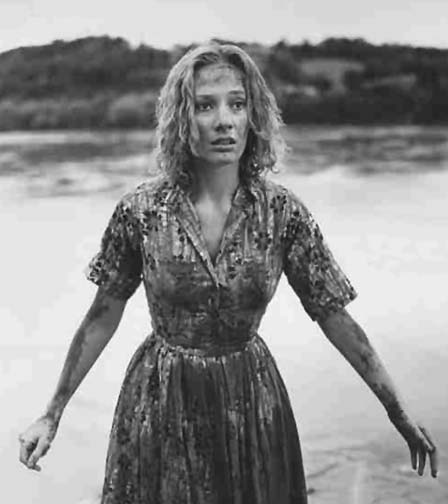
Filmed in black and white, with Gene Moore's hypnotic organ score that saturates the film, Carnival of Souls begins with an accident during a drag race between a car full of young men and a car full of young ladies.  One of the young ladies, Mary (Hilligoss) miraculously crawls out of the river three hours after the car she is in runs off a bridge.  Stunned, she staggers home and continues on with her plans to take a new job as a church organist in Utah.

Candace Hilligoss in Carnival of Souls
Traveling to her new home, Mary passes an abandoned bath resort/carnival on the shore of the Great Salt Lake.  She begins to see apparitions as she is driving.  Basically, she is not feeling well, and greatly disturbed.  Taking a room in a boarding house, she discovers that her neighbor across the hall is John Linden, a creep who spends his days on the make.  Actor Sidney Berger, who later became an acting instructor, plays John Linden, and does so with a delightful job of being creepy and distasteful.  His performance helps to cement the disturbing atmosphere of this bizarre movie.

The real terror, however, comes from the apparition that begins to stalk Mary.  A white-faced ghostly image of a middle-aged man wearing a suit.  No, he wasn't a radio-active creature, not an alien with eyes on the end of two long stalks.  Just a man, whose intense stare is too much for the unbalanced Mary.  At first she does her best to keep away from this silent watcher.  But finally she can no longer stand not knowing who he is and what he wants.  Unable to get any help from a local doctor, she begins to see more ghouls around her.

The Ghoul (Herk Harvey)
Finally, she is drawn to visit the abandoned carnival.  And there, she will eventually find the answers she is seeking.  Harvey makes use of the abandoned location with well-crafted scenes that are bizarre, ghoulish, and surreal.  I was expecting something over the top, but was happy to find that Harvey keeps the whole movie understated, with just the right amount of creepiness and dreamlike atmosphere.

Hilligoss is cast well as the doe-eyed blonde who stumbles around in this dreamy fantasy.  She never looks like the typical stupid young girl that so many horror movies offer up.  Instead, though she can't seem to figure out what is going on, she retains her dignity even as she is slowly overcome by the ghouls that haunt her.

Carnival of Souls is available on Amazon Instant Video.  Use the link below to check it out.


Wednesday, February 20, 2013

My View of Seven Thieves

An obvious attempt to market the movie as an
Ocean's Eleven knock-off, despite the fact
it was released four months before
the Rat Pack extravaganza.
Everyone knows the heist caper Ocean's Eleven--all you youngsters know the Brad Pitt, George Clooney, glitzy production by Steven Soderbergh; you older kids might first think of the Rat Pack glamour flick from the days when Frank, Dean, Sammy, and Peter were the hottest ticket in town.  They were both entertaining movies.  Both of them sold tickets because of their stars; as ensembles go, these movies are some of the best examples of an ensemble cast with dynamite chemistry.
  The Ocean's Eleven success did more than just propel the Rat Pack (and eventually the Clooney/Pitt Pack) to iconic status.  Released in August of 1960, it almost completely erased the film Seven Thieves from our collective memory.  Unfortunately for those actors and technicians who worked on Seven Thieves, it was released only four months prior to Ocean's.  This gave it very little time to garner any sort of loyalty from the viewing public.  I think I can see several reasons for this:
  The obvious jumps out at us right away--who would most people rather watch?  The young, dynamic Rat Pack lead by Sinatra and his side-kick Dino?  Or  the elderly Edward G. Robinson with his dour companion Rod Steiger?  Thieves might have had an advantage with the alluring Joan Collins in its corner (she does a strip-tease, more or less), but at best this leaves the film evenly matched with Ocean's own glamorous screen-goddess Angie Dickinson.
  Just as obvious is the fact that Ocean's is filmed in color, Thieves in black and white.  Now, that's not a problem for a cinephile  like myself, but it certainly didn't help this movie at a time when the public was increasingly coming to expect color films at the theaters.  Black and white was okay for television, even though color television had been broadcast since 1951.  (Oddly enough, it wasn't until the 1970's that more Americans were buying color TVs instead of black and white ones.)  But a film about casinos really ought to be seen in color.
A far more appropriate ad campaign for a
film that easily stands on its own two feet.
  The third difference that hits you right away is the comedy found in Ocean's, which is non-existent in Thieves.  The Rat Pack spends more time making jokes than being tough-guy crooks.  The whole feel of the movie is that it is all a lark.  And it was.  The boys filmed it in the afternoons, after waking up late from their nights of performing in Vegas.  There was little acting, since they were essentially playing themselves.  It was all shot right there in the casinos where they performed.  (Including Dino's crooning in his little piano bar.)  There's no humor in Seven Thieves.  Though a heist movie, it also carries a pretty heavy Noir atmosphere, much like the French heist film Rififfi.  By 1960, the Noir train had run out of steam; the dark days of WWII were getting farther away, the boom of the 50's was well established, and people weren't looking to explore the darker side of life anymore.
  So why have I mentioned all of that?  Why don't I just review Ocean's Eleven and forget about Seven Thieves like everyone else?  Because it's a darned good movie, that's why.  So let me tell you all about it.
  The film opens when a professor by the name of Theo Wilkins (played by the unique and fascinating Edward G. Robinson) lures an old partner to Monte Carlo for the typically perfect heist.  The partner, Paul Mason (the staid, menacing Rod Steiger) wants nothing to do with it.  He's been in prison, and is not too eager to get caught again.  But as Wilkins points out, this one is fool-proof!  And he's assembled a team.
  You know what comes next: we begin to meet the crew.  There's the beatnik played by Eli Wallach.  If you're a fan of his, like I am, you'll know he's always a bit wild.  But for some reason, I never saw him as a beatnik.  But it suits him here.  He plays in the band as we meet the enticing Melanie, played by a twenty-seven-year old Joan Collins.  She's still a bit young here, and hasn't quite hit her stride yet in Hollywood, but you can tell she has charisma.  She's a stripper who wants to make that big score and get out of her club life.  Collins was famously trained by Candy Barr, a somewhat notorious stripper from the 50s.  (Please note the link will take you to her Wikipedia page, but there aren't any pictures there, guys, sorry.  But if you're really interested in her, I can tell you she shot her second husband and hung around with the likes of Mickey Cohen.  So...)  The rest of the team is filled in with the pretty boy safe-cracker (Michael Dante), the muscle (Berry Kroeger) and the fish-out-of-water Alexander Scourby, playing the "inside man" at the casino.
He's having an affair with her?  Are you kidding me?
(Alexander Scourby and Joan Collins in Seven Thieves.)
  I'll leave the musical dance number alone.  Watch the film and judge for yourself if Ms. Barr taught Ms. Collins anything worthwhile.  This is 1960, of course, so the strip-tease is anything but.  I will say it seems out of place, since the atmosphere of the rest of movie does not fit in with a club-act like hers.  But I'm sure the executives at the studio insisted on this to put seats in the seats, so to speak.
  One of the unique characters in this film is Raymond, played by the very English Alexander Scourby.  Some of you might know him from those commercials that used to run all the time advertising the Bible on audio tape, read aloud by Alexander Scourby.  He's very proper, always the unshakable Brit.  But not here.  Yes, he's the assistant to the Director of Casino operations, but he's also having an affair with Melanie, and he's the one who provides the information needed to locate and extract the money.  But he's one anxiety attack away from the funny farm.  He's a mess.  Who would have though Alex Scourby would be the comic relief?
  Edward G., as always, is top notch.  He has that haunting lilt to his speech.  I don't often say this about a guy, but his voice is mellifluous.  He could talk me into a crime caper, I'm sure, no matter how much I didn't want to get involved.  Yes, he's always portrayed as the gangster tough guy, but that's missing the point about him.  When he's not actively trying to intimidate you, he's subtly at work on you, suggesting, probing, giving out little bits of wisdom like chocolates.  Watch him in The Cincinnati Kid, or Double Indemnity, and you'll see what I mean.  And he gets it right here too, with a little twist; he shows unabashed love for his friend Paul Mason.  Who knew Edward G. could do this?  His face opens up, he looks like a kid who's just opened a Christmas present.  You can see he is so delighted to be with Rod Steiger, which is odd, since Steiger never seems to inspire this in anyone.  Ever.  But that is explained later in the film.
Steiger takes control of the crew and never lets go.
(left to right: Robinson, Steiger, Collins, and Wallach.)
  And speaking of Rod Steiger, let me say a few things.  First of all, I've always had a reserved respect for him.  Not because I don't like his acting, but because he's always played reserved, hard-to-like characters.  Almost always noble, full of good-intentions, Steiger's characters just have trouble being nice to whomever he happens to be next to.  One gets the idea there isn't anyone he is fond of, respects, or wishes to make happy.  Robert Osborne, the TCM host, said the same thing.  Saying he was surprised when Steiger came on the show to co-host a few movies, he was very affable, and easy to get along with.  All of which I point out because that is Steiger's character, Mason.  He doesn't want to be there.  If he has to be, he's gonna be in charge, and no one is going to question how he does things.  Beyond that, he says very little.  The Alpha dog who really just wants to be the lone wolf.  And of course, Melanie finds this irresistible, and her loyalties to Wallach, Scourby and even Robinson pale in comparison to her desire to be with Paul.  Some guys have all the luck.
  One more observation on Steiger.  I can see that Russell Crowe is our generation's Rod Steiger.  Both have that same solid, quiet power that keeps the camera entranced.
  Joan Collins has become something of a joke to our society.  Her success as the bad-girl of Dynasty as well as a few forays into the tawdry, near-porn of her late-70's films, as well as her stint as Potiphar's wife on stage in Joseph and the Amazing Technicolor Dreamcoat have all combined to convince us that she is nothing more than a sexed-up cougar who's only career asset was her body and her seductive ways.  But if you watch some of her earlier works, you'll see a talented actress who knew how to hold her own with actors like Steiger, Richard Burton, and yes, even William Shatner.  Here, in Thieves, she is more than just eye-candy.  Her effect on the usually unflappable Steiger is enough to spark some excellent scenes between them.  They're not Bogart and Becall, but they're not far behind.
  The heist itself is well done, with that same slow, systematic atmosphere one finds in other heist movies like Riffifi and the little known Maximilian Schell/Peter Ustinov Topkapi.  While there is tension as Steiger and Dante risk the high window ledges above the Mediterranean, the better story is on the casino floor as Wallach and Robinson put on their show for the casino officials, which includes one of my favorite actors, Sebastian Cabot.
  This is 1960, and so the Breen office still would not allow crime to be successful unless the crooks were eventually punished.  You know this going in, and I won't spoil the way they handled it.  It is not the strongest finish to a film, but it does manage to surprise you.  After all, who would have thought that I'd find it touching when Rod Steiger holds Edward G. Robinson in his arms and actually sheds tears?  I sure didn't.
  Seven Thieves is not the best heist caper you'll ever see.  It may not even be the best movie of 1960.  But I would strongly recommend it.  Ignore the silly newer posters/DVD covers for it.  It is not anything like Ocean's Eleven.  The marketing department needs a swift kick in its collective backside for trying to ride that horse.  Directed by Henry Hathaway (Kiss of Death, Niagara, True Grit), this movies stand easily on its own merits, and you'll be glad you took the time to look it up.  For now, you can rent it for just $2.99 from Amazon.  (See below.)  It is available at Neflix, though not for instant watch.


Wednesday, October 31, 2012

A View of What Scares Us

This poster was everywhere in Paris in April.
I recently watched what is the latest in thing in Horror--a Joss Whedon special--The Cabin in the Woods.  This mash-up fright flick is basically a tongue-in-cheek look at slasher flicks of the past.  Not designed to scare you as much as make you think that Joss Whedon is ingenious and funny and just a little wise.  I'll give him funny, since there are as many funny lines in it as an episode of Home Improvement (though the movie is three times as long as a Tim Taylor episode), but if Whedon wants to mix comedy and horror, he should rent The Frighteners and take lots of notes.  I would have to substitute clever for ingenious, since the plot could be considered ingenious but the clipped, quick theatrical version of the film is just too short to handle the possibilities of such a plot.  As for wisdom, there isn't any.  Not even a hint of profundity.  It manages to project a few brief, ironic moments, as when partiers ignore a victim being brutalized on TV monitors overlooking the crowd.  It is not that this group of people watch violence like the crowds at the Coliseum.  They in fact cannot even become interested in the violence, much like movie-goers today.  And so the movie ends in horrific bloodshed with little to no suspense.
  Which left me wondering why we had just watched it.  I was expecting it to be what we old people (as in non-teenagers) would call a scary movie.  No, I did not expect to scream and shake in my seat.  But I can still find a movie now and then that leaves me disturbed, a bit hesitant to walk through the house in the dark, and unable to fall asleep without listening to the sounds of the house once the living have taken refuge under the covers.  Cabin in the Woods did none of that for me.  The most suspenseful moment was one of the oldest shticks in the film-makers bag-of-magic-shticks; that moment when you say don't go down in the basement.  Beyond this, there is nothing to make your heart pound.  Sure, there are zombies stalking the characters, and even an explosion of our worst nightmares let loose upon the screen that is more or less designed to make us say "oh-fill-in-the-blank-expletive".  But it never reaches scary.
Peter Jackson's 1996The Frighteners
  Perhaps Whedon would defend his film by declaring it was never meant to be scary.  I can buy that.  It would make more sense.  I wouldn't argue with him.  This is more about my own expectations and how this movie failed to meet them.  Maybe I should have read more reviews before I saw it.  Maybe I just shouldn't be so picky.
  But what exactly then does a movie need to be scary?  That's the question over which this movie left me wondering.  It is a question that has vexed me for some time as I work to construct a plot for a future novel of mine as well.  I mean, let's face it, the scariest things in life are never in the movies we call scary.  Where, for example, are the horror classics April the 15th, and The Mortgage from Hell.  Guys with chainsaws chasing you?  They can't compare to the bureaucratic horror of an insurance company's convoluted medical policies.
  Honestly, one of the scariest moments I ever saw in a movie was in a Jamie Lee Curtis movie called Mother's Boys.  The movie wasn't scary, but in one scene, a little toddler is running across a room in his fuzzy sleeper, with a large glass of water held out in front of him.  Right away, any parent worth their salt feels their heartbeat quicken, their forehead feels flush, and they want to shout "stop running in the house!"  Why?  Because we know those cute little sleepers have plastic feet that stick out too far, and they are slippery, and this kid is gonna...oh yeah, in slow motion, we watch him pitch forward, eyes wide, hands still holding onto that glass...and he falls face first into the glass, which shatters.  It is one of the most traumatic and scary moments I've ever seen.  I knew as soon as he started running it would happen.  I still don't know how they filmed that scene, but I'm disturbed that they did.  It was truly horrifying.
  So what movies have really scared us?  The Exorcist is often cited as the scariest movie ever filmed.  And it is, for someone who does not know the power of Jesus that is available to believers.  A simple movie about mountain climbing scares people who are afraid of heights.  Many things scare us on personal levels, and these cannot be objectively evaluated.  Bumblebees don't scare most people, they are slow, passive, and even sort of cute.  But if you've ever had one get caught in your bangs, you tend to have a troubling view of them.
The Skull in our display.  (And a shameless plug for our books.)
  Skulls don't scare me.  We were in the Paris Catacombs with millions of them and they never bothered me.  I find them fascinating, since we all have one.  In fact, we all have one that we will never get to see.  I just think that's weird.  But during a book festival, when we had a fairly realistic skull sitting on the table, a surprising number of people shied away from it, asking if it was real as they recoiled from it as if its jaw might suddenly open wide as it prepared to eat them.  I was actually shocked to see their reactions.  One lady, her eyes as big as the empty sockets on the skull, her head shaking back and forth like a bobble-head skeleton, answered my question "do you like ghost stories?" with the simple answer "no, no, no, no, no..."  Okay, so skeletons scare her.  Maybe one of them fell on her in a science lab once.  I dunno.
Julie Harris learns what it means to be afraid in 1963's The Haunting
  For good old-fashioned scary I would suggest you look for The Haunting or its British cousin The Legend of Hell House.  Both of these movies do a great job of examining the iconic haunted house story, with actual examinations of them as their plots.  Burnt Offerings and The Changeling do a nice job of scaring the audience.  Any time a movie has multiple moments when you say "stop going into that room!" it is worthy of inclusion on these types of lists.  For a more recent movie, I suggest Identity, which plays with the slasher formula much better than Cabin in the Woods, and leaves us not only afraid of a killer, but afraid of a mind that has gone very, very wrong.  You are forced to consider what it means to lose your mind-- a horror that Gogol examined in The Diary of a Madman.  The mind is a far more terrifying place than the world around us.  Even worse is the darkness of man's heart.  Something I examine in the short story What Scares Henry Payne.  (Another shameless plug!)
  And most people will agree that the scariest parts of any movie are the parts that are never seen.  It is why so many old movies are still respected.  Were the censors aware that they were creating more suspense and terror by not allowing things to be shown?
  So what is it that really scares you?  What movies have captured this feeling best?  Room With No View would love to know!


Friday, September 28, 2012

My View of Bridge on the River Kwai

  Okay, we all know the drill.  Every year, Hollywood puts out action movies that are devoid of character development, solidly written dialog, and restrained pace  These are first-shot-explosion-turned-chase-scene-turned-shoot-out-to-the-last-scene-explosion epics that plaster the wide screens from April through September.  They have no background development.  The characters are flat, dialog is non-existent.  Despite our complaints about them, the fact is, we're all dazzled by the whiz-bang wizardry of Hollywood's bland magic makers.  We can't help it.  We twist our necks to see what's happening, much like any one would when a loud noise catches our attention in a crowded space.  Sadly, it has reduced us to onlookers, driving by and blinking in surprise at what we see without stopping to find out what it's all about.
  Without these dizzying effects to keep our attention (just think of someone standing next to you, snapping his fingers every few moments to keep you looking in his direction) we have become bored with things like character development, conversations, reflective moments, and yes, even setting.  The funny thing is, this is what made up the bulk of all those classic movies that everyone is so quick to say they love.  Consider the following:
  In Bridge on the River Kwai, William Holden and Alex Guinness must battle the misery and brutality of a Japanese Prison Camp during World War II.  It's a war movie that runs for 161 minutes.  For those of you who gave up math because it's just too time consuming, let me remind you that 161 minutes is two hours and forty-one minutes.  That's like watching six episodes of The Office back-to-back on a DVD, with about fifteen minutes left over to discuss all the hilarious ways Michael mistreated his employees.  So during all of this screen time, you would expect this war movie to have loads of action.  But in reality, there is very little.  There's an escape attempt about twenty minutes into the film.  It is shot in the dark, by moonlight, and there's some running around in the jungle, a few gunshots, and a knifing.  Later, more than an hour later, we see a very quick one-sided gun battle, followed by more running in the jungle, and another knifing.  It is not until the final scene that we see some action which includes mortar fire, machine guns, and explosives.  And yet, even during this action, the greatest and most memorable moment in it is when two characters utter one word at the other.
Jack Hawkins attempts to draw William Holden into
his plan to demolish the River Kwai Bridge.
  And that's it.  That's all the action you get.  By today's standards it's boring.
  I sat my two teenage sons down one night to watch this long, drawn-out drama, with the firm conviction that it was one of the best war movies I've ever seen.  Sure, they've seen Saving Private Ryan, and  Band of Brothers.  I knew that they loved action movies, thought even the most creative CGI displays don't keep their full attention.  They have a habit of chit-chatting during movies, joking and poking at each other as if they need something else to entertain them during the film.  I admit I worried that their focus would wander during Kwai, which I knew to be thin on action.  But I pressed the play button and hoped for the best.
  Two hours and forty-one minutes later, as the credits filled the screen, I looked over at my sons, who were still leaning towards the screen, a position I had noticed them in early on in the film.  They both reluctantly turned away from the screen, looking in my direction.  "Wow, that's a good movie," one of them said.  The other one nodded.
  Now, a little full-disclosure is required here.  I've raised these boys on classic movies.  Though they watch plenty of modern movies like Tron:Legacy, and Hitchhiker's Guide to the Galaxy, they've also watched many Bogart movies with me, as well as Steve McQueen, and John Wayne, and even Buster Keaton.  They learned how to pay attention during long conversations and they understand that lighting and music can be used to create and promote themes in the background of a movie.  But that doesn't always mean they like the older movies.  It doesn't mean the classics always keep their attention.
  But Kwai had them from the get-go.  The moment they heard that theme song being whistled by a ragtag bunch of prisoners marching vigorously, shod only with the tattered remains of what might once have been boots, proudly holding their place as the wounded straggle in behind them, they were hooked.  And it wasn't action that held them there.
  The first thing to keep them pinned to their seats was the slightly humorous British officer, played with such dry excellence by Sir Alec Guinness, as he obnoxiously argues with the prison camp commander Colonel Saito.  Guinness is at his best here, but I believe it only works so well because of the equally stunning performance by veteran actor (and former silent film star) Sessue Hayakawa.  Hollywood, in 1957, also thought he was pretty darned good.  He was nominated for an Academy Award as supporting actor.  The humor here quickly leads to drama as Guinness is locked into the hot box and a battle of wills ensues.
  The linchpin of this long film is a scene between these two officers near the middle of the movie.  It is not the point at which they square off and fight with amazing gravity defying skills that can only be filmed with the use of harnesses and green-screens.  In fact, such a fight never happens.  Why should it when these two men can hold us captive with a conversation.  That's all it is.  A conversation over dinner.  Two men just talking. And yet, it is mesmerizing.  At the end of it, you feel the need to stop and take a breath, and marvel at the sheer magic that can be accomplished by a writer, two actors, and a director.
  As the film builds to its climax, we aren't assaulted with a dizzying array of brutal prison camp scenes that most modern movies like to throw at us.  What we see instead is a bizarre twist as Guinness emerges as more of a villain than Hayakawa.  At the same time, we see Holden do everything he can to not be a hero.  He goes out of his way to be a coward.  And yet, fate drags him closer and closer to the climax.  And we begin to suspect that despite his anti-hero wise-cracks, Holden will not disappoint.  He will, in fact, emerge as the hero, boots planted victoriously astride the bodies and ashes of the Japanese and their bridge.
  Spoiler alert here.  I hate to do this for anyone who hasn't seen this movie.  But the climax is the point of what I am saying.  If you are the type to care about these things, and you haven't seen the movie, stop now, go and rent it and watch it, then come back to finish reading.  Otherwise, just keep reading.  Knowing the end doesn't ruin the movie.  The sum total of this movie's greatness does not lie in a twist ending.  It won't lose anything if you know what happens.  You won't care once you finally sit down to watch it, because you'll be spellbound anyway, and forget what you read here, and it will be just as satisfying to watch as if you'd never heard what happens.
Sir Alec Guinness struggles with duty and pride in
the heat of the Burmese Jungle.
  As I said before, the final battle contains machine-gun fire, mortars dropping on the river, and the bridge blowing up.  But that doesn't matter very much.  What does matter is that one character must face the decision to kill one of his own, and we know, from character development, that he has enough trouble killing the enemy, let alone a fellow officer.  What does matter is that William Holden, the Hollywood Star (and only American in the film) shrugs off his cowardice, boldly surges across the river under enemy gunfire, utters a one-word line that is his best line in the film, and dies needlessly, accomplishing nothing.  What does matter is that Guinness utters the same line as Holden, dies in shame, and only redeems himself through happenstance.
  What really matters is the doctor's last words.  (Played by the wonderful Scottish actor James Donald.)
  "Madness!  Madness!"
  None of which would be worth watching without character development, a slow, gut-twisting pace, and minimal action.  When it is over, and the bodies are strung out in a line in the riverbed, you'll need to catch your breath.  And if you take the time to think about it, you'll wonder what all these action movies today are lacking.  Because none of them, with their millions of dollars of CGI stunt-laden action, can approach this kind of finale.

Monday, September 10, 2012

My View of Ida Lupino

  Okay, as many of you know, I have a great many photographs of actors and actresses in my theater.  I have decided to add Ida Lupino to my wall, and am not sure which picture to add.  I'd love to hear what readers think is the best picture to add to my collection.  I'll give you a few choices from which to choose.

  Now, to start, there's this great shot of Ida with (anyone surprised?) Humphrey Bogart.  I should warn you, Mr. Bogart is already on my wall in about a half dozen photos, so as much as I like the shot, it may not be the best choice.
  Lupino and Bogart filmed They Drive By Night together in 1940, after which they filmed High Sierra, from which this still is taken.  I liked They Drive By Night better, but it is hard not to like any picture with these two film greats together.


  You may not know it, but Jack Palance had quite a career as a leading man, appearing in many great Film Noir thrillers.  This publicity shot is from 1955's The Big Knife, a great movie that showcases the acting range of Palance.  Shelly Winters and Rod Steiger have excellent supporting roles.  Lupino is stunning in this picture.  A fun, wild look behind the scenes of Hollywood.  Palance, always creepy, would be a nice addition to my wall.


  Okay, speaking of creepy, and since October is coming up, it would be pretty cool to add Basil Rathbone, along with sidekick Nigel Bruce, as they assist the young, troubled Lupino, saving her life, and the British Empire, of course, in The Adventures of Sherlock Holmes, in 1939.


  Now, what collection of movie stars doesn't look good with a studio, publicity glamour shot?  This is not Lupino's best look, since she made a career out of being a victimized woman (one who fought back with more bite than many of her fellow actresses, to be sure), though she does glamour pretty well.


  Speaking of fight, here's Lupino, her back against a wall but her hands full of a Winchester rifle.  She was always a tough girl, with that throaty voice of hers, it was easy to believe she could hold her own if the need arose.  In this 1949 western, Lust for Gold, Lupino stars with Glenn Ford, along with Gig Young (a personal favorite of mine), Will Geer (you know him as Grandpa Walton), and Jay Silverheels (Tonto!).  Gold, betrayal, and Ida Lupino with a Winchester--man, why can't they make movies like this anymore?

  This last publicity shot, from The Big Knife, is your last choice.  I like it, because it shows her slightly more vulnerable side, which always shone through her tough-girl act.  It's why she was able to be the tough girl.  Unlike many of today's tough girls, who are tough without a speck of vulnerability, hence little chance to earn our sympathy, Lupino always managed to both convince us that she was only as tough as she needed to be to protect a sensitive spirit that hid within.
  Lupino not only had a successful career as a leading lady in Hollywood, but she became one of the first major female directors in that male dominated field, including being credited as the first female director of a Film Noir (The Hitch-Hiker, 1953).  She directed many feature-length movies, as well as directing numerous television programs, including Gilligan's Island, Bewitched, The Twilight Zone (The Masks), and Alfred Hitchcock Presents.  She has also guest-starred on many shows, including The Twilight Zone (The Sixteen-Millimeter Shrine), Charlie's Angels, Colombo, Ellery Queen, Bonanza, and Batman (as Dr. Cassandra Spellcraft, a criminal alchemist).

So go ahead, let me know what your vote is.  Which picture of Ms. Lupino would be the best one for my Hollywood wall?

And if you are interested in Ms. Lupino's work, be sure to check out the following movies:
(High Sierra can be viewed online at the link below.)

Sunday, September 9, 2012

My View of Sunset Boulevard

  As a pretty serious film buff, there have been a few major movies that I have not yet seen.  Since this list contains movies made forty, sixty and even eighty years ago, and this list of movie titles does not grow, I have not gone out of my way to watch them all quickly in order to strike them off the list.  I have time to work through them slowly, opening each one like a gift, knowing that these are special movies.  Some of these movies do not live up to their hype, but these are rare.  Most of the time I discover that their pantheon status is well-deserved.
Sunset Boulevard (1950)
  I'd passed on the chance to watch Sunset Boulevard earlier in life for several reasons, the most prominent being that it just seemed to be about an old lady who was unhappy with having lost her popularity as a silent film star.  It just didn't sound too thrilling, and when I was younger I tended to look for more thrilling movies than ones that were not.  And although I loved William Holden in Stalag 17, I had never heard of Gloria Swanson, and so I felt no compulsion to watch a movie in which she was the female lead.  Back then I was more interested in Kathryn Hepburn, Grace Kelly, or Kim Novak.
  So after being bedridden with the flu, I found Sunset Boulevard on Netflix and decided it was time to give it a chance.  After all, it was rated as one of the top films ever made about Hollywood.  It has been included in the Library of Congress' first list of 25 films that are "culturally, historically, or aesthetically significant."  It had been nominated for 11 Academy Awards.  (Not always a good indicator, mind you.)  It was a Billy Wilder classic, which could be a good thing, and could be a bad thing.  I like Wilder, some of his movies top my favorites list.  But some of his top my most disappointed list as well.
  And so, like Gloria Swanson's character in the movie (though I did not know it at the time), I settled in to watch an old screen legend on my in-house movie screen.
  From the opening shots, we see two corpses:  one of a man lying face-down in a pool, one of a monkey lying in state, the silk sheet drawn back to reveal its death-mask.  The first image tells us this is going to be a noir-thriller.  The second tells us it is going to be anything but common; it is, in fact, going to be a Gothic, macabre tale.
  Joe Gillis, played with William Holden's usual laconic dry humor, is a struggling Hollywood hack who desperately needs to make some dough.  Sure, he's behind in his rent, but his big concern is losing his car, which as any man will tell you, symbolizes his freedom.  Unable to scrounge up a job, he ducks his car into what appears to be an abandoned garage on Sunset Boulevard while running from the repo-men.  Sunset is known for lavish, wealthy estates populated by the original stars of Hollywood, most of whom, at this time (1950) are living in seclusion, having dropped out of the public eye since the introduction of sound in pictures twenty-three years earlier.  Most of these stars, once the most envied by the public, were nearly forgotten in the wake of the unprecedented explosion of Hollywood's popularity.
  To Joe's unnerved surprise, the house is not empty.
  Here's where I began to enjoy this movie.  The house is presented as something close to Dracula's castle.  No, it's not a castle in the conventional moat-and-drawbridge sort of way, but this Italianate mansion actually has a creaky gate, bizarre decorations, and wide, open rooms that certainly give us that Castle feeling.  The butler, with his gargoyle-like stony expression, adds to the classic-horror feel as Joe is told he is "expected".
  Oh boy, don't walk in that gate!
  A woman's throaty voice calls out from the top of the stairs.  "You're late.  Come up here!"
  Oh boy, don't go up them stairs!
  The butler tells him, "if you need help with the casket, just call me."
  Excuse me?
  At the top of the stairs, he hears that same woman's voice say-- "In here."
  Oh boy, don't go in there.
  "He's right here."  She draws back that silk sheet to reveal the dead monkey.
  How does Bill Holden get out of this with only some dry humor and good looks?
Gloria Swanson's iconic portrayal of Norma Desmond
 And so begins this tale, of a man who discovers a silent film star, Norma Desmond (Swanson's role), who is living in some sort of Boris Karloff unreality, and decides she wants Holden to stay with her.  Holden's Joe Gillis, who doesn't flee as any right-minded man would, thinks he can exploit her for a job and some easy dough.  Well, why not?  If had acted as a right-minded man should, it would not have been a movie.
  From here on in, like Joe, we begin to learn of a Hollywood that no longer exists.  Of card games played by former stars: Gloria Swanson was actually a silent screen film star, and she gets old friends Buster Keaton, H. B. Warner, and Anna Q. Nilsson to join her at the card table.  What a delight it was to see Keaton in this cameo!  Her old friend and director Cecil B. Demille gets to play a significant part in the story, and even that old gossip Hedda Hopper shows up for the fun.  We are allowed to see the back-lots and offices of Paramount Pictures, as well as the sound stages.  All of which would make this a fun, cheery picture, except for the fact that these sights are only dressing added to the main story in that macabre house of Swanson's.
  Director Billy Wilder does this on purpose.  He wants to show us this hidden, sad layer of Hollywood, but he knows we won't buy it if it is done without the heavy involvement of the real Hollywood.  If Demille's role had been a generic, fake director, it would have made the movie just look like a farce.  So bizarre is the world that Wilder is showcasing that he must use these elements of truth to get us to agree to come along for the ride.
  Not all of Hollywood was thrilled at Wilder's depiction of their universe.  Many of the older stars complained about it.  But that had to be sheer vanity, since Wilder does a great job of highlighting one woman's loss of sanity, without condemning the entire industry along with her.
  There are some fascinating images used in this movie.  None of the doors in the mansion have locks, all of them have been removed, leaving holes in every door.  Oddball beauty treatments resemble something out of Phantom of the Opera.  The lavish, downright hokey decor in Swanson's house is great, especially when you find out that the set decorator actually designed similar houses for actual stars like Mae West.  Should anyone be surprised that Hollywood stars might have bad taste?
  The plot is not too original.  But it doesn't have to be.  It is simply a take on how Hollywood, with all of its money and glitz, can seduce a man who wants to do something good with his talent.  This is illustrated by the contrast between the glamorous Swanson and Holden's sweet love-interest, played by newcomer Nancy Olson.  (Boy, even her name reeks of sweetness.  She's almost too pure to be believable, looking and acting like one of those innocent college girls in a Superman comic book.)  A special gem in the movie is Nancy's friend Arty, played with enthusiastic joie de vivre by the unlikely Jack Webb.  He's so young, and so full of expression, I had to look him up on the Internet to figure out who he was.  I knew he looked familiar, but I would never have guessed Joe Friday could be so...smiley.
  There is so much I'd like to say about this movie, but can't, for fear of ruining it for the few out there who have not seen it.  (It seems unlikely, given its status, but I hadn't seen it until just the other day, so I have to assume there are others.)  All I can add is that once you've seen it, read up on the history of the actors involved.  Pay particular attention to the butler (Eric von Stroheim) .  His role is full of wonderful irony that is even more so when his real life is taken into consideration.
  Holden gets all the witty, cynical lines, as when he responds to Olson's comment that she had heard he had some talent--"That was last year.  This year I'm trying to earn a living."  But it's Swanson who gets the best lines.  When Holden threatens to leave her, she holds that movie-star profile high and says "No one ever leaves a star--that's what makes one a star."  But what Wilder makes so painfully clear is that though the stars may light up the sky for a time, stars also fall.  And when they do, it is fascinating to watch them plummet from the sky. 

Saturday, July 28, 2012

My Lonely View of Movies

Am I the only person who thinks most trailers are better than the movies themselves?
Am I the only person who says this time I'm not going to buy popcorn, and then buy it as soon as I smell it?
Am I the only person who thinks there is too much action in action movies?
Am I the only person who thinks Ashley is not worth all that bother?
Am I the only person who sits in an empty theater, only to have a man with a chronic cough sit down directly behind me?
Am I the only person who enjoys the snack food/please be quiet film at the beginning of the show?
Am I the only movie-goer that hated Avatar?
Am I the only person who fell asleep at a Harry Potter movie?
Am I the only person who sees that Hollywood would make a ton of money if they just started re-releasing movies like The Good, the Bad, and the Ugly every week?
Am I the only person who watched The Passion of the Christ while some idiot behind me explained the movie to his lady-friend, mostly with explanations that were wrong?
Am I the only person that likes to read many of the technical credits even though I don't know one person who works in Hollywood?
Am I the only person who realizes that most of the numbskulls around me at the theater don't have a clue what's going on in the movie?
Am I the only man who thinks Glynnis Johns is sexy?
Am I the only person who watches fight scenes that occur in people's homes and cringe at the thought of all that home repair work that will need to be paid for and completed?
Am I the only person who thinks Elliot should have handed ET over to the authorities?
Am I the only person who thinks eating nachos at a theater is a no-no?
Am I the only father who teared up when his kids got the chance to see Casablanca on the big screen?
Am I the only person who gave up seeing the Eiffel Tower lit up at night to see The Lady from Shanghai in a little Parisian theater?
Am I the only person who has never double-dipped for a second, free movie at the multi-plex?
Am I the only person who remembers seeing The Sting with his parents when he was only three years old?
Am I the only movie-goer who still wants a refund for that Tom Selleck debacle Folks?
Am I the only man who thinks Angelina Jolie is not hot?
Am I the only person who thinks 80's synthesizer movie-scores were really cool?
Am I the only person who is glad Peter Jackson changed Glorfindel to Arwen for Frodo's rescue at the Ford of Bruinen?
Am I the only person who never liked jujubes?
Am I the only person who has watched a movie from the first row in the seat farthest to the left?
Am I the only person who thought The Boatniks was a great movie?
Am I the only person who thinks Moonraker should be stricken from the James Bond collective memory?
Am I the only person who misses the scratchy needle-on-a-record sound that preceded the beginning of movies before digital ruined everything with its perfect sound?
Am I the only person who wishes he could quit his job, buy an old theater, and play classic movies as a career?
Am I the only person who recasts movies in his mind even as he's watching them, even if he likes the actors in it?
Am I the only person who suddenly wants to go to a theater near me?