Like Jason's Facebook Page

Showing posts with label Classic Horror. Show all posts

Friday, October 25, 2013

Carnival of Souls: A Cult Classic Reviewed

Carnival of Souls (1962), directed by Herk Harvey

As the classic horror movies of the Universal Monster era evolved throughout the 1930's into the 1950's, creatures remained the at the top of the genre.  That decade saw such gems as The Blob, Tarantula!, The Creature from the Black Lagoon, The Giant Claw, Attack of the Giant Leeches (a personal favorite!), and William Castle's The Tingler.  Rarely did horror not include a monster or an alien that was out to get you.

However, in the 1960's, even as creatures continued to menace theaters, horror fans began to see a new type of movie.  Darker themes lit up the big screen.  Man became a terror all his own.  Thanks to Alfred Hitchcock and a little known author from Wisconsin (Robert Bloch, a friend of H.P. Lovecraft), audiences all over the United States discovered that we need not fear giant ants or alien parasites when a man like Norman Bates is lurking behind a shower curtain in the 1960 classic Psycho.  Horror directors began to delve into the creepier aspects of what scares us.  Around this time period, Herk Harvey, a director of educational films from Kansas had an idea for a thriller-horror movie while on vacation in Utah.

For only $33,000, he filmed his movie, Carnival of Souls, using a professional actress (Candace Hilligoss) while filling in most of the cast with local talent, including himself.  In just three weeks, he completed his film.  As a "B" movie, it did poorly, and Herk Harvey never made another feature film.  Most of his crew came from the company he worked for making educational films.  The music score was done by Gene Moore, a co-worker who is also credited with such great films as How to Run a Filling Station and Embryology of the Chick.  (And no, those titles aren't humorous.  The films were actually about running a filling station and embryology...whatever that is.)  Actress Candace Hilligoss only made a few more films.  Carnival of Souls might never have been remembered had it not been seen again.  But as often happened, as cable television sought out more and more old movies to show late at night, Carnival of Souls was resurrected in the 1980's, and over time has become a respected film of 1960's horror.

So let's get to the movie.

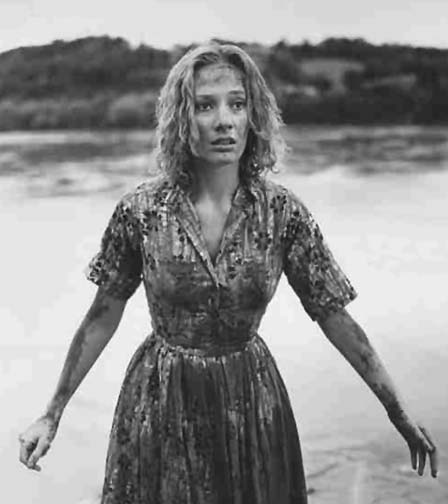
Filmed in black and white, with Gene Moore's hypnotic organ score that saturates the film, Carnival of Souls begins with an accident during a drag race between a car full of young men and a car full of young ladies.  One of the young ladies, Mary (Hilligoss) miraculously crawls out of the river three hours after the car she is in runs off a bridge.  Stunned, she staggers home and continues on with her plans to take a new job as a church organist in Utah.

Candace Hilligoss in Carnival of Souls
Traveling to her new home, Mary passes an abandoned bath resort/carnival on the shore of the Great Salt Lake.  She begins to see apparitions as she is driving.  Basically, she is not feeling well, and greatly disturbed.  Taking a room in a boarding house, she discovers that her neighbor across the hall is John Linden, a creep who spends his days on the make.  Actor Sidney Berger, who later became an acting instructor, plays John Linden, and does so with a delightful job of being creepy and distasteful.  His performance helps to cement the disturbing atmosphere of this bizarre movie.

The real terror, however, comes from the apparition that begins to stalk Mary.  A white-faced ghostly image of a middle-aged man wearing a suit.  No, he wasn't a radio-active creature, not an alien with eyes on the end of two long stalks.  Just a man, whose intense stare is too much for the unbalanced Mary.  At first she does her best to keep away from this silent watcher.  But finally she can no longer stand not knowing who he is and what he wants.  Unable to get any help from a local doctor, she begins to see more ghouls around her.

The Ghoul (Herk Harvey)
Finally, she is drawn to visit the abandoned carnival.  And there, she will eventually find the answers she is seeking.  Harvey makes use of the abandoned location with well-crafted scenes that are bizarre, ghoulish, and surreal.  I was expecting something over the top, but was happy to find that Harvey keeps the whole movie understated, with just the right amount of creepiness and dreamlike atmosphere.

Hilligoss is cast well as the doe-eyed blonde who stumbles around in this dreamy fantasy.  She never looks like the typical stupid young girl that so many horror movies offer up.  Instead, though she can't seem to figure out what is going on, she retains her dignity even as she is slowly overcome by the ghouls that haunt her.

Carnival of Souls is available on Amazon Instant Video.  Use the link below to check it out.


Friday, October 18, 2013

Those 70's Horror Movie Stars

Boris Karloff, Frankenstein (1931)
Back in the day, actors like Bela Lugosi and Boris Karloff became huge celebrities as they helped to create a class of films that became known as Horror.  They were (and still are today!) household names.  But as horror movies evolved, and involved more, uh, odd behavior, morphing from Gothic classical material to shamelessly campy and graphic horror, the top roles in horror movies seemed to go to unknown actors who remained as such.  Vincent Price might be an exception to this rule.  And even Bela, Boris and Vincent were never really accepted as mainstream actors.  Horror was their shtick and to horror they shtuck.

Today, it is mostly the same.  Horror films are made with few known actors in their casts.  You might see an actor or actress whose career has tanked take a role in a horror movie because they can't get any other work.  But you rarely see an A-lister seek after a horror role.

But something funny happened in the 1960's that led to a rash of top Hollywood stars who dove head first into the horror genre.  Maybe it was the success of such films as Hush...Hush, Sweet Charlotte (1964) that allowed horror films to drag themselves into respectability behind the casting of such mega-stars as Bette Davis and Olivia de Havilland.  Also, as the 70's dawned, there was a great revival of spiritual interest in the United States.  Unlike the spiritualism kick of the 1920's, this new interest did not just see the spiritual plane as something benign, where old relatives sat around wishing to speak with their great-nieces and great-nephews.  Just as the churches were experiencing a rise in popularity of the charismatic movement, secular society was becoming more intrigued by the spiritual battles between God and Satan.  This turn of attention was noted in Hollywood, and some very big stars were suddenly willing to lend their name and image to some rather strong horror...uh, shall we say offerings?

Oliver Reed, Burnt Offerings (1976)
And since we've used the word, I'll start with Burnt Offerings, a film from 1976.  This is a very good haunted house film, and it starred Oliver Reed, who was just beginning to reach his stride in what would become a very big career.  He was no stranger to horror, having played a local thug in The Shuttered Room, the 1967 adaptation of Lovecraft's short story The Dunwich Horror.  And though Reed was not yet the iconic celebrity he would become, Burnt Offerings also attracted such stars as Burgess Meredith and Bette Davis.

What I liked about this movie was the slow tension as Reed's character slowly, and ever so slightly, begins to change as a husband and father.  It never fully degrades like the father character in The Shining, but this more subtle change is unnerving coming from a man of Reed's brute frame.  He always had that smoldering undertone that made us believe that acting or not, you wouldn't want to turn your back on this guy for long.  And in this film, he uses it to great effect.

Gregory Peck, The Omen (1976)
Not the usual image we have of Atticus Finch.
Next on my informal list is The Omen (1976), which of course starred that stony-faced megastar Gregory Peck.  His appearance in this movie definitely gave credibility to the idea that any actor could consider appearing in a horror movie.  After all, he was arguably as big a star as Bette Davis.  And while she had an image as a bit of a feisty woman who never wanted to follow the rules, Peck had impeccable credentials as an all around good guy.   And Lee Remick had already been cast opposite some very big names.  She was already becoming a star.  As for the movie itself, I can't endorse it.  I tried to watch it, and it was so silly, I gave up early on it.  It just seemed so corny.

As mentioned in an earlier post, the 1979 Dracula starred none other than Laurence Olivier, often considered Britain's greatest Shakespearean actor.  In this film he plays Van Helsing, the Dutch doctor who is summoned to help puzzle out the malady that is afflicting the anemic Lucy.  What I like about Olivier's performance is his near perfect accent that truly mimics the syntax of Stoker's Van Helsing character.  He also manages to portray Van Helsing just as the character is written.  He is at times cute, odd, mysterious, bold, and even frail.  Olivier exhibits all of these mannerisms in a way that makes sense and is in no way forced.  I will point out that this is no stretch for Olivier to take on this role, since the source material is part of the classic canon.  However, he was also willing to join in on the bloody fun of Marathon Man in 1976, where he maniacally tortures Dustin Hoffman with a dentist's drill.  Obviously he did not seem to worry that such movies might hurt his respectable image.

George C. Scott, The Changeling (1980)
George C. Scott, a bigger-than-life star, took on the haunted house theme in the 1980 film The Changeling.  (Yes, 1980 is still the 70's for all you nit-pickers out there.)  And for me, this is one of the better modern haunted house stories.  Also drawing in Golden Age of Hollywood film star Melvyn Douglas (the man who made Garbo laugh in 1939's Ninotchka), a personal favorite of mine, this movie is saturated with atmosphere and will make you wary of old, high-backed wheelchairs.  At this point, Scott was definitely a major player in Hollywood, having been nominated for an Academy Award four times (and winning best actor for his signature role in Patton).  This was not his only outing in the horror genre, later playing the mystic Native American Indian in Firestarter and even joining the cast of The Exorcist III.

Of course, some horror fans out there would suggest that the biggest film for this genre in the 70's was The Exorcist, which certainly drew its share of Hollywood talent.  Max von Sydow was already an accomplished actor in 1973, as were Ellen Burstyn and the irascible Lee J. Cobb.  However, I'll concede they do not fit the profile of my A-listers whose impressive notoriety aided Horror as it matured into a respected film category.  But a little known fact about this movie should be highlighted here: the original actress offered the lead role by director William Friedkin was none other than Hollywood's most respected lady of the silver screen, Audrey Hepburn.  And she was actually willing to accept the role.  Unfortunately for Friedkin, she was something of a recluse by this time, and would only take the role if the filming could be done in Rome.  The studio said no, and Anne Bancroft eventually accepted the role, only to be forced to back out due to a pregnancy.  I often wonder just how Hepburn's casting might have changed this movie, and how it might have changed her already legendary career.

Douglas Fairbanks Jr., John Houseman, Fred Astaire,
and Melvyn Douglas, Ghost Story (1981)
This is not a complete listing of movies that fit this profile, but it gives you an idea of how the genre was changing.  By the 1980's, we would see more of the same.  Ghost Story, in 1981, starred no less than four classic actors: Fred Astaire, Melvyn Douglas, Douglas Fairbanks Jr., and John Houseman.  (And I shouldn't leave out Patricia Neal, a great lady from the Silver Age of Hollywood best known for her roles in Breakfast at Tiffany's and The Day the Earth Stood Still.)  Silence of the Lambs boasted stars Jodie Foster and Anthony Hopkins.  Hopkins, of course, ended up winning the Best Actor Oscar for his horror role.

Will we see such casting again?  I'm sure it will happen.  Perhaps Sean Connery could be lured from retirement to star in a ghost or haunted house story.  Maybe Tom Hanks could be tempted into something more diabolic than his light-weight Dan Brown religious thrillers.  After all, Robert De Niro did play Frankenstein's monster in Kenneth Branagh's 1994 version of Frankenstein, though very few people saw it.

Sadly, much of the horror genre has been hijacked by the recent obsession with torture-porn, and this has drained a great deal of credibility from what these classic actors and actresses helped to create.  Will there come a time when the A-listers decide to take back what their predecessors built up?  Only time will tell.

Thursday, October 20, 2011

Five Reasons to watch The Beast with Five Fingers


It is getting close to Halloween, which is a great time to dig up some old, black and white movies of yesterday to warn us of the many dangers that lurk in the dark.  In our present age we spend too much time worrying over the economy, pandemics, the price of gasoline, and who will run for the Presidency.  These might be valid concerns, if you are into reality, but these do not begin to compare to the worries that really ought to keep us up at night.  If people today could only realize the horrific and plausible prospect of giant leech attacks, great globules of furious jellied alien life, and apes run amok in the streets of Paris, our petty concerns about overcrowded jails and teenage bullying would be forgotten in an instant of pure terror.
     Just the other night, around midnight, I came into our bedroom and found that my wife had gone to sleep with the TV on.  In the blackened room, lit only by the pale light of a black and white horrorfest, I watched a poor woman running from a deranged ghoul.  Locking herself in a bathroom, she stared in horror at the water running from the faucet.  Through the miracle of Hollywood, this water was bright red, even though the rest of the film was black and white.  Turning from the crimson flow of bloody water, she stared in catatonic shock at a bathtub full of the same, bright blood.  Rising out of this viscous pool was a hand covered in gooey crimson muck.  The woman, in the face of this incomprehensible yet totally reasonable scene, died of fright.
     This was typical of the macabre scenes we often saw as children when the late, late movie was playing at this time of year.  I hated these things, and only watched a little of them before rushing to the TV and turning them off.  Who could blame me?  Even during the day, watching Creature Feature on Saturday afternoons, I had trouble making it through such terrors.
     Now, older and wiser, I have come to enjoy these movies on a higher level.  Yes, they are often filled with campy scenes and low budget monsters that look like the director’s teenager in a suit made out of old carpet swatches, but that is hardly the point.  What these movies really did was allow us to escape fears of reality through the terrors of imagination.  If you need to do so this season, here are five reasons that you would do well to watch The Beast with Five Fingers.

1.  Gothic Atmosphere and Music
     Right from the start this movie has all the makings of a classic horror.  It is set in an Italian village, which is like so many of the European settings for movies like Frankenstein, The Black Room, and The Masque of the Red Death.  It was a way for movie makers to take American audiences and place them in strange lands that were still highly superstitious and plausibly full of dark undertakings.  This was also a chance to fill out the cast with odd, harsh looking immigrants who were readily available in California to project a disturbed view of the population.  There are rarely scenes that include blond All-Americans with classic facial proportions.
     The house in which the story takes place is full of Germanic decoration, large rooms with startling shadows, and statuary that keeps one wondering if they just might come to life.  The central room is nearly empty with only a grand piano set in the middle of it.  Adding to the gloomy and majestic set is the music of Bach’s Violin Partita in D minor, a dark piece that is not only heard throughout the film by the audience but also by the characters who learn it is a sinister precursor to death.  Again and again we hear the music along with the characters and wonder, who will die next?
2.  Robert Alda’s Performance as Bruce Conrad
Robert Alda     A nice treat in this movie is the performance of Robert Alda.  The father of Alan Alda, Robert Alda plays the heroic lead.  We first see him as a scam artist, with a wisecracking attitude around the local law enforcement as well as those who live in the main house.  It is easy to see the seeds of Alda’s son’s character “Hawkeye Pierce” in this smart-alecky role.  As the plot progresses, we see Alda slip into the familiar horror hero role, maintaining an easy-going skeptical presence, intent only on keeping near the heroine and securing her attentions by protecting her from whatever silly thing is worrying her.  He will of course have to both seduce her and save her while keeping above all the horror.


3.  J. Carrol Naish’s Performance as the Commissario
   
Naish (left)

     Naish is one of those character actors that would never get a chance to perform today.  An Irishman by birth, he played nearly every ethnic role (with accent) but an Irishman.  In The Beast With Five Fingers, Naish plays the local lawman, known to all as The Commissario.  An over-the-top character, Naish delivers an unmistakable (and some would now say unforgivable) Hollywood Italian accent, complete with-a the added a on-a every-a word-a.  (Naish had done the very same thing just three years earlier as the tragic Italian in the World War II thriller Sahara alongside Humphrey Bogart.)  Yes, many would shun such nonsense and shake their fingers at this kind of condescending thing, but why?  It’s a foolish performance to be sure, but it is so over-the-top that it can’t be taken seriously.  I suppose if I were Italian I might take offense.  However, as a good German, I don’t take offense at the equally silly performances of actors like John Banner’s Shultz in Hogan’s Heroes.  Why would I?
     Here in Five Fingers, Naish plays a police chief who does a more than competent job investigating the murders.  He does a good job of throwing his authority around, with sincerity at times, and he moves the story along quite well.


4.  The Hand!

     What horror movie would be complete without a monster?  And here, in brilliant black and white, we get to see a most horrifying sight: the murderous, finger-walking hand!  Now here I must spoil the movie for you and warn the faint-hearted that this movie does indeed have a disembodied hand scampering about and killing willy-nilly.  It might just make you ill to see it, so don’t watch if you have a weak stomach.  This hand is so realistic you can see the remains of the radius and ulna where it is cut at the wrist.  Even worse, at times this hand, animated by the magic of Hollywood, looks just like a fake hand that cannot move unless manipulated by Peter Lorre as he hugs it to his chest.  It is almost too terrifying to behold!  (Ummm, never mind.)
     There is, in fact, an intense scene in which the hand crawls through fire, and I am sure it must have been pretty dramatic for audiences in 1946.  As we watched this movie just the other day, my wife remarked that she well remembered the fire scene from watching the movie as a young girl.  Such things are nightmares made of!

  
5.  The Always Perfect Performance of Peter Lorre


The Beast with Five Fingers, Peter Lorre, 1946 Photographic Poster Print, 12x16
You can buy this poster at Amazon, check it out!
       One can never say enough about the screen presence of Peter Lorre.  A mild-mannered, creepy scholar who only wants to be left alone with his books, Peter Lorre’s character, Hilary Cummins, carries the movie with his large sad eyes, and his halting thin voice that never ceases to both repel an audience as well as win them over.  Lorre has always been able to do this.  Even in one of his greatest roles, as the murderer in Fritz Lang’s M, the audience is quickly repulsed by his degenerate behavior, yet equally filled with compassion for him.  Lorre never passed up the chance to exploit this advantage with the audience.  He does so in Five Fingers and then lures the audience along with him as he descends into madness.
     Lorre can’t help but steal the show.  He cannot even walk into a room with the other characters without grabbing your attention by the throat.  In one scene, as all of the characters follow the lawyer into the main room to sign a document, Lorre is the last to enter.  Sliding off to one side, he sits with his back to the others, pausing a few moments before turning to look over his shoulder at them with those big eyes, as if to say, okay, I know I have to be here, just don’t make me join the group.  I don’t like groups!  He never says a word, and that’s the best part of it.
     I know it will come as a shock that Lorre is revealed as the villain.  Who could have seen that coming, right?  But the great bit of writing here is the way in which Lorre loses his mind.  He is no mad-dog monster who charges blindly around attacking the females in the house.  His near sleepwalk attack of Andrea King’s character is as subtle as his transformation to madness is hysterical.  It is easy to quit mocking the Gothic camp of the film and allow yourself to get caught up in his insanity.

In the following scene, Lorre explains what he has done with the Horrible Hand! 


     When all is said and done, and the ghastly hand is finally revealed, The Beast with Five Fingers satisfies on many levels, leaving five reddened finger marks at the base of your neck.  Dare I say, it will really grab you?  The solid screenplay is from the pen of Curt Siodmak, who earned his monster chops writing during Universal Pictures’ golden age of monsters, including the screenplays for The Wolf Man, The Son of Dracula, and The Invisible Man Returns.  (Other notable screenplays by Siodmak include I Walked with a Zombie and Donovan’s Brain.  He also developed the story for Earth Vs. the Flying Saucers, a favorite Sci-Fi of mine.)  The creepy atmosphere includes a mausoleum in the center of a graveyard, desecrated bodies, and creeping hands.  Along the way you will be entertained by the performances mentioned above, as well as the heroine played by Andrea King.  The best line of the movie might just be Robert Alda’s.  As he hears Peter Lorre hammering in a far corner of the house, he asks King, “what’s he hammering on down there?  He’s a sick man!”  Priceless!  Also, keep a sharp eye out for William Edmunds, known for his role as Mr. Martini in It’s a Wonderful Life as one of the servants.
     As in all movies of that age, the greedy will be punished, of course, and the lovers will be united.  It was imperative in that era that the criminals always paid for their crimes; a sentiment that has disappeared in Hollywood.  Once the horror has come to an end, all ends well as the Commissario enjoys a last joke and reminds us just how fun and absurd it has all been.


This movie is not available on DVD, but there are several online movies sites that list it available for download. Amazon is presently providing it for download rental, or you can buy it for download.