Like Jason's Facebook Page

Monday, January 20, 2014

Williamsburg, VA: A Promised Trip from 1982 (Part Two)

Together in Saltville, Pauline (top row, 2nd from the left, known much
later to us as Granny) and her little sister Bea (bottem left), along
with the rest of the ladies in their family.  Below is Bea's note to Pauline.


 Williamsburg, Virginia, a visit in pictures to Virginia's Colonial Capital.

The following pictures are from a fold-out packet of souvenir pictures.  To see the story behind the packet, and the first set of pictures, check out part one of this post: Williamsburg, VA: A Promised Trip from 1982 (Part One).  The link for Part One can be found at the end of this post.  .


Williamsburg, VA: A Promised Trip from 1982 (Part One).
And for more information on visiting Williamsburg, check out VisitWilliamsburg.com.

Friday, January 17, 2014

Williamsburg, VA: A Promised Trip from 1982 (Part One)

"Granny", with her daughters, visiting the Empire State
Building in 1965.  
"This is where we'll go if you come back..."
It was 1982, and my wife's grandmother, Pauline, a woman everyone called Granny, received a folded packet of postcards in the mail.  She lived here in Lake Charles, Louisiana.  The packet was from her sister, Bea, who lived in Saltville, Virginia.  Saltville was the family home, where Granny had been raised, before she had followed her husband to a job in the sweltering heat of the Louisiana coastal plain with one son in tow in the 1930's.  The transplanted couple added two daughters to the family, the youngest of which became my mother-in-law.  By 1982, Granny had lost her husband to emphysema, her daughters were both married, and she lived with her son, who never left home.  Granny never would move back to Saltville, choosing instead to live out her years in the home she had built with her husband.  She would, on occasion, still visit her ancestral home in the mountains.  Obviously looking forward to a visit later in the year, her sister slipped the packet in the mail.

I found the packet just a few days ago, stuffed inside a high-backed secretary desk in the home of Granny's oldest daughter.  Bea intended to take her sister's family to Williamsburg, Virginia.  Did Granny and Bea ever get to Williamsburg?  I do not know.  I'd never heard talk of such a trip, nor have I ever found pictures to suggest it happened.  Both sisters are no longer here to answer such questions.  Neither are Granny's children.  But what we do have is the packet, which gives us a great look at what they might have seen if they ever made the five hour, 350 mile trip from Saltville to Williamsburg.  The packet is all-in-one, connected and folded to the size of one postcard.  Unfolding it reveals the trip that may or may not have happened.


Watch for part two of this post for the rest of the postcards in this collection.
And for more information on visiting Williamsburg, check out VisitWilliamsburg.com.

Tuesday, January 14, 2014

After-Christmas Shopping with Burstein-Applebee in 1968

Okay, I know what you're thinking.  Christmas is over.  Way over.  Like there isn't even any Christmas turkey left in the house.  The last of the turkey-jello was fed to the cat at least four or five days ago.  What's left of the Christmas fudge was accidentally packed away with the ornaments, which, incidentally, isn't a bad thing.  After all, it helps to have the fudge inaccessible as we try to meet those New Year's resolutions that have more to do with fantasy than reality.  So...why am I posting this about Christmas shopping?

Well, let's look at the facts.  You, along with everyone else, were given gift cards galore.  So many that you were able to stuff your wallet with them.  And now, stacked inside that worn, supple leather, they'll sit for months, forgotten behind the expired library card and the unused Putt-Putt Golf frequent duffer card.  But here's your chance to be really wise about your forgotten gift cards.  Check this out.

First things first: get those cards out and look them over.  Which ones do you want to really use?  If you're a book lover like yours truly, you'll definitely want to set the Barnes & Noble card to one side.  That one will get used.  In fact, I doubt it made it into the wallet.  It was probably used up before Christmas was officially over at midnight.  Online shopping is such instant gratification, isn't it?  But look through your cards and grab the ones that weren't quite...you.  Yeah, you know the ones, given by a distant relative who really had no idea what you do with your life.  Maybe you aren't so keen on Omaha Steaks since you're a vegetarian.  Or you'll never buy a hat from Lids, since you have a perfect head of hair that should never, ever, be covered by a wide-brimmed ball cap with primary colors that came straight off of Blues' Clues.  Heck, maybe you just refuse to use that Amazon gift card because you once bravely announced publicly that you'd never do business with those cut-throats at Amazon because...well, you can't remember why you said it and sort of regret it but you know your friends and family are now watching you to see what you'll do with that Amazon gift card and wondering if you'll stick to your principles or if you'll just go ahead and order the entire set of Star Trek: The Next Generation on Blue-ray.  Anyway...take these cards and sell them to friends at work.  Sure, you'll have to come down a bit on their value, but that's okay.  At least you'll spend money on your own terms, without being forced to buy something from some store you don't like.

Now, here's the genius of my plan.  With all that money you've managed to salvage from the gift cards, you are now free to pick up one of these great specials at Burstein-Applebee.  Just check out these deals:
 Have you ever seen such a versatile tape recorder?  Of course you haven't.  And that's because right there in the Burstein-Applebee catalog, you'll find the most versatile tape recorder yet!  Well, it's the most versatile yet in 1968.  There may be one that is more versatile now, in 2014, but I challenge anyone to tell me they can find one that is more versatile and lower priced at $119.50.  Go ahead, just try and beat this deal.  I mean, seriously, this baby has versatility coming out its reels.  Just consider:
     The 2 track monaural allows for 12 hours of recording time.  Twelve hours!  That's like half a day.  In fact, that is half a day.  Golly.
     This wild ride has three speeds: 7 1/2, 3 3/4, and 1 7/8.  Who could ask for anything better than that?  Who would want to even think of fractions beyond these?  You'd have to be a math teacher to even try and slow that speed down to a number even remotely divisible by 1 7/8.
     That slim attache case is designed at only 3 5/8" thick.  I don't know about you, but I think 3 5/8" is truly the definition of slim.  You couldn't get slimmer than that unless you developed digital technology and created an MP3 player that was only 5/8" thick.  And trust me, in 1968, you wouldn't have been smart enough to develop digital technology.  Fact is, you aren't smart enough to develop it in 2014.
     And let's not overlook the fact that this baby has volume and tone controls that are recessed.  Do I even need to point out how cool that is?  I didn't think so.
Now here's a deal you can't ignore.  Okay, okay, you've seen portable TVs before.  But have you seen one with 82 channels?  You can use this sweetheart anywhere, which is important, since you'd never get to use all 82 channels in 1968.  So you just port this puppy over to 2014 and then you'll be able to appreciate the full range of television programming that can be packed into this beautiful, solid state, deluxe, television and its full 37 square inch viewing area.

For just under one hundred dollars, you'll get a super bright picture for the whole family to see.  Even in broad daylight!  I know, that's crazy, right?  But there's more:  its transistor circuitry has 44 solid-state devices.  It even has a modern, clean look when the set is turned off.  That's right.  It doesn't have that outdated, dirty look when it's off.  And why would it?  This amazing set is produced by the world-famous Matsushito guys.  And they've always been about modern, clean looking televisions that are turned off.  Now just don't forget to order your four-pound battery pack for $29.95.  That's less than eight dollars per battery pound.  When's the last time you saw a steal like that?
Now, don't forget all of the B-A personal mail order service you'll get when you order one of these fine after-Christmas products:
     For starters, you'll have this handy B-A order blank...whenever possible.  Sometimes, it just isn't possible for the order blank to be handy.  We realize that there are limitations to when an order blank can be handy.
     You tell B-A how you want the shipment made.  Express?  Freight?  Regular Parcel Post?  Decaf Parcel Post?  Or how about Air?  That's right, they can float your order to you on the clouds.  And you get to decide when you send the money too.  Use a money order, or a bank draft (whatever that is!) or even...heck, let me quote them.  You'll think I'm making this up, but I'm not.  "Many B-A Customers ask us to fill in the exact amount on their signed blank check...a most convenient and safe way to send remittance."  Uhhh...okay.  Oh yeah, and don't forget that the Federal Reserve Bank Ruling states you cannot send in a check where the bank name has been deleted.  That Federal Reserve is sharp, I tell ya.  Nothing gets past them.  Not even checks without bank names on them.  Someone's thinking down in D.C.
     But before you go and get too excited about these amazing shipping options, let me bring you back to reality a bit.  There is an important little rule to keep in mind.  There is a minimum order size.  I know, right?  Disappointing.  But I have to admit they make a good point.  They state, and again, I quote:
"Since it is not economical to process many small orders, a 50c service charge is necessary for any order under $5.00.  You avoid this charge entirely on orders over $5.00."  Well, they got you there.  You'll have to spend at least five dollars.  Okay, so the B-A shopping experience isn't all fun and games.  As mothers have said since the beginning of time: life is full of disappointments.

And speaking of disappointments, don't even get me started on the $35.00 minimum order for opening a new B-A Revolving Charge Account.

Sunday, January 12, 2014

Quick View of Apples and Poetry

I don't often do this, but I'm going to post a quick video here.  I'm not much of an Apple fan, but someone over there has the heart of an artist.  This video debuted just moments ago during an NFL playoff game, and I think it is one of the most extraordinary short videos I've seen in a long time.  So turn up your speakers, focus for a minute and a half, and experience this moving, poetic moment.


Saturday, January 11, 2014

A View from an Abandoned House

Recently I've been digging around an old house that we will soon be remodeling.  It has been interesting to discover many outdated products and brands that I either remember with fondness or have no memory of at all.  The house was built in the early 1960's.  It had been unoccupied for many years, and we decided that not much of the original house was practical to preserve.  This mostly included the wood paneling that covered the entire house.  Yes, that's right, except for the two small bathrooms that were lined with drywall, the rest of the house was covered in wood paneling.


The paneling itself was still in good condition, but it really just had to go.  So off it went.  And as it did, I noticed this little logo stuck inside the paneling on every other piece.  It turns out that the wood came from Gabon, which, in the early 1960's, had just obtained its independence from France.  I realize that the drum motif is African, but I couldn't help but think that this image was making an attempt to snag the attention of home builders who were still wanting to jump on that Tiki bandwagon that had been rolling along.
A little surfing tells me that Gabon is known for its petroleum and timber products.  Port-Gentil, a small town after WWII, grew to 20,000 residents by 1960, and it seems many of them made it their mission to panel as many of the walls of America as possible.  


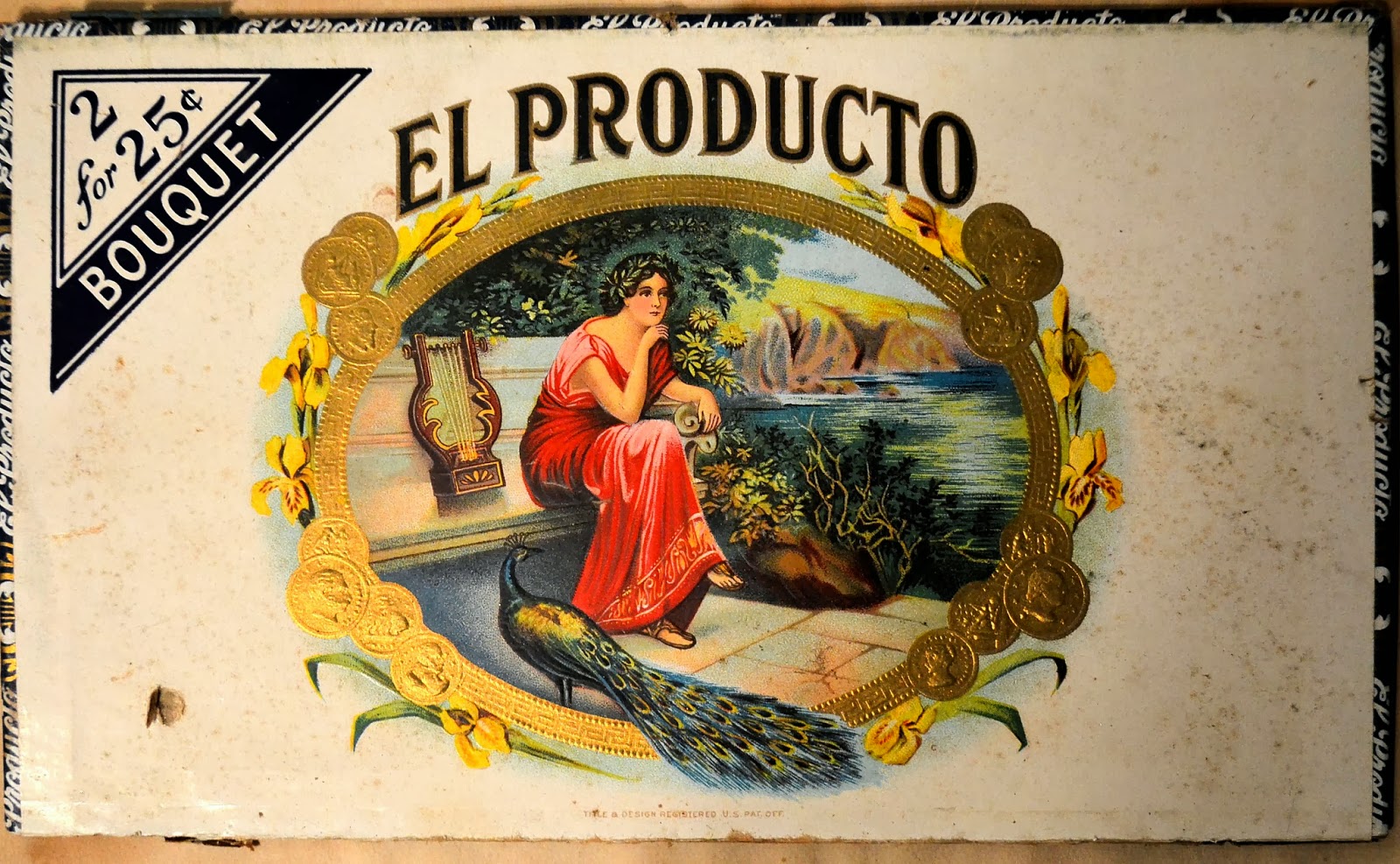
I found many cigar boxes in the house, most of which were in very bad shape.  However, in a store room cluttered with piles of junk, I dug out this box, which was badly discolored and stained.  Opening it, I discovered that the image inside the top lid was nicely preserved.

El Producto cigars were once a popular cigar, though that was nearly one hundred years ago.  While most cigar fans looked elsewhere for something to smoke, George Burns was well known for his devotion to the brand.  You can read more about his love of El Producto Queens, what he called his little ladies, at cigaraficianado.com.


Tuesday, December 17, 2013

Christmas Shopping with Burstein-Applebee in 1968

I've been too busy for Christmas shopping this year.  I'm in the middle of a project that includes cleaning out an old house and prepping it for a major remodel.  So it was quite fortuitous that I came across this handy Christmas edition of a Burstein-Applebee electronics catalog.  All of my shopping needs can be easily met right here in this fantastic collection of high-tech wizardry.  As you can see on the cover, there are many stores to choose from if I want to shop in person, and I can even send orders to the main office and expect fast personal service.  That's right...personal service through the mail.  I don't know how they do it.

Right off the bat I can see that one of the Christmas Specials is a steal.  A Solid State Telephone Amplifier; just $14.95!  This baby allows a room full of people to listen and talk on the same telephone.  Not only that, but it's battery powered and requires no installation.  And with that amazing on-off switch, you, well let me quote them here.  I want to make sure the copy-writer gets all the credit for this poetic line.  "Simple flip switch when in use, turn off when call is completed."  Yep, it really is that simple.  What will they think of next?

This is what they thought of next.  A "really portable tiny solid state TV."  This should be perfect for a friend of mine who is really tiny and portable.  This sweet 16 inch (that's 16 square inches, mind you) television gives you striking beauty with its 90 degree aluminized picture tube has true picture detail.  And that dark-tint screen "assures pleasing contrast indoors or out, and when set is off it blends in with modernistic design."  I had to put that last bit in quotes so you wouldn't think I was making that up.  Oh man, I'm thinking of putting this on my own wish list.  Imagine settling in to watch Star Trek on this baby.  It almost looks like Mr. Spock's science station.


I'll be back with more great items from this wonderful catalog.  Stay tuned!

Saturday, November 30, 2013

Avalon: A Thanksgiving View of the Past

Avalon, Directed by Barry Levinson

There are many movies that families watch as annual traditions.  When we were kids, it was Mary Poppins, Gone With the Wind, or The Ten Commandments.  These were common holiday movies.  As video tapes became available, we began to choose our own movies, and movies like A Christmas Story became a part of our yearly tradition.  And let's not forget all those Rankin-Bass greats like Rudolph the Red-Nosed Reindeer and Santa Claus is Coming to Town.  But around our house, a completely different movie has become a Thanksgiving tradition.  One that is not your usual holiday fare.

Here at our house, the kids have grown up watching a Barry Levinson film with the mysterious name of Avalon.

Avalon, written by Levinson as well, is a semi-biographical story of Levinson's family.  Set in Baltimore of the 1950's, it tells the story of Sam Krichinsky, who came to America in 1914 (or was it 1915?).  You see, as the family gathers every holiday, Sam tells the younger generations about when he came to America.  We hear these stories through the eyes and imagination of Sam's grandson Michael, played by a very young and precocious Elijah Wood, long before he became a hobbit with a dreadful journey ahead of him.

As the holiday dinner proceeds, we learn more and more about the Krinchinsky family, both past and present.  Despite the fact that this is set in the 1950's, I felt right at home when I watched this scene for the first time.  My own childhood was full of such family gatherings in the 1970's, and it was much the same as in Levinson's film.  It is why this movie became such a favorite of mine, and why my kids came to like it so much.  I often pulled it out to watch, and they loved to watch along with me.  I was always narrating over the dialog, telling them how the film matched my own memories, or how they differed.  I didn't know it then, but I've since heard some of my kids say they have the same nostalgic feelings for this film that I had simply because we watched it so many times and they identify it with my own past.  This is somewhat ironic considering Levinson's objective with the movie.

The Krichinsky family, at the outset of the film, is very close, and aunts, uncles, cousins, and parents are all friends, highly involved in each other's lives.  Holidays are spent in one house together, sitting around after the massive dinner, talking about the home country, telling old stories.  But as television begins to enter the picture, and shopping creeps into their holiday traditions, the family begins to splinter.  Objectives change and tempers flare.  Eventually, there is a split, and half of the family goes its own way.  By the end of the 1960's, Michael, now a young father, must visit his grandfather in a nursing home, where Sam is still telling the same old stories, though his memory is not what is used to be.

Elijah Wood and Amin Mueller-Stahl in Avalon
The character of Sam is played by Armin Mueller-Stahl, whose magical performance stands out in this cast, though there are few cast members who do not shine in this ensemble.  Joan Plowright, as Sam's wife Eva, is a delight to watch, and Aidan Quinn turns in the best performance of his that I've ever seen as Michael's father.  Elizabeth Perkins takes on the role of Michael's mother; her attempts to make sense of her husband's family is both entertaining and extremely realistic.  Lou Jacobi steals the show as Sam's obstinate brother Gabriel, though Kevin Pollack gives him a run for his money as the swift-talking cousin Izzy.  I could name cast members here until I've listed every one of them.  One of Levinson's strengths as a director is the way he draws such natural performances out of his cast, including the smallest of the roles.

The movie wouldn't be half as good without Randy Newman's painfully beautiful soundtrack.  This is not the Randy Newman of his Short People style of music.  Here he is more like Gershwin and Mozart mixed together.  There are moments when a simple piano, accompanied by a single trumpet, will melt your heart.  It is a soundtrack that should not be left out of anyone's playlist.

Sam and his extended family, captivated by that new
gadget, television.
Filled with humor, tragedy, and a few bitter truths, Avalon pans across the wide vista of a family's struggle to adapt to the technological and sociological changes that transformed America in the middle of the Twentieth Century.  And for some odd reason, it has become a family tradition in our home to watch it.  We watch it nearly as often as we watch A Christmas Story.

For some viewers (my wife foremost among them) Avalon might be seen as a bleak movie.  But I've never seen it that way.  Instead, it is always a great reminder to push back against the isolating influence of progress and to hold on to family traditions.  Why my kids like to watch it, I'm not entirely sure.  You'll have to ask them.

The movie can be seen on Amazon's Instant Watch (the left link) and the soundtrack can be found at the link on the right.

Thursday, November 14, 2013

Parkland, Not Your Average Kennedy Film

Parkland, directed by Peter Landesman

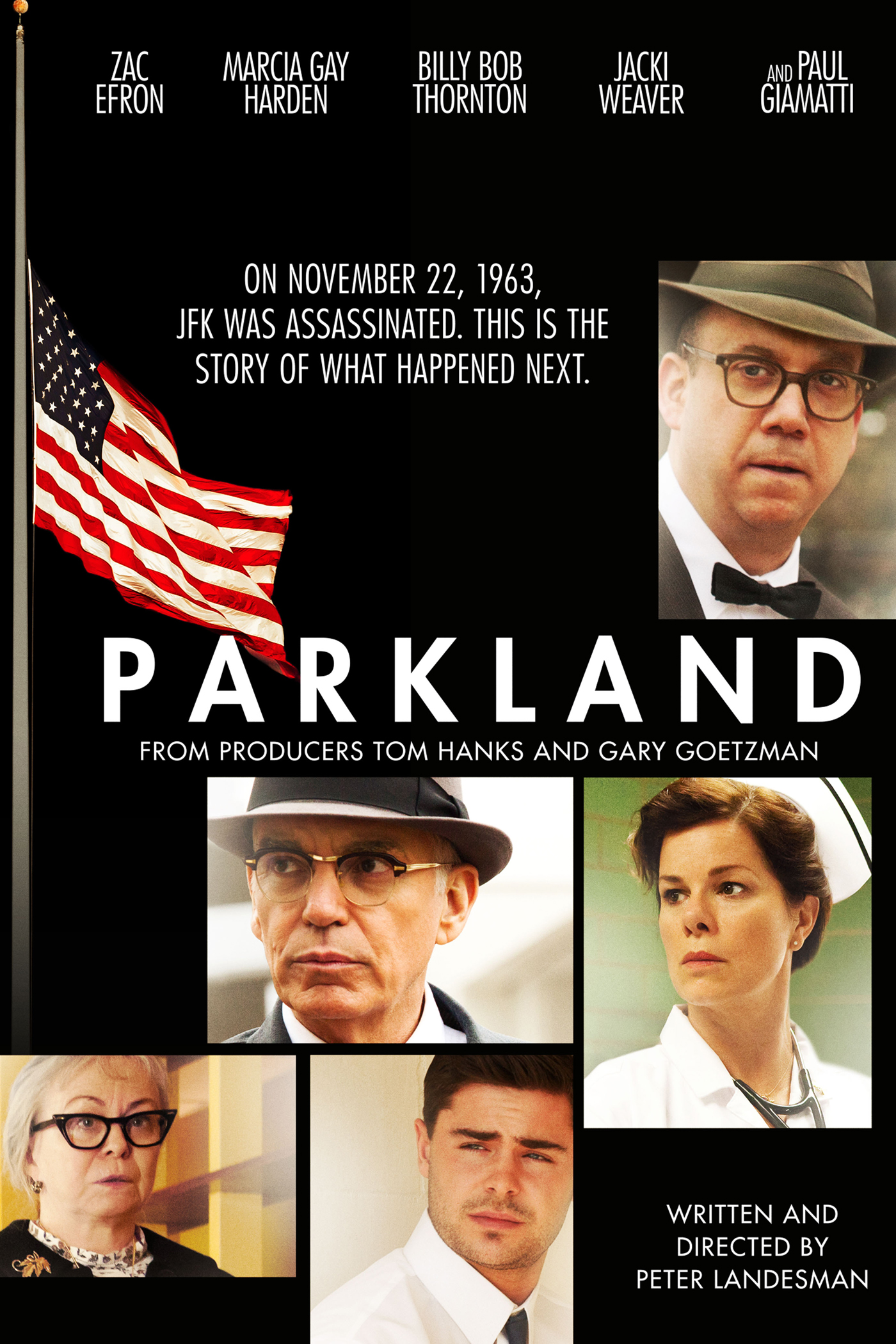
I'd only seen a few glimpses of this movie in the last week; a small display at Wal-Mart, part of a commercial during a football game.  I had no idea what it was about.  But I saw right away that Paul Giamatti and Billy Bob Thornton were in it and I had that funny feeling that this was one of those sleeper films that would turn out to be a real gem.  When my son and I went looking for a movie to watch (simply to have an excuse to make nachos and chill out for the night) we found Parkland listed in the pay-per-view queue.  Discovering that it involved the Kennedy assassination, we decided to give it a try.  Honestly, there wasn't much else that looked interesting.

It turns out I was right.  This was definitely a gem.  To start with, the cast was very impressive.  In addition to Giamatti and Thornton, who both turn in strong performances, there were plenty of other cast members who caught my eye.

James Badge Dale turns in a stronger than usual performance as Robert Oswald, brother of the infamous shooter.  Dale, who had the early distinction as Jack Bauer's partner in season two of 24, works his role with understatement, as if he is sleepwalking through the nightmare that hits his family when it is announced his brother has shot the President.  That's not an insult.  He does it well, allowing us to see the unfolding tragedy that overtakes his average life.

I've always liked Ron Livingston since his tour of duty on Band of Brothers.  Here he plays Federal Agent James Hosty, and he brings his world-weary persona to a role that was a pleasant surprise.  Hosty is a bit of a cynic, but he hasn't given up.  He is still in the game, working leads, and trying to make some sense out of the crazy guys in the world like Lee Harvey Oswald, a man he's been tracking simply because he was a real mess.  That his guy ends up killing the President leaves Hosty defensive, confused, and ultimately in some very hot water.  Livingston is well cast in this role, and I only wished his role had been expanded.

Macia Gay Harden in Parkland
Marcia Gay Harden takes a very small role here, but her presence is palpable despite the fact she is mostly a bystander in the hospital, responding to the shock of the President's bloody arrival by clinging to her role as head nurse, executing her duties as if she were attending a king in his court, instead of a patient in an emergency room.  I can't hardly remember any of her lines, but her eyes were saying enough every time the camera focuses on her, which is what this movie is really all about; watching as events overtake everyone in the room.

Other cast members fill out this film with similar understated performances; Zac Efron, Glenn Morshower (another 24 veteran), and Colin Hanks.  But really I could list most of the actors involved in this movie.  So many of them had small, nameless parts, passing in and out of scenes as needed by the script, having few lines but lending their emotional weight to every scene.  And that's what makes this film unique.  The dialog is not the focus of this story.  Often, the action carries through without dialog, save for the chatter that crowds around an emergency.

Landesman is to be praised for his approach to a story that has been seen too many times before.  He is well aware that we know the story.  He's not trying to tell us what happened to John F. Kennedy that day.  What he wants us to do is take a trip with him away from the main event.  Yes, the events we all expect to see are there in the movie, but do you really see them?  They are always off to one side; a reflection in someone's glasses, a noise off to the left, a blur of action to the right.  It's okay.  We already know what's going on.  We know Jackie is hit with spatter from Kennedy's wound.  We know she inexplicably crawls out onto the trunk.  But Landesman wants us to look away from all of that, and see what is happening around this historically momentous event.

Why?  Because everywhere you look, you see people who are deeply affected by this horrendous attack.  We tend to forget that violence was not so prevalent in our visual horizons back then.  The Vietnam War had not yet invaded our living rooms.  And Kennedy, a young, exciting leader with terrific charisma, was not only cut down with a rifle, he was murdered on live television, an act that left so much of the nation shocked and as off-balanced at Jackie climbing onto the back of that convertible.  And that's what makes Parkland something special to watch.  Landesman takes one of the most sensational historical moments of the last century and reminds us that it had real emotional impact on the people caught up in the middle of it.

We've allowed conspiracy theories to cloud our perception of that day.  Mention the Kennedy killing and most people will pause, take on a thoughtful expression, and say "you know, I don't think we'll ever really know what happened that day," or "I'm pretty sure I can guess who paid Oswald to do it."  The puzzle of it fascinates us and long ago we learned to ignore the sheer tragedy of the moment.

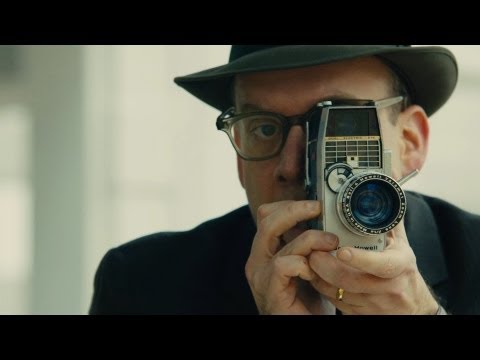
Paul Giamatti in Parkland
Not Landesman.  He doesn't even begin to nod in the direction of a conspiracy.  If you want that, go see Stone's JFK.  You won't get any of that foolishness here.  What you'll get is an idea of how this impacted our people.  Giamatti, taking on the role of amateur film-maker Abraham Zapruder, really brings this point into 8MM color focus.  As he's filming, giddy at the chance to see his President, we hear him gasp in shock as the bullets hit.  He continues to film, caught up in the moment.  When he finally drops the camera and stumbles away, he is nearly sick to his stomach, overcome with grief.  It is an important moment.  I felt as if the director were reminding me that I can't just be a voyeur at this killing.  He wants us to be more than that.  Because at that moment, our nation was staggering from a tremendously powerful blow.  And instead of obsessing over convoluted theories, we too, should be staggering from this blow.  

I was tempted to think he'd gone overboard, watching secret service men and cops and admirals who were overcome with emotion, tears in their eyes, losing their comportment.  But I was reminded of what my mother told me.  She told the story of how she and my father sat on the steps of her parents' house and wondered if the world was coming to an end and how they decided right then to go ahead and get married, since no one could be sure of anything any more.

Parkland keeps its focus on this emotional trauma, though it never blinds us with it.  Yes, there is that macabre scene when Jackie is discovered in the emergency room with hands cupped, still cradling what bits of her husband's skull and brains she had been able to save.  But this isn't a sensational moment.  After all, this is long after Kennedy arrived at the hospital, after the doctors and nurses had done everything to save him.  After they had lost their battle.  You realize with sympathetic admiration that Jackie has been holding this the entire time.  These are stories we've heard before, but it is sobering to see it in the context of all that happened that day.

If you are any sort of casual history-buff, you won't see anything you didn't already know.  But when it is put all together, you get a clearer picture of that day in Dallas, and it is well worth taking a little trip back in time.  I was especially impressed by a little scene that involved the President's casket and Air Force One.  Keep an eye out for it; a perfect demonstration of the passion and confusion that must have overcome so many professionals that day.


Friday, November 8, 2013

Confessions of a Bibliophile

It is not something that I recognized right away.  Growing up, my yearnings seemed normal to me.  But that shouldn't surprise anyone.  That is the way these things develop.  You feel an attraction to something that seems perfectly normal to you, and as you gratify your desires, and you become more comfortable indulging in them, you begin to equate joy with your particular object of desire.  And that's how a young boy from the heartland grew up to be so obsessed with books.

Sure, coming into my home as an outsider, you would recognize this dysfunctional behavior immediately.  You'd simply look to the left and the right, spot the stacks of books that line the walls and cover the furniture (all of which does not include the shelves full of books) and say to yourself "what a sick, sick, man.  Doesn't he know there are programs that can help him out of this private hell?"  Then, when you realize I've raised five children in this atmosphere, you'll add this addendum: "not such a private hell!  Here's hoping he hasn't warped these kids for the rest of their lives!"

But take a step back, realize that no matter how obvious this addiction is to you, it has never been obvious from my perspective.  Back in the 1970's, before any real awareness of electronic media alternatives (yes, television had emerged as a healthy counterpoint to the unsavory habit of reading, but it had not yet won over a super-majority of society at that point), it was considered perfectly normal that an old, converted city bus would creak its way into our little town on the Illinois prairie and wheeze to a stop next to our little IGA grocery store.  Mind you, this was just a block from our house.  My mother, bless her heart, saw nothing sinister in allowing us children to don our stocking caps and stuff ourselves into our wool coats as we ran down the street to clamber aboard the Bookmobile.  (I was under the age of five!  A mere babe in the wood...on a treeless prairie, no less!)  Just that name—The Bookmobile—you know it was designed to lure children into its crowded passages, full of colorful, worn books, all of them suffused with the odors of a million aging pages pasted to hardback covers with crusty, yellow paste; pages that had been pored over by thousands of other bibliophiles from hundreds of other small towns identical to our own.  One can easily see how yet another obsession of mine germinated in the suffocating shell of that ancient bus—my germaphobia.  That old Bookmobile would sneak into town during the day and every homemaking mother would encourage her innocent children to check out books from its jam-packed shelves.  I often wonder, did our fathers even know this thing existed?  Were they aware of its book-peddling influences on our provincial, pastoral lives?  I doubt it.  One can only imagine how the men of that town would have snatched their shotguns down from their fireplace mantels and chased that asthmatic motorcoach into the surrounding cornfields, eventually shooting out its flabby tires.  I'm sure with a little help from a few of the local farmers, that old bus would never have been seen again.  Just think of how that might have saved me from a lifetime of bibliophilia.

But the bookmobile was never hunted down and murdered by the men of our small town.  And as the years passed, I never did purge myself of the bookworm that had nested deep inside me.  And as I grew in stature and age, so did that serpent within.  By the time I was in high school, I was maintaining a small library of no little significance.  Of course, I married a bibliophiliac.  Neither one of us was aware of our literary disorder, though we must have been subconsciously drawn to each other.  She accepted my library as hers, mixing it with her own peculiar affection for reading.  Her own addiction was for a much more ancient form of reading.  Thus began my experimentation with the hard stuff: books that had been around for centuries, books that normal people instinctively keep out of their homes.

While I've overcome my shame enough to admit these things, it is still hard to confess what inevitably came next.  It is not easy to admit that we actively drew our children into this world of words and ideas.  Sure, young parents make the simple mistake of reading a few, light verse children's books to their beeblets when the little tykes need something to lull them to sleep.  But parents can be forgiven this indiscretion, since these youths are far too young to be affected by such incidental contact with books.  However, we didn't stop there.  We continued to read to our children, even as they matured enough to understand what we were reading them.  We would read with passion, acting out the actions of the characters, developing elaborate and memorable voices for the dialog, shaking the children to make sure they did not fall asleep before the story had come to an end.  We would leave the books lying around, and never scolded the kids when they were found sitting in a corner of the room, gazing at some book's illustrations without permission.

Children raised under the shadow of books.
All of this occurred, mind you, during the 1990's and the 2000's, as most children in our society had been freed of traditional book-reading habits by the advent of Gameboys, the Cartoon Network, AOL Instant Messenger, and Myspace.  The rise of digital media meant we had no excuse for our actions.  Yet we continued to buy books, filling our home with stacks and stacks of Hardy Boys Mysteries, Choose-Your-Own-Adventures, and Great Illustrated Classics.  Stuck in our own reading quagmire, we gleefully dragged our children down with us.

But this story ends with a little hope...of sorts.  Though I've not yet had a road-to-Damascus epiphany, I have begun to see our book habit for what it is; this blog post is a painful yet important first step on the road to recovery.  I've begun throwing our books out.  Not a complete purge, mind you, I'm just taking baby steps for now.  But they are steps, nonetheless.  I've been able to toss out not only books I've already read, but even a  few I had hoped to read again.  More importantly, I've been able to take that most difficult of steps; admitting that a few of the books I bought are books I'll never read.  They've taken up space in the house for decades, and it takes real courage to say "this book looked interesting back in 1994, and it was a steal at $3.99 from the Edward R. Hamilton Bookseller mail order paper, but I haven't read it in nineteen years, and I know in my heart I'm never going to sit down and read the darned thing."  I know.  I just went from talking about baby steps to taking Goliath steps.  Like I said, this story contains a little hope.  And if I can throw out a book like My Summer in Alaska (One man's struggle to survive in the Alaskan Wilderness) and admit that it is no great loss for me, then maybe someone else out there can do the same, and together we'll all take those baby steps, Goliath steps, and all those steps in between as we break free from our obsession with books.

Now, if only Amazon would quit selling so many eBooks for just $1.99.  But that's an addiction to conquer at a later date.

Friday, October 25, 2013

Carnival of Souls: A Cult Classic Reviewed

Carnival of Souls (1962), directed by Herk Harvey

As the classic horror movies of the Universal Monster era evolved throughout the 1930's into the 1950's, creatures remained the at the top of the genre.  That decade saw such gems as The Blob, Tarantula!, The Creature from the Black Lagoon, The Giant Claw, Attack of the Giant Leeches (a personal favorite!), and William Castle's The Tingler.  Rarely did horror not include a monster or an alien that was out to get you.

However, in the 1960's, even as creatures continued to menace theaters, horror fans began to see a new type of movie.  Darker themes lit up the big screen.  Man became a terror all his own.  Thanks to Alfred Hitchcock and a little known author from Wisconsin (Robert Bloch, a friend of H.P. Lovecraft), audiences all over the United States discovered that we need not fear giant ants or alien parasites when a man like Norman Bates is lurking behind a shower curtain in the 1960 classic Psycho.  Horror directors began to delve into the creepier aspects of what scares us.  Around this time period, Herk Harvey, a director of educational films from Kansas had an idea for a thriller-horror movie while on vacation in Utah.

For only $33,000, he filmed his movie, Carnival of Souls, using a professional actress (Candace Hilligoss) while filling in most of the cast with local talent, including himself.  In just three weeks, he completed his film.  As a "B" movie, it did poorly, and Herk Harvey never made another feature film.  Most of his crew came from the company he worked for making educational films.  The music score was done by Gene Moore, a co-worker who is also credited with such great films as How to Run a Filling Station and Embryology of the Chick.  (And no, those titles aren't humorous.  The films were actually about running a filling station and embryology...whatever that is.)  Actress Candace Hilligoss only made a few more films.  Carnival of Souls might never have been remembered had it not been seen again.  But as often happened, as cable television sought out more and more old movies to show late at night, Carnival of Souls was resurrected in the 1980's, and over time has become a respected film of 1960's horror.

So let's get to the movie.

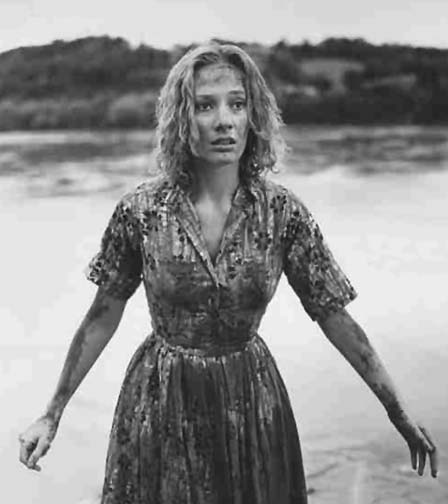
Filmed in black and white, with Gene Moore's hypnotic organ score that saturates the film, Carnival of Souls begins with an accident during a drag race between a car full of young men and a car full of young ladies.  One of the young ladies, Mary (Hilligoss) miraculously crawls out of the river three hours after the car she is in runs off a bridge.  Stunned, she staggers home and continues on with her plans to take a new job as a church organist in Utah.

Candace Hilligoss in Carnival of Souls
Traveling to her new home, Mary passes an abandoned bath resort/carnival on the shore of the Great Salt Lake.  She begins to see apparitions as she is driving.  Basically, she is not feeling well, and greatly disturbed.  Taking a room in a boarding house, she discovers that her neighbor across the hall is John Linden, a creep who spends his days on the make.  Actor Sidney Berger, who later became an acting instructor, plays John Linden, and does so with a delightful job of being creepy and distasteful.  His performance helps to cement the disturbing atmosphere of this bizarre movie.

The real terror, however, comes from the apparition that begins to stalk Mary.  A white-faced ghostly image of a middle-aged man wearing a suit.  No, he wasn't a radio-active creature, not an alien with eyes on the end of two long stalks.  Just a man, whose intense stare is too much for the unbalanced Mary.  At first she does her best to keep away from this silent watcher.  But finally she can no longer stand not knowing who he is and what he wants.  Unable to get any help from a local doctor, she begins to see more ghouls around her.

The Ghoul (Herk Harvey)
Finally, she is drawn to visit the abandoned carnival.  And there, she will eventually find the answers she is seeking.  Harvey makes use of the abandoned location with well-crafted scenes that are bizarre, ghoulish, and surreal.  I was expecting something over the top, but was happy to find that Harvey keeps the whole movie understated, with just the right amount of creepiness and dreamlike atmosphere.

Hilligoss is cast well as the doe-eyed blonde who stumbles around in this dreamy fantasy.  She never looks like the typical stupid young girl that so many horror movies offer up.  Instead, though she can't seem to figure out what is going on, she retains her dignity even as she is slowly overcome by the ghouls that haunt her.

Carnival of Souls is available on Amazon Instant Video.  Use the link below to check it out.